
FG Nexus: Manufactured Housing Expansion, Regional Concentration, and the Economics of Platform Building
FG Nexus Inc. has pivoted toward direct ownership and management of manufactured housing communities, deploying capital into both direct acquisitions and equity investments in operators. While this strategy offers the potential for stable rental income and defensible returns, the company’s concentrated North Carolina footprint and exposure to regulatory and environmental headwinds underscore the importance of scaling, operational discipline, and risk management.
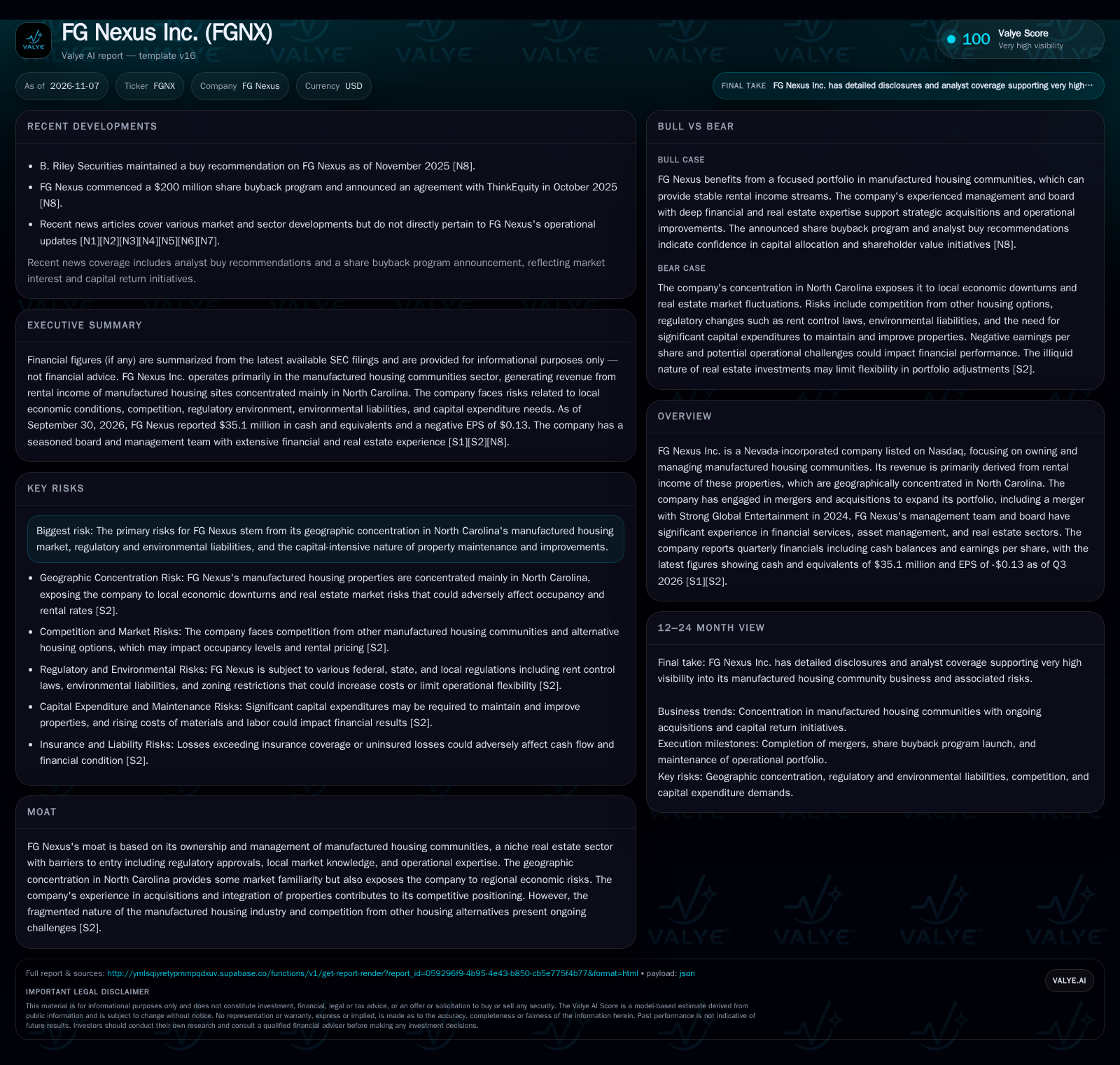
FG Nexus Inc. is concentrating its business around manufactured housing communities, with recent capital deployed into direct property acquisitions and an equity investment in a third-party operator. The company’s near-term revenue and cash flow will depend on occupancy and rent growth, but geographic concentration and regulatory exposure remain central risks. The success of its platform hinges on scaling efficiently, managing capital expenditures, and navigating local market dynamics. [S2]
FG Nexus Inc. is undergoing a strategic evolution, channeling capital into the ownership and management of manufactured housing communities—a real estate niche that offers recurring rental income but demands disciplined risk management and operational execution. With a major footprint in North Carolina and recent investments both in direct property and third-party operators, FG Nexus is positioning itself to capture stable cash flows and potential scale advantages. However, the company’s fortunes are closely tied to regional economic health, regulatory shifts, and the ability to control costs in a sector known for both defensible returns and capital intensity.
Recent Capital Deployment and Operating Snapshot
FG Nexus has recently executed a significant pivot by deploying $10 million into FGCI, a private operator of manufactured housing communities, and by directly acquiring its own manufactured housing properties in October 2026. These moves mark a shift from prior business lines (including digital assets) toward a focused real estate platform. The company reported cash and liquidity metrics for the period; these figures do not by themselves establish operating runway, investment capacity, financial flexibility, or financing capacity. The company’s latest reported quarterly revenue was $9.08 million as of June 2025, though this figure primarily reflects legacy and merchant banking activities prior to the full-scale real estate transition. [S2]
Rental Income Dynamics and Capital Intensity in Manufactured Housing
FG Nexus’s business model is built around generating rental income from manufactured housing sites, where occupancy rates and achievable rent per site are the foundational revenue drivers. Manufactured housing tends to offer more predictable cash flows than many real estate segments, with lower tenant turnover and relatively high demand for affordable housing. However, operating leverage is two-edged: while fixed costs (property taxes, maintenance, and overhead) can be spread over more sites as the portfolio grows, the model is capital-intensive—requiring ongoing investment in property upgrades, compliance, and infrastructure. Inflation or regulatory-driven increases in operating or capital costs may not be fully offset by rent increases, especially in jurisdictions with rent control or aggressive local zoning. The company’s recent acquisitions mean that ramping occupancy and optimizing expenses will be central to achieving positive cash flow and eventual profitability.
The capital-intensive nature of manufactured housing communities necessitates a nuanced approach to balancing growth with financial discipline. While ongoing capital expenditures are essential to maintain property standards and comply with evolving regulations, FG Nexus must carefully prioritize investments that enhance tenant retention and community desirability. For example, infrastructure improvements that reduce long-term maintenance costs or enhance utility efficiency can improve margins despite upfront expenses. Furthermore, the company’s ability to forecast and manage inflationary pressures—such as rising labor, materials, and property tax costs—will significantly influence profitability, especially if rent increases lag due to market or regulatory constraints. A disciplined capital allocation framework that aligns expenditures with clear return thresholds will be critical to sustaining cash flow generation in this environment.
Barriers, Fragmentation, and Regional Vulnerabilities in the Manufactured Housing Sector
FG Nexus’s competitive position benefits from the inherent barriers to entry in manufactured housing, such as zoning restrictions, lengthy permitting processes, and the operational complexity of managing communities. Local market knowledge and regulatory navigation are critical, especially in North Carolina, where the company is concentrated. However, the sector is highly fragmented, with many small operators and a handful of national consolidators. This fragmentation provides opportunities for disciplined acquirers to build scale, but also means that price competition, variable property quality, and uneven management standards are persistent risks. Alternative housing—such as apartments, single-family rentals, and newer modular housing—remains a threat, especially if local economic conditions shift or if regulatory burdens become prohibitive. FG Nexus’s recent merger activity signals intent to build scale and expertise, but geographic concentration amplifies exposure to local shocks and policy changes.
Pathway to Scalable Income: Operational Efficiency and Asset Aggregation
FG Nexus could realize outsized returns if it successfully aggregates manufactured housing properties at attractive yields, maintains high occupancy, and manages operating costs below industry averages. Upside would be further enhanced if the company leverages its experienced board and management to execute accretive acquisitions, integrate new sites efficiently, and maintain pricing power in its target markets. Confirmation of this scenario would come from rising occupancy rates, above-market rental growth, stable or improving operating margins, and evidence of successful property integrations without major regulatory or environmental setbacks. Additional analyst upgrades or increased acquisition activity at favorable multiples would further support the upside thesis.
Core Outlook: Steady Rental Operations Amid Regional and Regulatory Headwinds
The most plausible scenario is that FG Nexus operates as a regional manufactured housing platform, delivering steady but unspectacular rental income growth. The company may benefit from stable occupancy and modest rent increases, but faces periodic cost pressures from property maintenance, compliance requirements, and inflation. Geographic concentration in North Carolina leaves results sensitive to local economic cycles, weather events, and regulatory changes (such as rent control or zoning restrictions). Evidence supporting this scenario would include stable quarterly occupancy, modest improvements in cash flow, and disciplined capital allocation with limited surprises in repair or compliance costs. Material deviation—such as unexpected regulatory action or a spike in capital expenditures—would challenge this base case.
Adverse Cycle: Local Economic Weakness and Regulatory Drag
FG Nexus’s risks are amplified by its regional focus. A local economic downturn in North Carolina could reduce demand for manufactured housing, drive down occupancy, and limit the company’s ability to raise rents. Regulatory changes—such as new rent control measures, environmental remediation requirements, or unfavorable zoning changes—could increase costs or restrict the company’s operating flexibility. A downside chain could include rising vacancies, declining rental income, unexpected capital expenditure spikes, and potential impairment of property values. Large uninsured losses from environmental or weather events would further exacerbate downside risks.
Milestones and Metrics That Will Shape FG Nexus’s Real Estate Thesis
Quarterly site occupancy rates and trends, especially for newly acquired manufactured housing communities, will be crucial for validating the company’s ability to stabilize and grow rental income. If disclosed, a breakdown by property or region would be valuable.
Average rent per site and rental growth rates will indicate pricing power and the ability to offset inflation and rising costs. Periodic updates on rent roll composition would help test this thesis.
Trends in operating and capital expenditures as a percentage of revenue will reveal the company’s efficiency in managing maintenance, upgrades, and compliance costs.
Acquisition activity and the terms of new deals—including cap rates, integration timelines, and any earnout or contingent liabilities—will clarify the scalability and economics of the platform.
Reported environmental or regulatory liabilities and the cost of compliance (including any material legal proceedings or remediation expenses) should be monitored for negative surprises.
Cash flow from operations and free cash flow, particularly as the new property base is absorbed, will be central to assessing sustainability and dividend or reinvestment capacity.
Regional economic indicators and policy developments in North Carolina, such as employment trends, housing demand, and new zoning or rent control legislation, will have outsized impact on performance.
Disclaimer: This is research-only, informational analysis and not investment advice. It may include AI-generated interpretation and general industry context. Always verify important details using primary sources.

Comments