
Creative Medical Technology: Clinical Momentum, Cash Reserves, and the High-Stakes Road to Commercialization
Creative Medical’s strong pilot study results in knee osteoarthritis, expanded IP around Ultrasome, and a robust current ratio highlight technical progress and liquidity. But with zero revenue and ongoing net losses, the company faces the classic biotech dilemma: can clinical promise and AI-driven data initiatives translate into regulatory approvals and sustainable business?
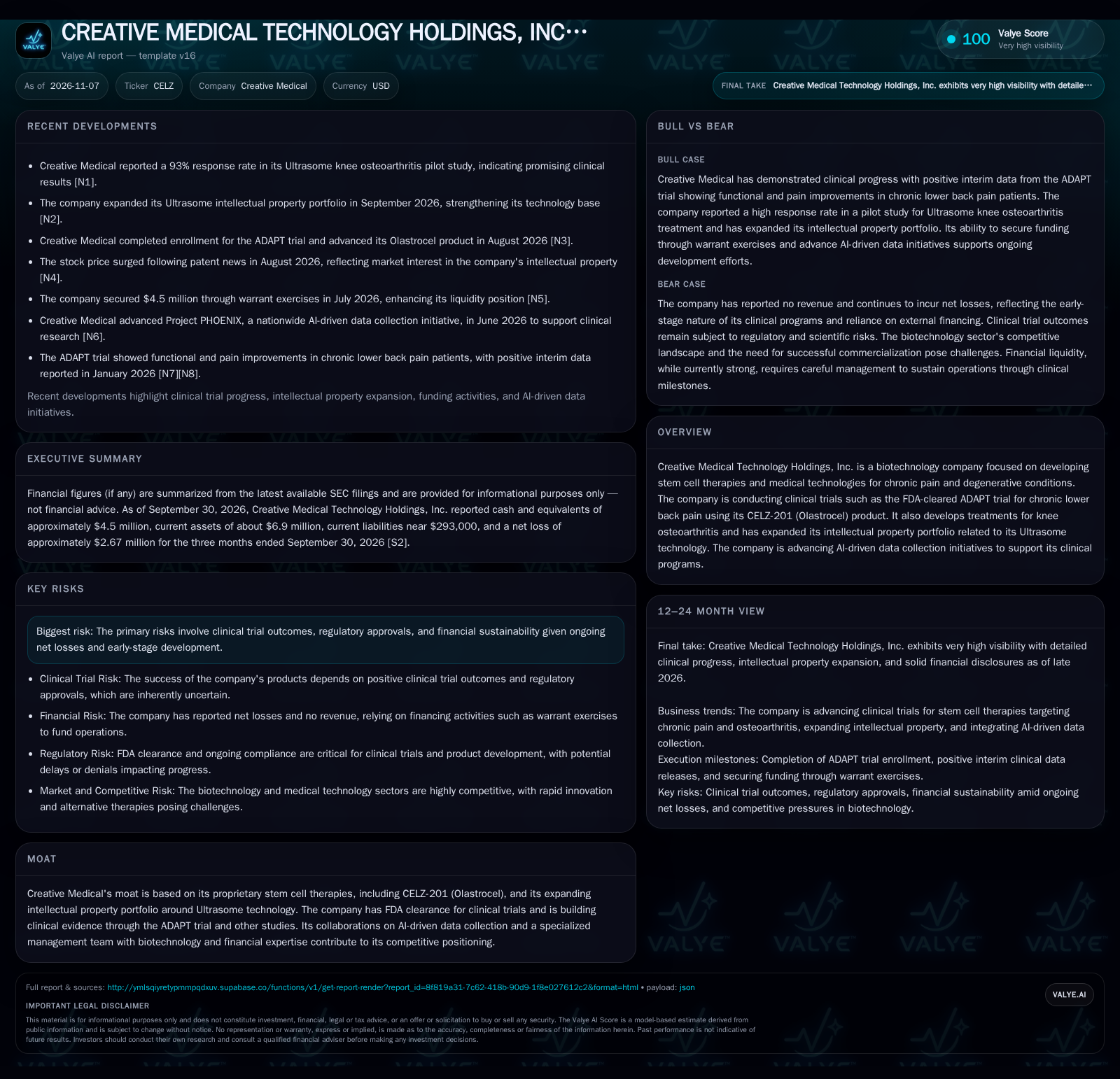
Creative Medical Technology Holdings (CELZ) has demonstrated notable progress with a 93% response rate in a pilot study for its Ultrasome treatment and expanded its intellectual property portfolio as of September 2026. The company’s cash position was bolstered by $4.5 million in warrant exercises, resulting in a reported current ratio. However, with no reported revenue and significant net losses, the company remains reliant on external financing while advancing clinical and AI-driven data initiatives. Commercial viability will depend on successful trial outcomes, regulatory approvals, and the ability to generate meaningful revenue streams from its pipeline.
Creative Medical Technology Holdings stands at a pivotal point where scientific validation and financial sustainability must converge. The company’s recent 93% response rate in its Ultrasome knee osteoarthritis pilot study and expansion of related intellectual property indicate technical progress and a drive to secure competitive advantage. With cash reserves recently strengthened by warrant exercises, Creative Medical has the resources to advance its AI-driven data collection and clinical programs in the short term. Yet, the absence of revenue and continued net losses underscore the company’s reliance on future trial success, regulatory milestones, and eventual market adoption. The coming quarters will test whether promising clinical signals can be translated into a viable, defensible business.
Clinical Results, Cash Infusion, and IP Expansion Shape the 2026 Landscape
Three recent developments define Creative Medical’s present condition. First, the company reported a 93% response rate in its Ultrasome pilot study for knee osteoarthritis, offering early but compelling clinical validation for a major pipeline asset [N1]. Second, in September 2026, Creative Medical expanded its Ultrasome intellectual property portfolio, which could enhance the platform’s defensibility and value proposition if commercialized [N2]. Third, the company’s liquidity position improved markedly after securing $4.5 million through warrant exercises in July 2026, contributing to a cash and equivalents balance of $4.5 million and a current ratio above 23 as of September 30, 2026 [S2] [N5].
Despite these positives, Creative Medical reported no revenue for the nine months ended September 30, 2026, and a net loss of $2.67 million for the most recent quarter [S2]. The company’s position is thus defined by scientific progress and a solid, if finite, reported cash balance, but remains fundamentally pre-commercial and dependent on future inflection points.
The timing and magnitude of future financing rounds will depend heavily on interim clinical data and regulatory feedback, which can either enhance investor confidence or necessitate more dilutive funding. Moreover, intellectual property expansion, while strengthening defensibility, must be coupled with clear pathways to commercialization to translate into tangible enterprise value.
The Economics of Early-Stage Biotech: Funding, Fixed Costs, and the Path to Revenue
Creative Medical’s business model is typical of pre-commercial biotechnology: significant upfront investment in R&D and clinical trials, with zero revenue until regulatory approvals unlock market access [S2]. The company’s cost structure is dominated by research, development, and SG&A spending, with net losses reflecting high fixed costs relative to nonexistent top-line.
If clinical programs such as Ultrasome or Olastrocel are eventually approved, the company’s economics could shift dramatically. In the best-case scenario, high-margin product sales (either direct or through partnerships/licensing) could drive operating leverage, as incremental sales would come with relatively low variable cost. However, commercialization introduces new capital requirements: manufacturing scale-up, regulatory compliance, and potentially large commercial teams or distribution partners. Until then, funding will likely depend on additional equity or dilutive instruments, especially if development timelines extend or trial outcomes are delayed.
The fixed-cost intensity characteristic of early-stage biotech underscores the importance of efficient capital allocation and milestone-driven spending. If Creative Medical can leverage AI-driven data initiatives to optimize trial design or patient recruitment, this may reduce time-to-market and lower development expenses, thereby improving capital efficiency. However, the transition from R&D to commercialization typically introduces variable costs linked to manufacturing scale and marketing, which could compress margins if not managed carefully. Partnering strategies could mitigate these risks by sharing costs and leveraging external expertise, but may also dilute future revenue streams.
Proprietary Platforms and Data Initiatives: Defensibility in a Crowded Field
Creative Medical’s competitive edge rests on a combination of proprietary stem cell therapies—such as CELZ-201 (Olastrocel)—and an expanding intellectual property portfolio around its Ultrasome technology. The recent IP expansion may help create barriers to entry for direct competitors in regenerative medicine and osteoarthritis treatments [N2].
The company’s Project PHOENIX, an AI-driven national data collection initiative, could further differentiate its clinical programs if it enables faster or more precise patient selection, outcome measurement, or regulatory submissions [N6]. However, the broader landscape is intensely competitive, with established biopharma, medtech firms, and emerging startups all pursuing similar indications with various modalities (biologics, small molecules, devices, and cell therapies). Larger incumbents possess more resources for clinical development, regulatory navigation, and commercialization, increasing the pressure on Creative Medical to either demonstrate clear superiority or partner with stronger players.
In a landscape crowded with regenerative medicine and osteoarthritis solutions, the ability to demonstrate differentiated clinical outcomes is paramount. Proprietary platforms like Ultrasome and Olastrocel must not only show efficacy but also safety and durability superior to existing standards of care to justify premium pricing or reimbursement. The integration of AI through Project PHOENIX could accelerate evidence generation and regulatory acceptance, but its impact depends on data quality, regulatory receptiveness to AI-derived endpoints, and the scalability of these insights across indications. Failure to establish clear clinical and technological differentiation risks commoditization and pricing pressure.
What If Clinical Success and Data Synergies Unlock Commercialization?
The most favorable scenario is built on a sequence of positive clinical trial results—starting with larger, controlled studies replicating the pilot-level efficacy seen in the Ultrasome knee osteoarthritis study [N1]. If supported by robust safety data and compelling improvements in patient function and pain, these results could accelerate regulatory approvals. The company’s AI-driven Project PHOENIX may provide a further edge by improving trial design, patient stratification, or real-world evidence generation, increasing the likelihood of regulatory and payer acceptance.
Successful commercialization—either independently or via licensing/partnerships—would validate the business model and potentially allow for high-margin product sales. Evidence that would confirm this scenario includes positive pivotal trial data, regulatory filings/approvals, the announcement of commercial partnerships or licensing deals, and initial revenue generation. Falsification would come from failed or inconclusive trials, regulatory setbacks, or inability to secure commercial partners.
Clinical Progress Continues, But Revenue Remains Distant
The most plausible near-term trajectory is that Creative Medical continues to advance its clinical programs, with ongoing data releases and incremental progress in expanding its IP portfolio and AI capabilities.
Confirmation of this scenario would be continued positive (but not yet pivotal) clinical data, further patent issuances, and news of completed trial enrollments or AI initiative milestones. This path would be challenged if cash burn accelerates, trial enrollment slows, or if clinical data fail to improve upon competitors or standard of care.
Adverse Trials or Funding Gaps Could Trigger Strategic Setbacks
The principal risk is that one or more clinical programs generate disappointing data—either insufficient efficacy or unexpected safety signals—leading to delays, regulatory rejections, or program discontinuation. In this scenario, the absence of revenue and persistent net losses quickly erode the current cash position, forcing the company into highly dilutive financings or strategic pivots (such as asset sales or early partnering on unfavorable terms).
Confirmation would come from negative or equivocal trial readouts, regulatory feedback indicating the need for additional studies, or a rapid increase in financing activity at depressed valuations. Falsification would require the company to maintain clinical momentum, secure additional non-dilutive funding, or demonstrate cost discipline that meaningfully extends the operating runway.
Milestones That Will Make or Break Creative Medical’s Transition to a Commercial Entity
Pivotal trial results for Ultrasome in knee osteoarthritis: Progression from promising pilot data to statistically robust, controlled studies would be decisive for regulatory and commercial prospects.
Interim and final data from the ADAPT and Olastrocel clinical programs: Positive, reproducible efficacy and safety signals would support pipeline value.
Expansion and defensibility of the intellectual property portfolio: Additional granted patents or successful defense against challenges would reinforce competitive position.
Progress and outputs from Project PHOENIX: Demonstrable improvements in trial efficiency, patient selection, or regulatory submissions attributable to AI-driven data initiatives would support the technology narrative.
Evidence of commercial partnerships, licensing deals, or initial revenue: Announcements of external validation or early commercialization steps would indicate business model traction.
Regulatory milestones: IND filings, fast track designations, or successful pre-IND meetings would clarify the regulatory pathway.
Disclaimer: This is research-only, informational analysis and not investment advice. It may include AI-generated interpretation and general industry context. Always verify important details using primary sources.

Comments