
JFrog’s Platform Ambitions: Orchestrating the Software Supply Chain in the Age of AI
JFrog’s accelerating revenue growth and deepening enterprise penetration reflect the rising complexity of software delivery—especially as AI, security, and compliance converge. But the company’s ability to scale product innovation and operational discipline amid intensifying competition will define whether it remains the system of record for modern software supply chains.
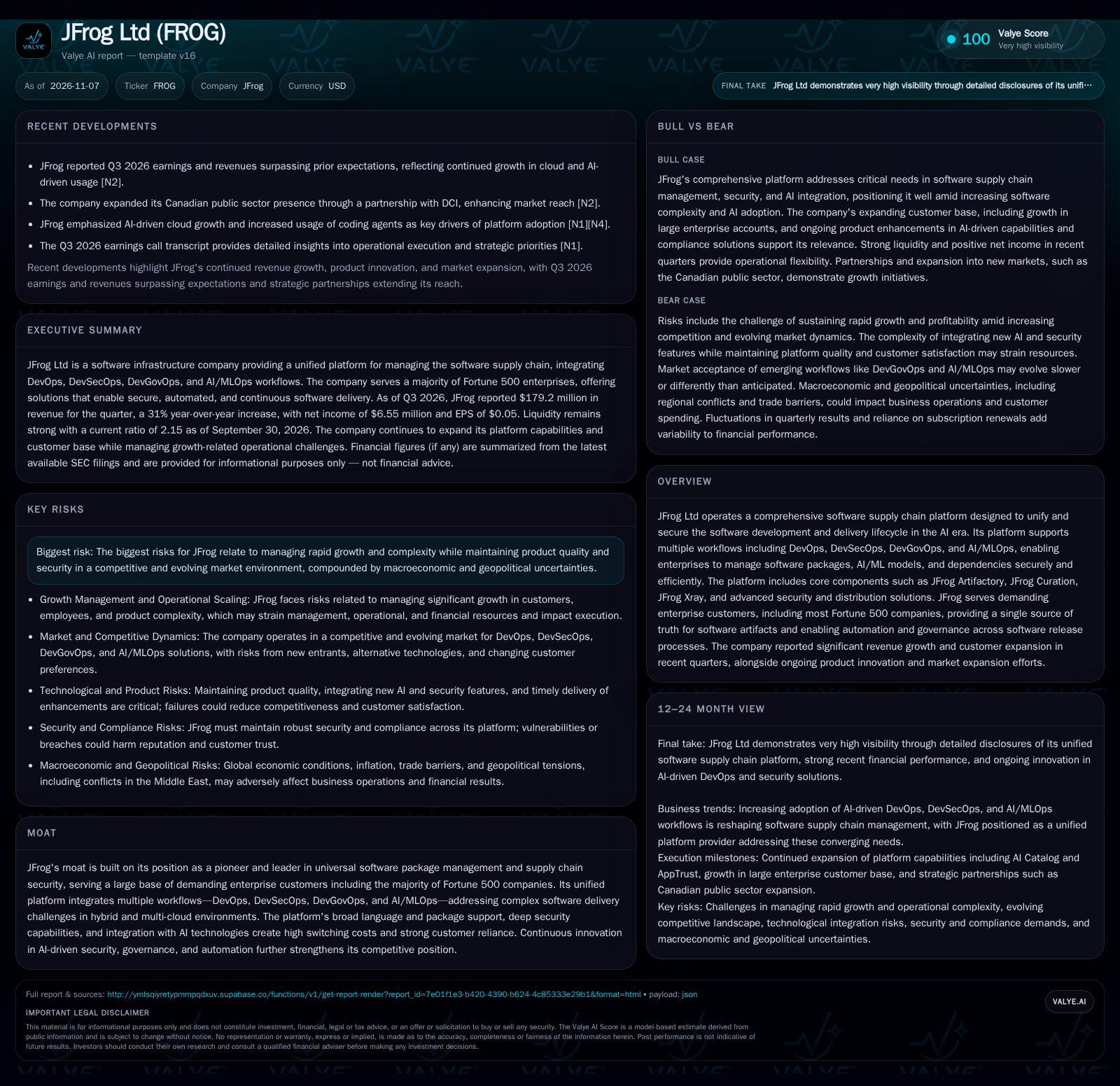
JFrog delivered 31% revenue growth in Q3 2026 as usage of its unified software supply chain platform expanded across large enterprise customers, including most Fortune 500 firms. New offerings in AI/MLOps, advanced security, and compliance are driving adoption, but rapid scaling of both customer base and employee headcount is straining management bandwidth. The company’s future hinges on maintaining innovation velocity and operational excellence while defending its position against a growing field of DevOps and security platform competitors. [S2]
As enterprises race to integrate AI, secure their software pipelines, and comply with mounting regulatory demands, JFrog has positioned its platform as the backbone for modern software supply chains. Its Q3 2026 results show not just robust revenue growth and expanding customer relationships, but also the escalating operational challenges that come with scale in a hypercompetitive market. The company’s future will turn on its ability to sustain innovation across DevOps, security, and AI workflows while navigating the twin pressures of execution risk and evolving customer needs.
Enterprise Momentum Accelerates—But So Does Execution Complexity
JFrog reported Q3 2026 revenue of $179.2 million, marking a 31% year-over-year increase. Net income for the quarter was $6.55 million, with EPS at $0.05. The company’s customer base continues to deepen among large enterprises: customers with $100,000 or more in annual recurring revenue (ARR) climbed to 1,357, up from 1,168 at the end of 2025, and $1 million+ ARR customers reached 112, up from 74. This expansion reflects strong adoption of JFrog’s unified platform across Fortune 500 and other demanding organizations. [S2]
Liquidity remains substantial, with $75.2 million in cash and equivalents, $604.8 million in short-term investments, and a current ratio of 2.15 as of September 30, 2026. However, the company’s rapid growth in both headcount and customer footprint is putting strain on management and operational resources, raising the stakes for execution discipline. [S2]
Recent product launches—including AI Catalog, agentic security features, and AppTrust for compliance—underscore JFrog’s push to capture the next wave of software supply chain complexity, particularly as AI and regulatory demands reshape enterprise priorities. [S2]
How JFrog Converts Platform Breadth into Economic Value
JFrog’s revenue model is primarily subscription-based, with customers paying for access to its platform modules—ranging from core package management (Artifactory) to advanced security (Xray, Advanced Security), AI/ML model governance (JFrog ML, AI Catalog), and compliance (AppTrust). Pricing likely scales with enterprise footprint, usage volume, and the breadth of modules adopted, a structure that can produce high gross margins and strong operating leverage as customer spend expands.
The company’s rapid growth in $100K+ and $1M+ ARR customers suggests effective land-and-expand dynamics, where initial adoption (often for Artifactory or security) leads to cross-sell of additional modules as regulatory, AI, and operational needs grow. This model benefits from high switching costs: once JFrog becomes the system of record for artifact management and security, migration risk rises for customers, enhancing retention and potential for upsell.
However, scaling this economic model requires significant ongoing R&D and customer support investment, especially as product complexity and compliance demands rise. The need to continually integrate new AI and security features, and to support hybrid/multi-cloud deployments, means that fixed costs may remain high, moderating near-term margin expansion even as revenue grows.
Defending the System of Record: JFrog’s Moat and Its Vulnerabilities
JFrog’s core advantage lies in being deeply embedded as a system of record for software artifacts and supply chain security within large enterprises, especially those with complex, multi-cloud, and regulated environments. Its breadth—supporting DevOps, DevSecOps, DevGovOps, and AI/MLOps workflows, and integrating governance, security, and automation—sets a high bar for competitors seeking to displace it.
That said, the market is fiercely competitive. Rivals span legacy DevOps toolchains, cloud-native platforms, security vendors, and emerging AI pipeline solutions. Cloud hyperscalers and large security firms are increasingly bundling artifact management, vulnerability scanning, and AI model governance into their platforms, potentially eroding JFrog’s differentiation if they can match integration depth or undercut on price.
Switching costs are meaningful—especially for enterprises that have standardized on JFrog for artifact and model management—but not insurmountable if a competitor offers superior automation, lower TCO, or regulatory assurance. The pace of innovation in AI-driven DevOps and the ability to address new compliance mandates will be critical in defending share.
AI-Driven Expansion and Compliance Tailwinds Unlock New Revenue Layers
If JFrog successfully leverages its platform to become the default system of record for both software and AI/ML artifacts—while embedding advanced security and compliance automation—it could see a step-change in average contract value and retention. The convergence of AI/MLOps, DevSecOps, and DevGovOps creates a need for unified governance and risk management, a space where JFrog’s cross-functional platform could become indispensable.
Upside would be confirmed by continued acceleration in $1M+ ARR customers, evidence of major wins in regulated industries or government, and high attach rates for new modules such as AI Catalog and AppTrust. Margin expansion could follow as R&D efficiency improves and platform modules are leveraged across a larger customer base. The strongest evidence would be customer testimonials or case studies highlighting JFrog as a core compliance and AI governance partner, and a rising share of revenue from new platform modules.
Sustained Growth Amid Rising Complexity and Execution Demands
The most plausible trajectory is that JFrog continues to grow at a healthy—if moderating—pace, as enterprise customers expand platform adoption but competitive intensity and operational complexity increase. New product modules, especially in AI/MLOps and compliance, help sustain expansion in large accounts, but incremental growth requires significant ongoing investment in R&D, security, and customer success.
Confirmation would come from steady progress in both $100K+ and $1M+ ARR customer counts, balanced by evidence of continued hiring in engineering and support. Margins may remain roughly stable as additional revenue is reinvested in platform innovation and customer onboarding. Falsification would be signaled by stagnation in large customer additions, rising churn, or delays in integrating new features—particularly those related to AI and compliance.
Operational Strain and Technological Disruption Undermine Platform Stickiness
In a negative scenario, JFrog’s rapid expansion outpaces its ability to maintain product quality, security, or customer support—leading to execution missteps and customer dissatisfaction. This could be exacerbated if a major security vulnerability emerges, or if competitors launch more seamlessly integrated or lower-cost alternatives, especially in AI and cloud-native environments.
Downside would be confirmed by a slowdown or reversal in large customer growth, margin compression due to escalating support or R&D costs, and publicized customer losses to rival platforms. Additional warning signs include security incidents, negative regulatory findings, or evidence that new module launches are failing to gain traction with existing customers.
Milestones That Will Clarify JFrog’s Platform Power and Growth Durability
The quarterly growth rate in customers with $1 million+ ARR—acceleration or deceleration would reveal whether JFrog is deepening its enterprise foothold or facing wallet-share pressure. [S2]
Adoption rates and revenue mix from new modules (AI Catalog, AppTrust, agentic security)—if disclosed, these would test whether JFrog is succeeding in cross-selling and upselling next-generation capabilities.
Gross and operating margin trends—monitoring whether incremental revenue is translating into profitability or being absorbed by R&D and support costs.
Churn rates among large enterprise customers—a rising churn rate, if disclosed, would signal platform vulnerability or competitive pressure.
Evidence of major platform security incidents or vulnerabilities—these could directly undermine trust and retention, especially in regulated industries.
Customer case studies or disclosures highlighting JFrog’s role in regulatory compliance and AI governance—these would validate the platform’s strategic relevance.
Hiring and retention trends in engineering and support—rapid turnover or unfilled roles could signal operational strain.
Announcement of major competitive wins or losses—public customer migrations would clarify JFrog’s defensibility in key verticals.
Disclaimer: This is research-only, informational analysis and not investment advice. It may include AI-generated interpretation and general industry context. Always verify important details using primary sources.

Comments