
WEED, INC. Confronts Capital Constraints While Advancing Cannabis Genomic Research and Digital Asset Initiatives
Latest quarterly disclosure underscores ongoing financial challenges despite strategic progress in proprietary cannabis genomics and digital asset development.
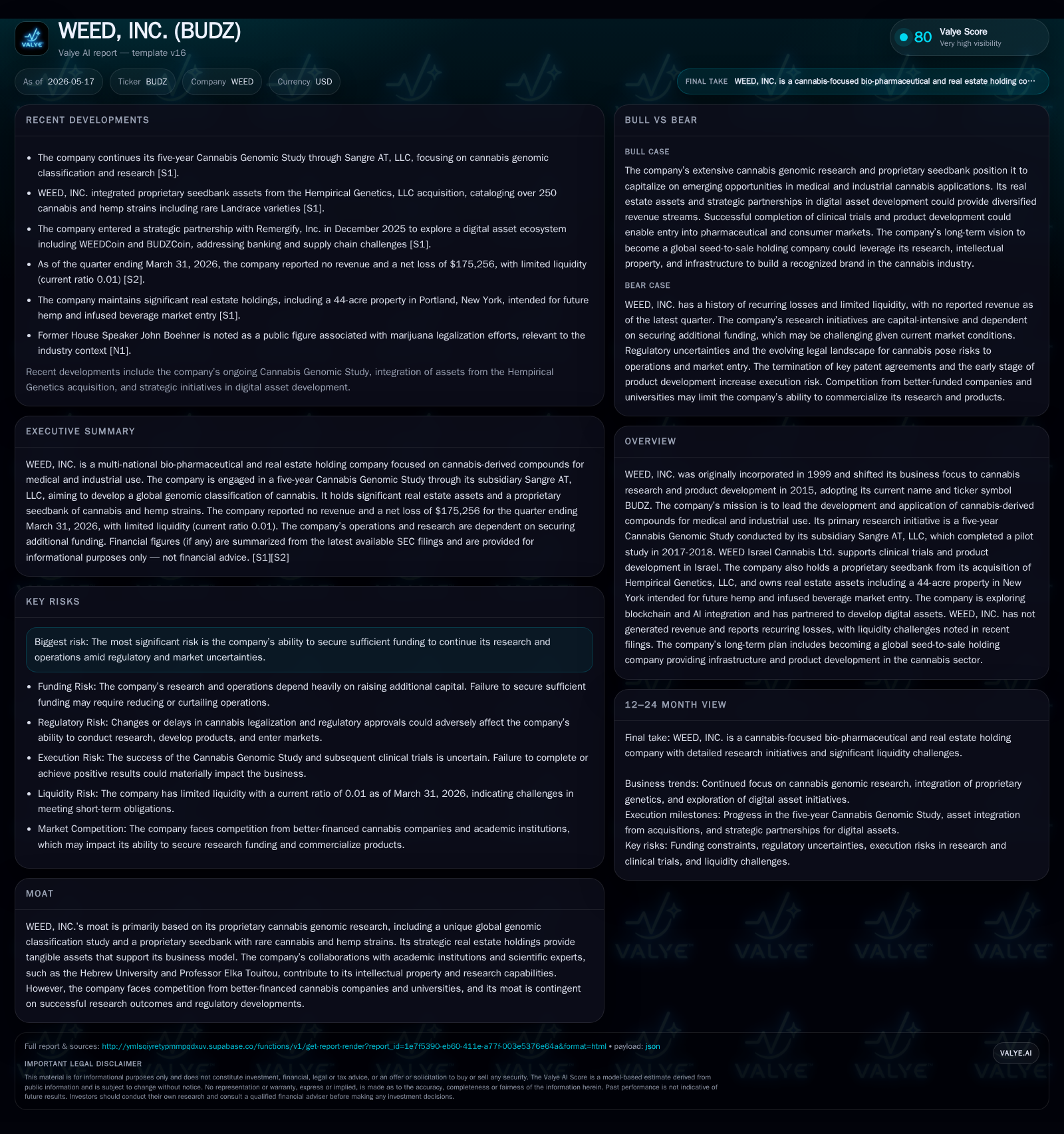
WEED, INC. continues its multi-year Cannabis Genomic Study alongside explorations in blockchain-based digital assets, as detailed in its May 2026 quarterly filing. Despite these strategic advances, the company faces acute liquidity issues with a critically low current ratio driven by high current liabilities against modest assets. Its business model banks heavily on proprietary genetic research, clinical trials through Israeli partnerships, and real estate holdings aimed at future hemp and infused beverage market entry. While its genomic expertise and unique seedbank foster differentiation, WEED, INC.’s expansion is constrained by regulatory uncertainty, a persistent need for capital, and the inherent risks of early-stage clinical research.
Recent Operating Update: Critical Liquidity Stress Amid Strategic Progress
In its latest quarterly filing dated May 15, 2026 [S2], WEED, INC. reveals severe liquidity constraints with current assets of approximately $12,365 contrasted starkly against current liabilities of roughly $1.35 million—yielding a dangerously low current ratio near 0.01 [F1]. This acute imbalance signals pressing short-term financial risk despite the company maintaining minimal reported debt (~$3,661) [F1]. The operating income and net income remain negative with losses exceeding $1.3 million in fiscal 2025 [F1], underscoring continuous reliance on external financing for operational continuity.
Notably, no revenue has been generated per latest filings [F1], reflecting WEED’s developmental-stage positioning focused on long-term R&D rather than immediate commercialization. The quarter did not disclose any material changes to this capital structure or liquidity buffer that might alleviate near-term pressures.
Business Model: Innovative Cannabis Genomics Anchored by Research and Strategic Assets
WEED’s business is an R&D-centric venture aiming to develop intellectual property around cannabis-derived compounds for medical and industrial applications while leveraging real estate holdings for ancillary markets like hemp beverages.
Revenue Mechanics: With no product revenues currently reported [F1], potential future income sources include licensing patented genetic strains or research outputs; consulting or leasing cultivation infrastructure; proceeds from digital asset initiatives; and monetization of real estate once commercial operations commence [S1][S6]. These revenue streams depend on successfully completing costly genomic studies and clinical trials validating therapeutic value.
Strategic Strengths:
- Proprietary five-year Cannabis Genomic Study conducted by subsidiary Sangre AT, LLC aims to establish a comprehensive global genetic map of cannabis cultivars; pilot phases completed demonstrating advanced DNA sequencing techniques [S9][S23].
- Seedbank acquired via Hempirical Genetics includes over 250 rare landrace strains such as Panama Red and Acapulco Gold providing biological diversity critical for patentable discoveries [S8][S18].
- Partnership with WEED Israel Cannabis Ltd. enables human clinical trials under renowned scientific leadership including Professor Elka Touitou with decades of cannabinoid drug delivery expertise [S8][S28].
- Tangible assets include a strategically located 44-acre New York property with water extraction rights intended as a base for entering the hemp-infused beverage industry—a segment aligned with emerging consumer trends [S11][S12].
- Exploration of blockchain technology integration through collaboration with Remergify targets banking inefficiencies in cannabis supply chains via proprietary digital coins (WEEDCoin & BUDZCoin), though still at concept stage pending capital availability [S6][S19].
Weaknesses:
- Absence of commercial products or services results in full dependency on financing rounds.
- Limited operating history transitioning from mineral exploration to biotech since 2015 constrains performance predictability [S1][S10].
- Minimal cash reserves combined with outsized near-term liabilities increase risk of operational disruptions without fresh capital [F1].
Industry Context and Competitive Positioning
Cannabis research intersects biopharma R&D under complex regulatory frameworks that vary across states but remain restrictive federally due to cannabis’s Schedule I classification. This status limits patent protections and complicates banking access—challenges common across the sector but particularly burdensome for smaller firms like WEED lacking extensive capital.
Competitive moats largely derive from intellectual property portfolios encompassing patented genetic strains or delivery technologies. WEED’s moat centers on its proprietary genomic database coupled with rare Landrace strain collections acquired via Hempirical Genetics—a niche less common among peers focused primarily on cultivation or retail distribution.
Academic collaborations enhance credibility but face competition from university-led projects backed by government grants. The Israeli clinical trial partnership adds international research depth uncommon among microcap cannabis companies.
Compared to larger vertically integrated cannabis firms spanning cultivation to retail, WEED’s focus on early-stage genomic science places it at the innovation frontier but isolates it from established revenue-generating operations.
The nascent blockchain initiative could be differentiating if realized but remains speculative amid regulatory uncertainties surrounding crypto assets [S19]
Growth Drivers
Growth fundamentally depends on:
- Completion of Cannabis Genomic Study: Funding needed to finalize this multi-year project enabling gene-driven breeding programs aimed at designer cultivars optimized for medicinal efficacy—potentially unlocking novel patents [S9][S23].
- Advancement of Clinical Trials: Progress through phases 2 & 3 human clinical trials under Israeli jurisdiction offering favorable legal/scientific conditions; positive results could trigger licensing or partnerships [S8][S20][S28].
- Commercialization of Seedbank Assets: Translating extensive varietal seedbank into viable cultivars tailored for specific medical or industrial uses enhances revenue prospects.
- Entry into Infused Beverage Market: Leveraging New York property ownership with water rights supports entry into growing hemp-infused beverage segments aligned with shifting consumer preferences [S11][S12].
- Blockchain Ecosystem Development: Successful launch of digital currencies addressing banking/blockchain inefficiencies in cannabis supply chains could create new revenue streams but requires overcoming capital/regulatory hurdles [S6][S19].
- Potential Strategic Acquisitions: Management references possible acquisitions (e.g., distilleries for infused beverages) to deepen vertical integration or diversify offerings [S7].
Risks / Watchpoints / Constraints
- Funding Dependency: Recurring net losses exceeding $1.3 million annually coupled with negligible liquidity amid high current liabilities place survival contingent on expensive dilutive equity or debt financing amid macroeconomic instability [F1][S15][S19].
- Regulatory Ambiguity: Federal illegality complicates patent grants (notably vulnerable for cannabis IP), banking access, trial approvals in the U.S., repatriation constraints affecting international operations; adverse policy shifts could derail plans abruptly [S17][S22].
- Research Execution Risk: Scientific uncertainty means failure to produce conclusive genomic data or successful clinical trial outcomes would severely impair commercialization prospects [S20].
- Competitive Pressures: Investments by better-capitalized competitors or academic institutions overlapping research aims challenge uniqueness.
- Digital Asset Uncertainty: Early-stage blockchain/digital coin projects face unpredictable regulatory oversight potentially limiting scalability or causing abandonment disrupting strategy [S19][S27].
- Operational Scaling Limitations: Lack of production capacity or sales infrastructure may delay monetization even if R&D succeeds.
What To Watch Next
Critical upcoming milestones include:
- Fundraising announcements signaling capital secured for advancing genomic studies and initiating later-phase clinical trials.
- Updates on licensing outcomes or patent awards related to new designer cultivars.
- Progress reports on New York real estate developments indicating movement towards hemp beverage manufacturing capability.
- Developments within Remergify partnership including regulatory filings or beta launches tied to WEEDCoin/BUDZCoin ecosystems.
- Public disclosures about U.S. federal cannabis policy shifts impacting patent protections or banking access.
These milestones will shape WEED’s transition from pre-commercial R&D entity toward sustainable revenue generation.
Financial Profile Brief Summary
As of fiscal year-end 2025, WEED reported zero revenue accompanied by sustained net losses slightly exceeding $1.37 million annually reflecting its pre-revenue biotech model reliant on investment inflows rather than sales operations [F1]. The balance sheet shows minimal statutory debt ($3,661) overshadowed by disproportionate current liabilities ($1.35 million) relative to scant current assets ($12k), creating acute liquidity stress evident in a near-depleted current ratio (0.01) signaling near-term solvency risk absent fresh financing [F1]. Management acknowledges substantial doubt about going concern status highlighting urgency in securing funds essential beyond basic operations [S15][S17]. Operating expenses primarily reflect R&D investments including Sangre's sequencing efforts plus costs associated with real estate holdings and corporate overheads.
This analysis strictly references verified SEC filings without speculative extrapolations. It integrates sector knowledge reflecting typical biotech/R&D investment dynamics amid evolving federal-state cannabis regulations. Readers should weigh scientific success probabilities and regulatory uncertainties when assessing WEED’s prospects.
Disclaimer: This is research-only, informational analysis and not investment advice. It may include AI-generated interpretation and general industry context. Always verify important details using primary sources.

Comments