
Blackstone Inc. Growth and Strategy in a Competitive Alternative Asset Market
Blackstone’s strategic acquisitions and diversified revenue model underpin resilient growth amid regulatory complexities and fierce industry competition.
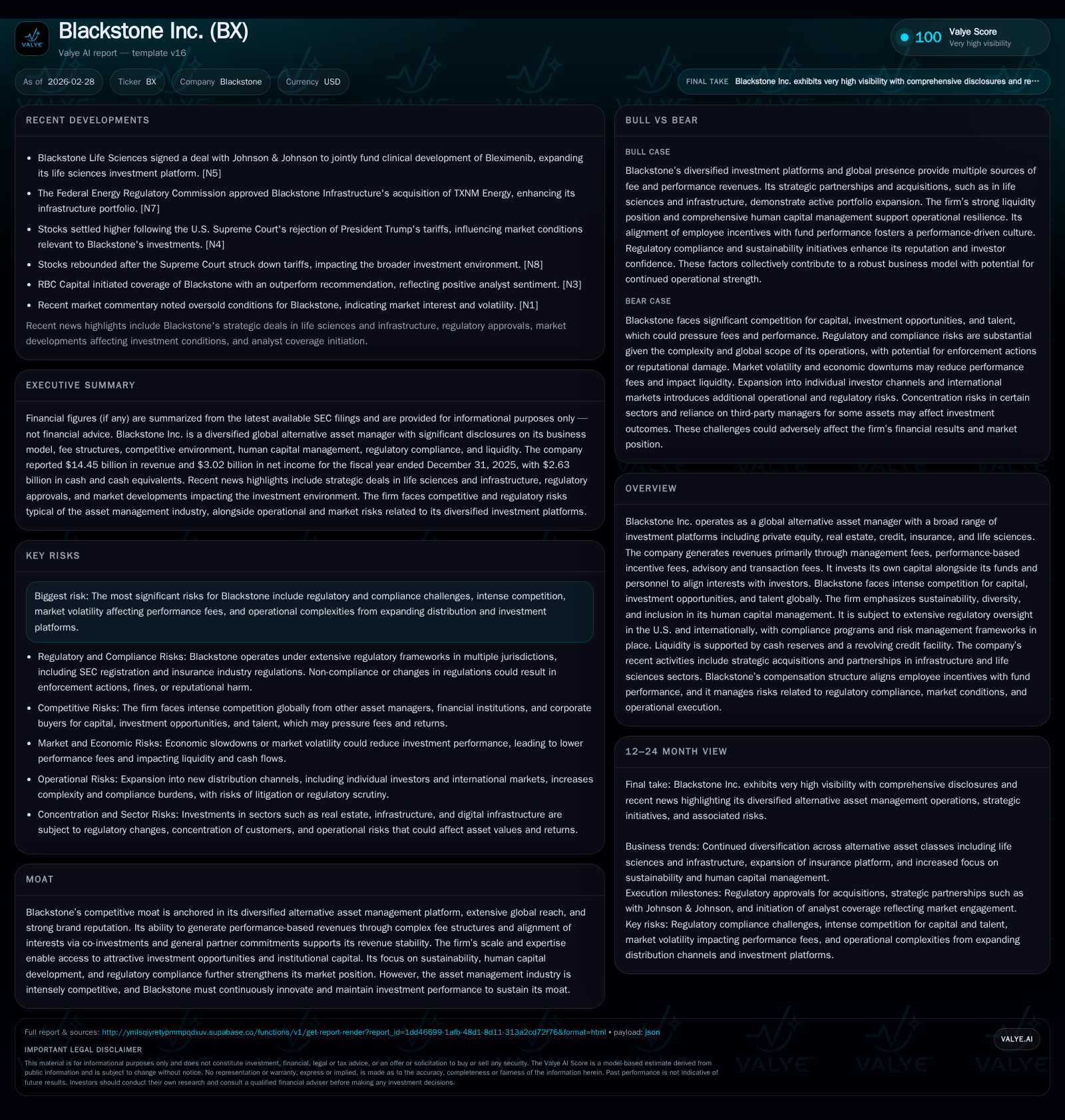
In 2025, Blackstone Inc. delivered robust financial results highlighted by strategic acquisitions that expanded its footprint across real estate, infrastructure, and life sciences sectors. The firm's intricate fee arrangements and performance-based revenue streams underpin its earnings stability despite intensifying competition and evolving regulatory scrutiny. Capital allocation remains disciplined, balancing significant dividends with moderate capital expenditures amid healthy cash flow generation. Looking ahead, Blackstone’s growth hinges on innovation in new investment platforms and proactive regulatory compliance while navigating competitive pressures.
Transformative Acquisitions and Partnerships of Early 2026
Blackstone has strategically enhanced its investment platform through notable deals executed in the first quarter of 2026. Among these is the acquisition of Champions Group from Odyssey Investment Partners, which broadens Blackstone's footprint into diversified real estate services with potential scaling of fee-earning AUM [N3]. Concurrently, regulatory approval by FERC for the acquisition of TXNM Energy solidifies Blackstone Infrastructure's presence in US energy assets, aligning with broader infrastructure expansion ambitions [N2]. The Life Sciences segment further demonstrated innovation via a partnership with Johnson & Johnson to co-fund clinical development of Bleximenib, positioning Blackstone Life Sciences at the forefront of biopharma venture investing [N1]. These moves collectively illustrate Blackstone's integrated approach to diversification across its real estate, infrastructure, and life sciences divisions.
Such acquisitions do more than extend sector reach; they augment recurring fee streams—management fees grow through incremental assets under management (AUM), while performance-based fees benefit from enhanced portfolio scale and exposure to high-growth verticals. This strategic layering partially offsets competitive pressures on fee yields observed industry-wide.
Examining Revenue Growth Drivers and Their Evolution Over Recent Years
Blackstone’s revenue trajectory exhibits strong momentum over the past four years. Total revenue grew from $8.52 billion in FY2022 to $14.45 billion in FY2025 — a compound rise fueled by both expanded base management fees linked to rising fee-earning AUM and increased realization of performance or incentive fees that depend on investment appreciation milestones being met [F1][S1]. The year-over-year growth accelerated notably from FY2023’s post-pandemic rebound phase through FY2024-25.
Management fees form the firm’s predictable baseline revenues calculated on invested capital or net asset values across its fund structures. Incentive fees — referred to as "performance revenues" — are subject to hurdle rates (commonly between 5–7%) that limit recognition until minimum returns are achieved. High water mark provisions prevent double counting prior losses before allocating carry or incentive fees. Payment schedules vary widely: some funds crystallize these revenues triennially or upon LP redemption events; others realize them quarterly if annual hurdle thresholds are exceeded [S1].
This multi-layered compensation hierarchy incentivizes prudent asset growth alongside aggressive value creation strategies but introduces volatility tied to market cycles and fund exit activity.
Diverse Fee Structures and Performance Revenue: The Backbone of Earnings
Blackstone operates within an intricate matrix of incentive arrangements specific to each asset vehicle category:
- Private equity funds typically apply a 20% carry subject to hurdles.
- Open-ended business purpose property (BPP) and infrastructure partnering (BIP) vehicles derive incentive fees generally between 7%–12.5% post-hurdle catch-up mechanics realized triennially or upon redemption events.
- Real Estate Income Trusts like BREIT command a performance participation allocation of about 12.5% over a 5% hurdle measured annually.
- Business Development Companies earn income incentive fees ranging from 12.5%–17.5%, subject to similar hurdles and caps paid quarterly.
- The Multi-Asset Investing segment encompasses hedge fund vehicles with incentive fees varying up to 20%, protected by high water mark provisions.
These arrangements collectively contribute materially not only to revenue but also underpin operating cash flow stability given their structured timing and alignment with fund performance cycles ([S1]).
Investment Outlook: Growth Prospects Through Innovation and New Platforms
Looking forward, Blackstone seeks growth beyond traditional private equity into innovative sectors such as life sciences through collaborations like the JNJ deal which directly links clinical pipeline success milestones to potential payouts [N1]. This marks evolution toward more programmatic corporate partnerships within BX Life Sciences.
Expansion prospects also hinge on increasingly large credit platforms where private credit continues its upward trajectory as a favored alternative income source amidst persistent bank retrenchment globally (noting themes highlighted by Blue Owl’s recent private credit fund adjustments indicating market tightness) [N6][N12]. Infrastructure assets acquired such as TXNM Energy manifest longer duration stable cash flow generation with inflation linkage advantages contributing to resilience against rising interest rate challenges [N2].
However, macroeconomic risks including tightening financial conditions could hamper capital availability or dampen exit multiples affecting performance fees realization (a key watch point given reliance on complex fee waterfalls) [S21][S26]. Adaptability via broadening product sets remains critical amid substantial competition from peers often able to engage more flexibly due to lighter regulatory burdens or niche specialization [S27].
Regulatory Landscape and Competitive Pressures Shaping Blackstone’s Strategy
The firm operates within a dense regulatory framework overseen by U.S. entities such as the SEC alongside global authorities imposing rising compliance costs and scrutiny particularly around fee disclosures, conflicts-of-interest management, investor suitability standards, anti-money laundering (AML), AI ethics regulations recently codified across jurisdictions (including the EU's AI Act), and insurance investment oversight [S6][S8][S14][S15][S19]
Heightened monitoring increases operational complexity; failure risks material penalties or reputational damage that could hinder fundraising capabilities—a core competitive threat given alternative managers' dependence on continual capital inflows [S11][S16][S17]. Sustained investment into compliance infrastructure is mandatory.
Competition remains heated among leading asset managers striving for institutional mandates across private wealth channels characterized by stringent regulation & client customization requirements driving adaptation costs higher while compressing potential fee margins [S27].
Capital Structure, Cash Flow Dynamics, and Return on Equity Analysis
As of December 31, 2025, Blackstone reported $2.63 billion in cash equivalents coupled with a total equity base around $8.67 billion supporting a roughly 35% return on equity calculated from net income near $3.02 billion [F1]. Operating cash flow was robust at $4.66 billion despite rising capex outlays totaling $116 million reflecting investments related likely to technology or system enhancements rather than principal acquisitions which tend be capitalized differently [F1].[S26]
Debt maturities were managed prudently; the company completed repayment of secured borrowings during the nine months ended September 30, 2025, with no outstanding balances under its revolver at year-end though it drew $900 million early February 2026 reflecting tactical liquidity positioning for recent acquisitions or opportunistic investments [S4][S10]. Such flexibility offers buffer amidst tightening credit markets noted industrywide.
Free cash flow calculated as CFO less capex remained strong near $4.55 billion underscoring internal funding sufficiency for dividends and selective reinvestment programs.
Dividend Policy, Capital Deployment, And Buyback Activity Details
Blackstone’s capital return strategy prioritizes dividend distributions consistent with steady income delivery expectations of shareholders; dividends totaled approximately $6.01 billion in FY2025 representing an increase relative to prior years despite volatile earnings environments [F1].[S10] Share repurchases have been minimal recently—with last significant activity reported well prior—signaling focus shifted toward direct yield generation rather than aggressive buybacks given market valuations or internal reinvestment opportunities.
With operating cash flows comfortably covering payout demands alongside strategic acquisitions financed largely through other means (including debt facilities), the dividend policy reflects disciplined liquidity stewardship reflecting asset management industry norms rather than proxy aggressive distribution leverage.
Key Milestones to Watch in 2026 And Beyond: Market Position & Fundraising
Investors should track Blackstone's fundraising cadence for flagship private equity funds alongside emerging credit/infrastructure pools since successful closes directly influence management fee run rates sustainably.[N7][N9] Clinical milestone achievements within BX Life Sciences connected partnerships will serve as performance catalysts tying directly into incentive fee accruals per current agreements.[N1]
Market reception following recent acquisitions integration efforts along with regulatory developments—especially concerning compliance costs or constraints—will shape valuation multiples accessible on portfolio realizations.[N3] Broader macro-financial conditions influencing exit markets remain crucial variables determining incentive revenue trajectory absent explicit company-issued guidance.[S1]
Sustainability, Talent Retention, and Compliance: Strengthening the Moat
Blackstone places pronounced emphasis on ESG factors manifested via sustainability initiatives embedded throughout its investment practices alongside committed diversity & inclusion programs designed to attract top-tier global talent amidst fierce industry competition.
Robust risk management frameworks combined with proactive regulatory compliance efforts mitigate operational disruptions enhancing investor confidence—a vital intangible component underpinning sustained fundraising success.[S6][S8]
Such human capital development alongside environmental stewardship provides competitive differentiation reinforcing brand prestige beyond pure financial metrics—a critical moat in an era where investor scrutiny encompasses non-financial dimensions increasingly influencing capital allocation decisions.
Historical performance (annual)
| FY | Rev ($bn) | Net ($bn) | CFO ($bn) | Capex ($mm) | Rev YoY | Net YoY |
|---|---|---|---|---|---|---|
| 2025 | 14.5 | 3.0 | 4.7 | 116 | +9.2% | +8.7% |
| 2024 | 13.2 | 2.8 | 3.5 | 61 | +64.9% | +99.6% |
| 2023 | 8.0 | 1.4 | 4.1 | 224 | -5.8% | -20.4% |
| 2022 | 8.5 | 1.7 | 6.3 | 235 |
Source: SEC companyfacts cache [F1].
Capital returns and efficiency (annual)
| FY | Div ($bn) | FCF ($bn) | ROE% |
|---|---|---|---|
| 2025 | 6.0 | 4.5 | 34.8 |
| 2024 | 4.4 | 3.4 | 33.8 |
| 2023 | 4.3 | 3.8 | 20.4 |
| 2022 | 6.5 | 6.1 | 22.8 |
Source: SEC companyfacts cache [F1].
Table: Blackstone demonstrated consistent revenue growth alongside strong cash flow conversion despite increasing capex associated likely with technology investments.
This analysis strictly reflects disclosed company data and public filings through February 28, 2026 without projections beyond explicit evidence or editorial speculation about future financial results.
Disclaimer:
This report is intended solely for informational purposes based on publicly available data as referenced; it does not constitute investment advice or recommendations regarding any securities discussed herein.
Disclaimer: This is research-only, informational analysis and not investment advice. It may include AI-generated interpretation and general industry context. Always verify important details using primary sources.

Comments