
Callaway Golf’s Strategic Refocus and Earnings Recovery in 2025
Following divestitures of non-core assets, Callaway Golf sharpened its operational focus on golf equipment and apparel, demonstrating a marked improvement in profitability despite topline pressures.
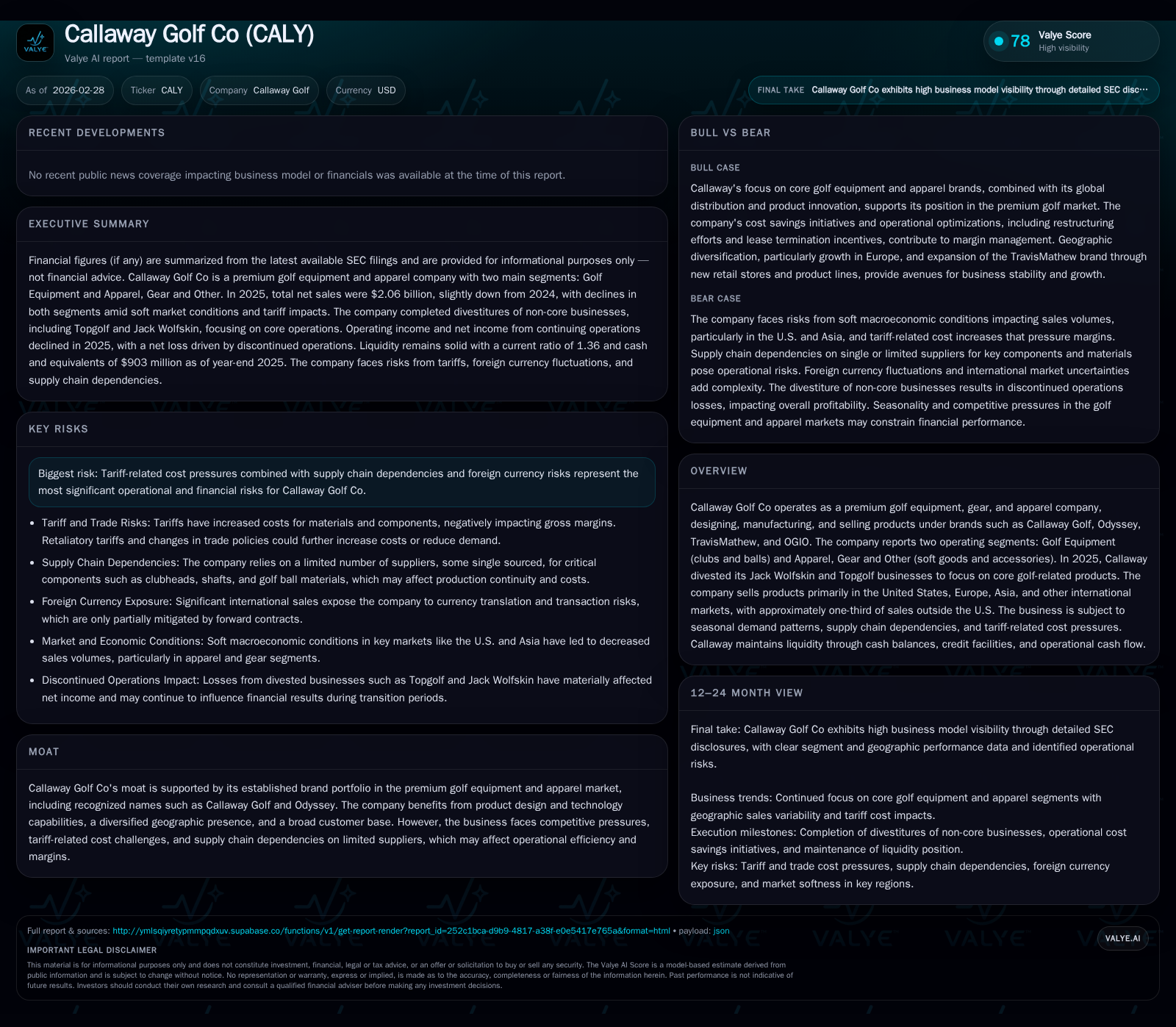
In 2025, Callaway Golf Co streamlined its portfolio around core golf-related products following key divestitures, achieving a slight revenue decline of 0.8% but substantially narrowing operating losses by nearly 96%. The company’s proceeds from divestitures facilitated significant debt reduction, resulting in a net cash position entering 2026. Capital allocation prioritized balance sheet repair over share repurchases or dividends amid tariff-related cost pressures and supply chain risks. Future growth will depend on regional apparel recoveries, product innovation, and supplier diversification.
From Broad Horizons to Core Focus: Callaway’s Business Realignment
Callaway Golf strategically exited non-core segments during 2025 through divestitures of its Jack Wolfskin apparel brand and majority stake in Topgolf entertainment businesses, refocusing operations on core Golf Equipment and Apparel, Gear and Other segments [S1], [S3]. This realignment streamlines the business model to enhance capital efficiency and sharpen product innovation within its premium golf ecosystem.
2025 Financial Recap: Revenue Pressure Amidst Operating Income Improvement
In fiscal year 2025, Callaway reported net sales of approximately $2.06 billion—a decrease of $17.6 million or 0.8% compared to 2024—primarily due to softness in the Apparel, Gear and Other segment affected by macroeconomic challenges in U.S. and Asian markets [S1], [F1]. Golf Equipment sales were relatively stable with a slight decline of 0.5%, driven mainly by reduced club volumes tied to packaged sets amidst softness in South Korea.
Despite revenue pressures, operating results improved markedly: operating losses narrowed from about –$1.26 billion in FY24 to –$54 million in FY25 per SEC filings and company facts data [F1]. This represents nearly a 96% reduction in operating loss year-over-year, signaling that operational efficiencies are materializing following portfolio simplification.
Historical performance (annual)
| FY | Net ($mm) | CFO ($mm) | OpInc ($mm) | Capex ($mm) | Net YoY |
|---|---|---|---|---|---|
| 2025 | -417 | 334 | -54 | 32 | +71.2% |
| 2024 | -1448 | 382 | -1257 | 295 | -1623.9% |
| 2023 | 95 | 365 | 238 | 482 | -39.8% |
| 2022 | 158 | -35 | 257 | 532 |
Source: SEC companyfacts cache [F1].
Capital returns and efficiency (annual)
| FY | Buybacks ($mm) | FCF ($mm) | ROE% |
|---|---|---|---|
| 2025 | 4 | 302 | -20.2 |
| 2024 | 31 | 87 | -60.1 |
| 2023 | 56 | -117 | 2.4 |
| 2022 | 36 | -567 | 4.2 |
Source: SEC companyfacts cache [F1].
Segment Performance Breakdown: Golf Equipment vs Apparel, Gear & Other
The Golf Equipment segment showed resilience with near-flat revenue (-0.5%), where club sales declined slightly (~0.8%) mainly due to lower packaged set volumes amid challenging South Korean market conditions; ball sales grew marginally (0.1%) likely supported by product refreshes [S1], [F1].
Conversely, the Apparel, Gear and Other segment experienced a sharper decline (-1.4%), attributed largely to weaker consumer demand across U.S.-based TravisMathew channels and Asian apparel markets including Japan and Korea [S1], [S22]. Tariff-driven cost pressures further strained margins.
This divergence highlights structural challenges where premium golf equipment maintains steadier demand while soft goods remain more sensitive to macroeconomic fluctuations common in discretionary lifestyle sectors.
Market & Supply Dynamics: Tariffs, Supplier Concentration & Geographic Exposure
With approximately one-third of revenues generated internationally, Callaway faces exposure to foreign currency volatility alongside tariff-induced input cost inflation impacting gross margins globally [S4], [S21]. The company depends on a limited number of single-source suppliers for critical components like clubheads, shafts, and specialized golf ball materials—a factor constraining supply chain agility amid evolving global trade policies.
Such supplier concentration amplifies risk amid inflationary pressures on raw materials and logistics costs prevalent across premium sporting goods manufacturing.
Capital Structure Reset: Debt Reduction & Liquidity Strength Post-Divestiture
Following the Topgolf sale proceeds received early in calendar year 2026, Callaway executed a $1 billion partial repayment on its Term Loan B facility due March 2030—comprising both mandatory ($500 million) and discretionary ($500 million) repayments—substantially reducing gross debt balances [S5], [F1].
Post-repayment, the company reported approximately $680 million net cash position entering the new fiscal period (cash & equivalents of ~$903 million less gross debt near ~$480 million), enhancing financial flexibility for growth investments or shareholder returns while improving credit covenant headroom across asset-based revolving credit facilities spanning North America and Japan [S7].
Capital Allocation Priorities: Share Repurchases & Investment Trends
Callaway’s capital allocation remained conservative through FY25 with share repurchases totaling $3.7 million—markedly lower than prior years—and no dividends declared as liquidity preservation took precedence during restructuring phases [F1], [S8].
Capital expenditures decreased sharply by nearly 90% year-over-year to $31.8 million in FY25 from elevated levels linked previously to capacity expansion initiatives now deprioritized post-portfolio refocus [F1], [S14]. Meanwhile research & development expenses increased modestly (+2%), underscoring continued emphasis on product innovation within core golf equipment lines.
This disciplined approach prioritizes balance sheet strength over immediate shareholder distributions consistent with buy-side preferences for sustainable financial health.
Risk Management: Cybersecurity Oversight & Trade Challenges
Cybersecurity risk management is governed at the Board Audit Committee level with dedicated leadership by a Certified Information Security Manager (CISM)-credentialed Chief Information Security Officer supported by certified experts holding CISSP and CISA credentials among others [S1]. Ongoing monitoring includes internal reporting and external consultant collaboration ensuring adaptive threat mitigation within an expanding digital footprint.
Simultaneously, tariff-driven cost pressures combined with supply chain vulnerabilities amplified by currency fluctuations require vigilant hedging strategies alongside supplier diversification efforts identified as critical risk mitigants within disclosures ([S21]).
Looking Ahead: Key Metrics for Sustainable Growth & Margin Expansion
Though explicit forward guidance remains undisclosed, key performance indicators meriting close attention include:
- Recovery trends within U.S./Asian apparel markets affecting Apparel & Gear revenues,
- Packaged set volume stabilization or growth signaling demand resilience for clubs,
- Progress toward diversifying sourcing bases reducing supplier concentration,
- Innovation cadence particularly around proprietary club designs or advanced golf ball technologies,
- Gross margin improvements potentially enabled through tariff relief or operational efficiencies.
Monitoring these factors alongside macroeconomic conditions will clarify whether Callaway can sustain its recent earnings recovery amid ongoing external challenges.
This analysis synthesizes facts solely from provided SEC filings ([S#]) and validated numeric datasets ([F1]). It avoids speculative conclusions beyond stated evidence or public commentary.
Disclaimer: This is research-only, informational analysis and not investment advice. It may include AI-generated interpretation and general industry context. Always verify important details using primary sources.

Comments