
Cayson Acquisition Corp Faces Nasdaq Compliance Challenge While Approaching Business Combination Deadline
The SPAC’s latest quarter reveals liquidity strains and shareholder redemption activity amid a pending extension to complete its initial business combination.
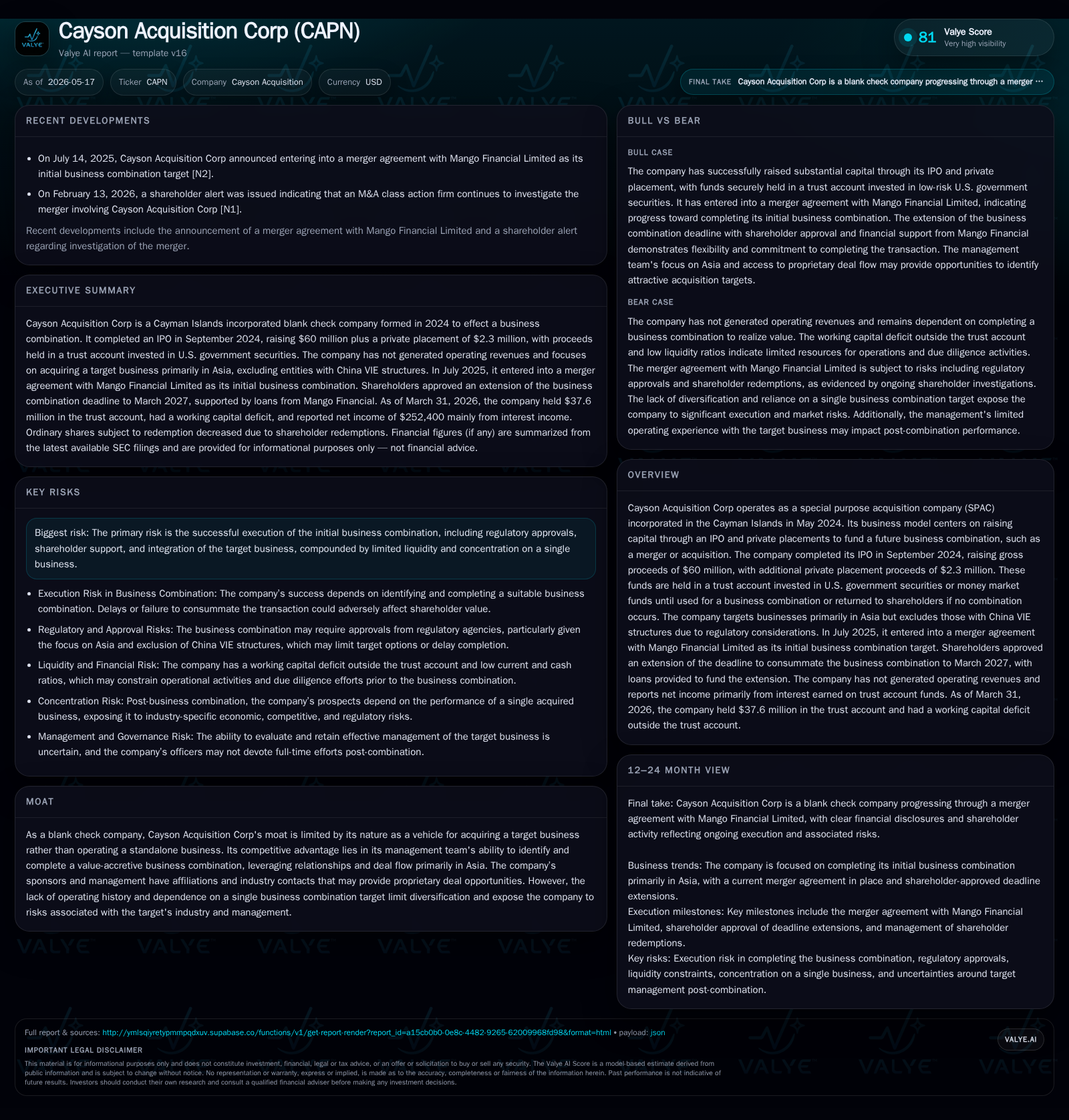
Cayson Acquisition Corp (CAPN), a Cayman Islands-based blank check company focused on Asian targets, reported in its Q1 2026 filing that it is navigating critical operational and compliance milestones. The company holds $37.6 million in trust accounts earmarked for its business combination with Mango Financial Limited, with a looming deadline extension to May 23, 2026. Meanwhile, a Nasdaq minimum holders compliance issue requires a remedial plan by June 11, 2026. CAPN has no operating revenues yet and relies solely on interest from trust funds and capital contributions. With limited working capital outside the trust and ongoing redemptions, the successful consummation of its merger remains pivotal to its survival.
Recent Operating Update
In the first quarter ending March 31, 2026, Cayson Acquisition Corp (CAPN) continued its operations solely aimed at preparing for and executing an initial business combination. The company reported no operating revenues as anticipated for a SPAC vehicle pre-merger. The primary income was derived from interest earned on cash and investments held in its Trust Account, amounting to $545,855 during the quarter [S2], [S13]. Notably, CAPN faced substantial shareholder redemptions during the period, resulting in $27.4 million withdrawn from the trust account [S13]. Despite this outflow, CAPN replenished some funds via promissory notes from Mango Financial Limited as part of an agreement extending the deadline for consummating the business combination from April 23 to May 23, 2026 [S18].
Operating costs remain tightly managed given the company's limited cash reserves outside the trust. As of quarter-end, CAPN held only approximately $64k in unrestricted cash against working capital deficits approaching $1.35 million [S13], [F1]. This mismatch underscores ongoing liquidity pressures ahead of the merger closure.
Additionally, CAPN disclosed regulatory challenges related to Nasdaq's minimum total holders rule, receiving a notice requiring submission of a compliance plan by June 11, 2026 [S3]. Failure to satisfy these requirements risks delisting or necessitates further appeals.
Business Model Overview
Cayson Acquisition Corp operates as a special purpose acquisition company incorporated in May 2024 in the Cayman Islands. Its model is straightforward: raise capital through an IPO and private placements—totaling $62.3 million gross proceeds at inception—deposited into a U.S.-based Trust Account invested largely in government-backed securities or money market funds [S1], [S2].
With no standalone product or service offerings, CAPN’s value proposition depends entirely on successfully identifying and merging with or acquiring an operating Asian business that fits its investment criteria excluding entities utilizing China VIE structures due to regulatory risks [S1]. Revenue generation only begins post-combination through the target's operating activities.
Management's role centers on leveraging regional insights and sponsor networks—primarily CEO Yawei Cao and affiliates—to source proprietary deals and negotiate terms that create value for shareholders while complying with SPAC regulations. Interest income on trust funds represents the sole financial accrual pre-combination.
Industry Structure and Competitive Position
As a blank check entity participating in Asia-focused SPAC transactions, Cayson Acquisition Corp competes within an increasingly crowded SPAC ecosystem targeting emerging markets growth opportunities where access to capital markets can be restrictive for mid-sized private firms.
However, CAPN’s narrow geographic focus combined with explicit exclusion of Chinese VIE-structured entities reduces candidate pools versus more broadly targeted peers but aims to mitigate complex regulatory hurdles prevalent in mainland China acquisitions [S1]. This selective strategy may appeal to investors wary of opaque ownership frameworks but also limits scalability.
Competitively, success hinges on management’s deal origination capabilities and structural partnerships such as with Mango Financial Limited—the announced business combination target since July 2025 [S1]. Absence of an operating history or multiple candidates heightens concentration risk relative to rivals with diversified pipelines.
Growth Drivers
Growth for CAPN is non-organic; it depends almost exclusively on consummating one or more strategic mergers or acquisitions within its defined parameters. Key drivers include:
- Timely Completion of Initial Business Combination: The foremost gatekeeper to growth; executing this by May 23 leverages nearly full Trust Account capitalization toward a viable operating company.
- Retention of Public Shareholder Confidence: Managing redemption levels is critical since excessive redemptions dilute transaction funding capacity.
- Regulatory Compliance & Approvals: Successfully navigating Nasdaq listing rules and any jurisdictional clearances safeguards continuity.
- Sponsor Capital Contributions: Promissory note extensions demonstrate sponsor willingness to support liquidity shortfalls preventing premature wind-down.
- Target Business Quality & Scalability: The merged entity’s operational strength will determine post-combination growth potential beyond static capital deployment.
Each driver maps directly into quantifiable KPIs such as remaining Trust Account balance post-redemptions ($37.6 million at Q1-end), shareholder approval votes (pending proxy), regulatory filings timetable (plan due June), and sponsor funding tranches ($125k increments) [S13], [S18].
Risks and Constraints
Several material risks temper CAPN’s outlook:
- Business Combination Execution Risks: Delay or failure in closing with Mango Financial Limited or alternative targets could trigger liquidation protocols as mandated by governing documents.
- Nasdaq Listing Compliance Risk: Non-acceptance of remediation plans could lead to delisting proceedings impacting investor liquidity.
- Liquidity Strains: Limited unrestricted cash relative to liabilities poses challenges for due diligence expenses and day-to-day operations prior to deal closure [F1], [S2].
- Concentration Risk: Dependence on single merger candidate concentrates industry-specific operational risks.
- Regulatory Hurdles: Acquisitions involving Asian jurisdictions require clearances which may not be obtained timely or at all [S1].
- Market Sentiment Volatility: SPAC valuations remain sensitive to broader market conditions affecting public shareholder redemption rates.
Mitigation efforts appear focused on securing incremental financing support from sponsors and adhering closely to regulatory deadlines.
What To Watch Next
Key upcoming value inflection points include:
- Submission of Nasdaq Minimum Holders Remediation Plan: Due June 11, determining ongoing listing viability [S3].
- Consummation Deadline Extension & Finalization of Business Combination: Scheduled by May 23; confirmation will pivot CAPN into an operating entity phase [S18].
- Shareholder Voting Outcomes: Proxy solicitation materials and votes expected imminently influencing merger approval prospects.
- Trust Account Balance Movements Post-Merger Announcement: Monitoring potential further redemptions impacting deal funding viability.
- Ongoing Sponsor Capital Infusions: Additional promissory note placements would bolster operational runway if needed.
Timely execution along these dimensions will define whether CAPN transcends its blank check status into an active industry participant.
Financial Profile (Q1 Ending March 31, 2026)
Latest financial snapshot
| Metric | Value | Period |
|---|---|---|
| Current assets | $126960 | |
| 2026-03-31 | ||
| Current liabilities | $1478867 | |
| 2026-03-31 | ||
| Current ratio | 0.09x | |
| 2026-03-31 |
Source: SEC companyfacts cache [F1].
FY Ending |
The stark working capital deficit reflects normal SPAC pre-combination dynamics where obligations related to setup costs outpace accessible current assets outside escrowed funds held pending merger completion. Trust account monies remain legally restricted but financially crucial as merger consideration pools.
Disclaimer
This analysis summarizes publicly available information without providing investment advice or recommendations. Investors should conduct their own due diligence considering all risks before any transactions involving Cayson Acquisition Corp stakes.
Disclaimer: This is research-only, informational analysis and not investment advice. It may include AI-generated interpretation and general industry context. Always verify important details using primary sources.

Comments