
Cambridge Acquisition Corp. Eyes Target Deals With Expanding Capital Flexibility
The company’s recent quarterly filing reveals a strong capital position, supporting its mission to secure an initial Business Combination in targeted innovative sectors.
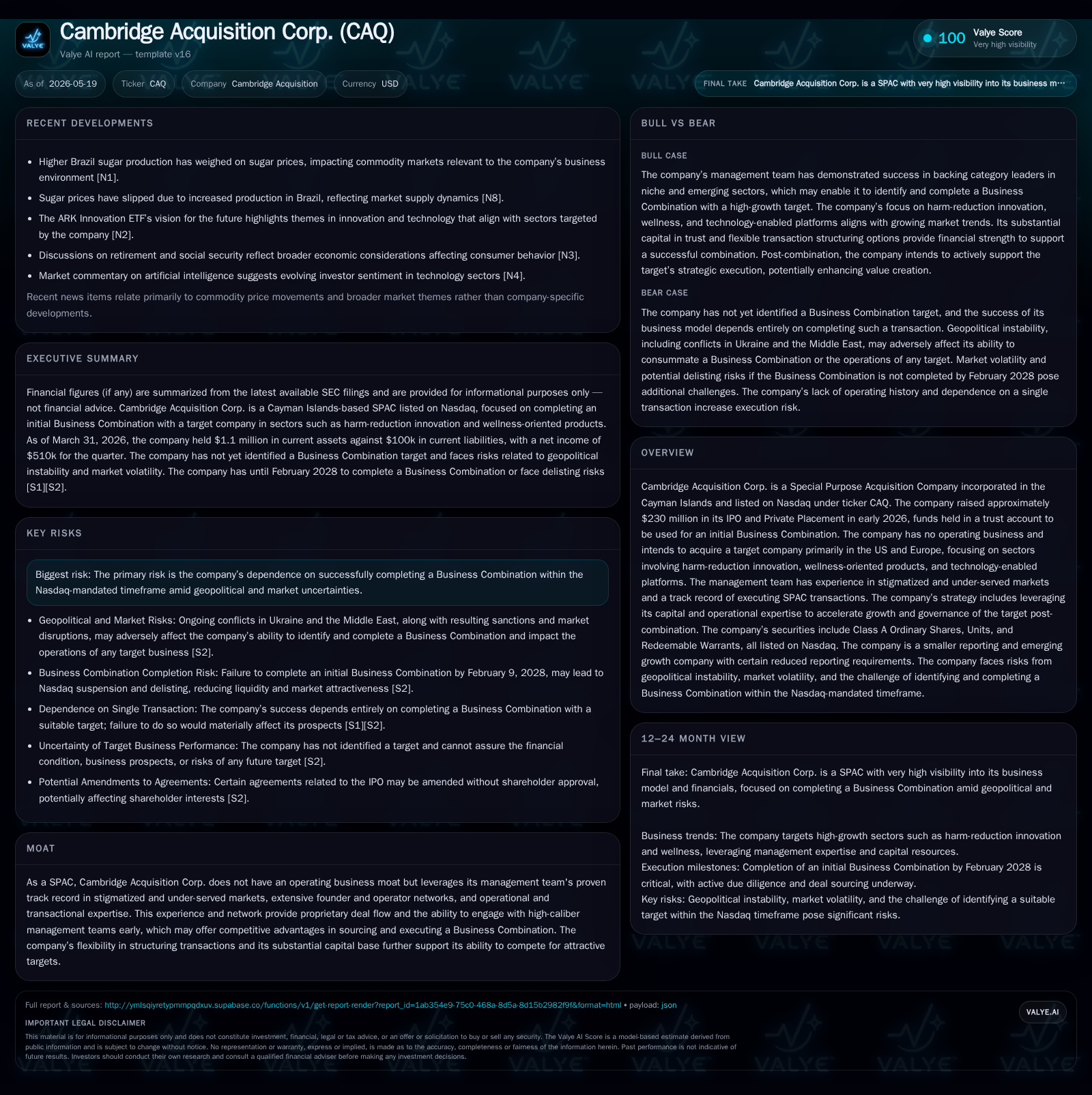
Cambridge Acquisition Corp., a SPAC formed in late 2025, reported in its May 2026 10-Q a robust balance sheet with approximately $1.1 billion in current assets against minimal liabilities, reflecting its trust account holding IPO proceeds for acquisitions. Since March 2026, the components of its units—Class A Ordinary Shares and redeemable warrants—have traded separately, enhancing liquidity dynamics. The company leverages an experienced management team focused on harm-reduction, wellness, and technology platforms to identify high-growth targets primarily in the U.S. and Europe. Key risks include geopolitical tensions impacting markets and compliance with Nasdaq deadlines for consummating a deal. Near-term milestones depend on announcements of initial Business Combination talks and investor response to the separate trading of securities.
Latest Quarterly Update Highlights
Cambridge Acquisition Corp.’s May 15, 2026 (10-Q) filing confirms its solid financial foundation as it pursues an initial Business Combination. Current assets total approximately $1.1 billion compared with current liabilities near $100 thousand, resulting in a high current ratio of about 10.93—reflecting IPO proceeds held primarily in trust accounts designated for acquisition purposes [F1]. Operating income remains negative at approximately $251 thousand due to ongoing administrative costs typical for blank-check entities yet to complete a transaction [F1].
Since March 30, 2026, the company’s Units have been separated into their components—Class A Ordinary Shares and redeemable warrants—which now trade independently. This structural change introduces new liquidity dynamics and pricing flexibility for investors [S2], [S3].
Business Model Overview
As a Special Purpose Acquisition Company (SPAC), Cambridge Acquisition Corp. currently operates without revenue-generating business activities [S1]. It raised approximately $230 million via its February 2026 IPO plus private placements; these funds are held largely in trust pending completion of a Business Combination with a target company
The original Units comprised one Class A share plus one-third of one redeemable warrant; post-March 2026 separation allows investors more granular control over their investment components [S3]. Founder shares owned by insiders align incentives but may dilute public shareholders upon conversion during the Business Combination process [S1].
The company retains flexibility to consummate its acquisition using cash from the trust account supplemented by potential debt or equity financing structured according to target needs. However, no binding third-party financing has been secured to date [S16]. Nasdaq rules impose a deadline within roughly two years from IPO to complete the transaction.
Industry Position and Competitive Context
CAQ distinguishes itself among SPACs through sector specialization targeting harm reduction innovations (e.g., alternative nicotine delivery), wellness-focused product franchises (functional botanicals), and technology-enabled platforms—all sectors experiencing cultural shifts and regulatory evolution that have historically limited institutional investment but now offer growth opportunities [S14].
The management team’s depth of operational experience across stigmatized or emerging markets generates proprietary deal flow opportunities less accessible to competitors relying solely on capital scale or sponsor profile. This network-driven sourcing capability is a competitive advantage within an increasingly crowded SPAC market [S10], [S14].
Flexible deal structuring options combining cash, stock or debt allow customized transactions aligned with seller preferences.
Management Expertise as a Strategic Asset
Leadership includes executives who have founded category-defining companies and navigated public market transitions via prior SPAC transactions. Their expertise spans nascent sectors like hemp-derived consumables and psychedelics where regulatory complexity requires nuanced engagement.
This founder/operator network facilitates early access to promising targets while enabling active post-close operational support aimed at value creation beyond capital infusion.
Potential conflicts arising from founder share ownership or multiple SPAC affiliations are transparently disclosed with governance safeguards in place [S18].
Growth Drivers: Secular Trends Supporting Target Sectors
CAQ targets macro-level secular themes reshaping trillion-dollar legacy markets driven by consumer health consciousness and regulatory reforms:
- Harm Reduction: New technologies reducing risks associated with tobacco/nicotine use.
- Wellness Products: Functional botanicals capturing preventive health demand.
- Technology Platforms: Digital ecosystems enabling innovative lifestyle services.
These areas benefit from improving legal clarity and diminishing stigma which historically constrained institutional investment but now support premium valuations if effectively executed post-Business Combination [S14].
Risks: Geopolitical Volatility and Execution Challenges
Geopolitical tensions involving Russia/Ukraine conflicts and Middle East instability pose risks by disrupting capital markets critical for identifying targets or financing acquisitions [S2]. Commodity price volatility adds economic uncertainty.
Additional challenges include:
- Regulatory uncertainty around novel sectors like psychedelics or hemp derivatives.
- Sponsor conflicts potentially attracting shareholder scrutiny.
- Nasdaq-imposed deadlines creating time pressure; failure to complete a combination leads to liquidation.
- Absence of announced targets leaves execution risk inherent with potential unprofitable acquisitions or integration difficulties [S2], [S22].
Watchpoints: Transaction Progress and Market Response
Investors should monitor announcements regarding potential target engagements or formal Business Combination agreements. Shareholder vote outcomes will signal investor appetite.
Market reaction following separate trading of units’ components—especially warrant valuation versus ordinary shares—will provide insights into merger timing expectations and perceived quality [S3], [S2].
Proxy activity or activist interventions may arise as governance oversight intensifies across the SPAC landscape.
Financial Overview Supporting Transaction Readiness
Financially, CAQ exhibits typical pre-combination characteristics: cash-like current assets approximating $1.095 billion significantly exceed nominal liabilities near $100 thousand as of March 31, 2026—funds primarily held for acquisition purposes within trust accounts [F1]. Operating expenses produce net operating loss around $251 thousand reflecting administrative overhead without revenue generation yet standard for blank-check entities pre-deal closure [F1]. Total debt remains modest at about $106 thousand recorded at year-end 2025 indicating limited leverage burden supporting strategic optionality ahead of transaction execution [F1].
This analysis synthesizes Cambridge Acquisition Corp.’s latest SEC disclosures within the context of SPAC industry dynamics targeting disruptive sectors. It highlights how the company's current financial strength aligns with both growth opportunities and execution risks amid evolving geopolitical conditions without providing investment advice.
Disclaimer: This is research-only, informational analysis and not investment advice. It may include AI-generated interpretation and general industry context. Always verify important details using primary sources.

Comments