
Coastal Financial's Dual-Engine Growth: Community Banking Meets BaaS Innovation
Coastal Financial blends its leading regional community bank franchise with a rapidly growing banking-as-a-service platform to sustain earnings growth amid evolving credit and operational dynamics.
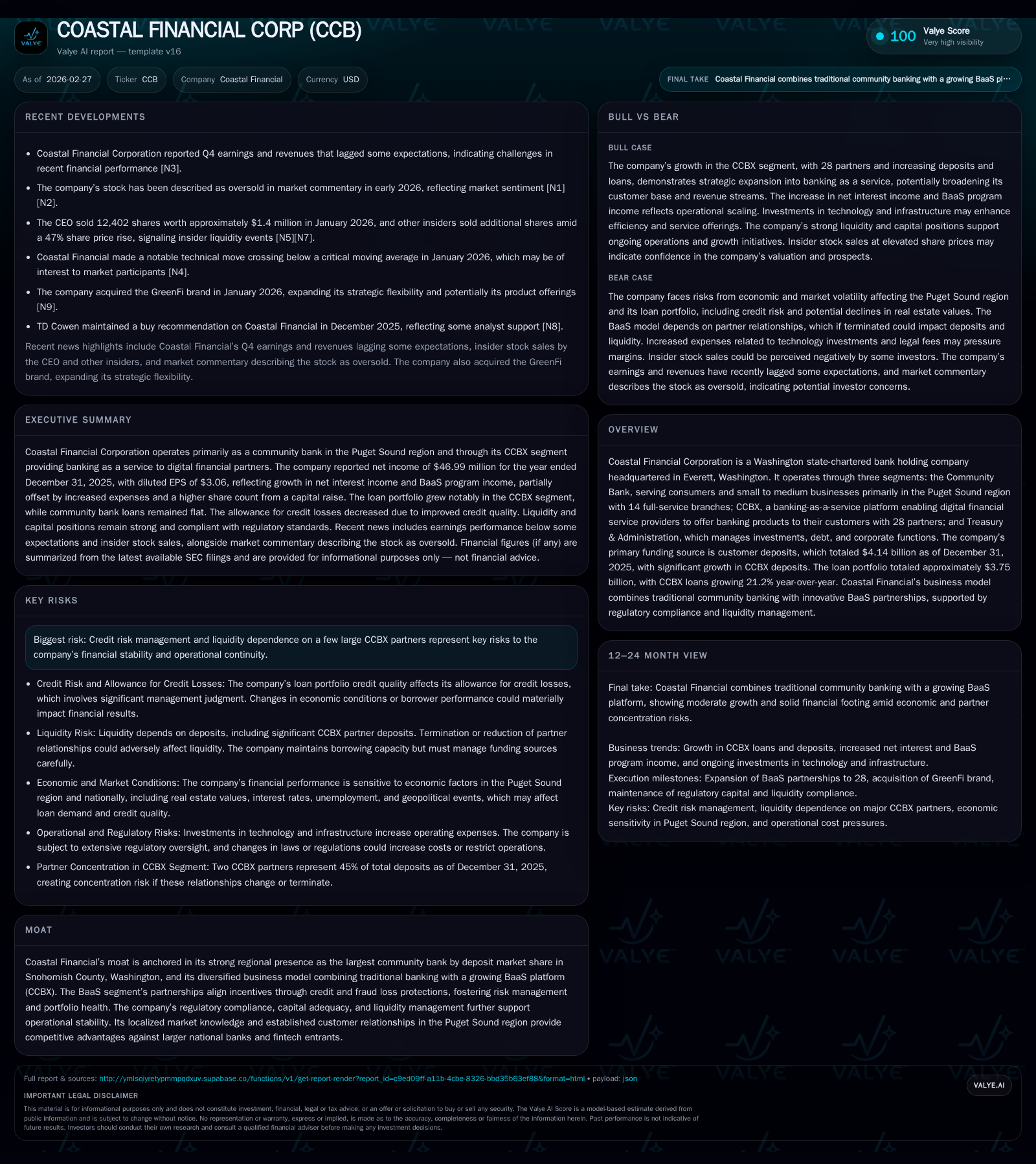
Coastal Financial Corporation leverages its position as the largest community bank by deposit market share in Snohomish County, Washington, to support consistent earnings while expanding its BaaS platform, CCBX, which recently maintained 28 partners and delivered over 21% loan growth year-over-year. Despite a modest 3.9% net income increase in FY2025, the firm navigates operational margin pressure driven by elevated expenses in CCBX and reduced credit enhancement income. Its capital structure remains robust, supporting an approximate 9.6% return on equity and generating strong free cash flow. Key risks include concentration exposures within CCBX partners and liquidity dependency that management actively monitors.
Historic Performance Highlights: Steady Earnings Amid Accelerating BaaS Growth
Coastal Financial Corporation posted net income of approximately $47.0 million for fiscal year 2025, marking a year-over-year increase of around 3.9% from $45.2 million in the prior year [F1]. This gain reflects steady underlying growth primarily driven by expansion in the CCBX platform alongside traditional community banking operations.
Operating cash flows declined slightly by roughly 2%, from $259.8 million in FY2024 to $254.6 million in FY2025 [F1]. The company reduced capital expenditures by nearly 15%, allocating $8.4 million versus $9.9 million previously—a measured approach consistent with investment scaling and infrastructure deployment to support BaaS growth.
Meanwhile, total equity rose significantly, from approximately $438.7 million at year-end 2024 to nearly $491.0 million at the close of 2025, signaling a solid capital base underpinning ongoing operations [F1]. Combining net income and equity data yields an approximate return on equity (ROE) near 9.6%, underscoring solid profitability despite margin pressures (see Table below).
Historical performance (annual)
| FY | Net ($mm) | CFO ($mm) | Capex ($mm) | Net YoY |
|---|---|---|---|---|
| 2025 | 47 | 255 | 8 | +3.9% |
| 2024 | 45 | 260 | 10 | +1.4% |
| 2023 | 45 | 197 | 6 | +9.7% |
| 2022 | 41 | 67 | 3 |
Source: SEC companyfacts cache [F1].
Capital returns and efficiency (annual)
| FY | FCF ($mm) | ROE% |
|---|---|---|
| 2025 | 246 | 9.6 |
| 2024 | 250 | 10.3 |
| 2023 | 190 | 15.1 |
| 2022 | 64 | 16.7 |
Source: SEC companyfacts cache [F1].
The sustained net income trajectory stems partly from Coastal's expanding deposit franchise and strategic loan book growth within the BaaS segment (CCBX).
Segment-Specific Drivers: Community Bank Stability vs CCBX Scaling Dynamics
Coastal Financial operates three primary segments: the Community Bank serving the Puget Sound region via fourteen full-service branches; the high-growth CCBX banking-as-a-service platform; and Treasury & Administration which handles corporate financial functions [S5], [S6].
The Community Bank maintains dominance as the largest community bank by deposit market share in Snohomish County with twelve branches located there plus two nearby branches [S6]. This segment provides stability through traditional consumer and small-to-medium business banking products.
In contrast, the CCBX segment has maintained twenty-eight active partners as of December 31, 2025—sustaining its expanded footprint—and recorded loans growing over twenty-one percent year-over-year across all segments [N1], [S5]. Deposits surged to approximately $4.14 billion with notable concentration under two large partners comprising about forty-five percent of total deposits [S11], [S16].
CCBX revenue drivers include credit enhancement income arising from indemnity arrangements where partners protect Coastal against credit losses—a significant risk mitigation feature [S18], [S25]. However, reduced credit enhancement income contributed partially to margin pressure in FY2025 alongside higher operating expenses incurred for loan servicing and fraud management related to growing BaaS activity [S25].
Indirect expense allocations between segments consider metrics such as employee headcount and asset balances while transfer pricing mechanisms align intrabank interest income/expense flows among divisions ensuring segment results reflect economic realities within the firm [S6].
Market Position and Competitive Moat in Puget Sound Region
Coastal’s moat is tightly linked to its entrenched regional presence—especially within Snohomish County where it holds largest community bank deposit market share—providing deep local expertise that national banks or fintech entrants find difficult to replicate [S5].
This advantage is reinforced by Coastal’s conservative regulatory compliance framework coupled with capital adequacy comfortably above minimums ensuring operational stability [S23]. The firm benefits from customer intimacy fostered through longstanding relationships across its branch network plus digital reach.
Moreover, Coastal integrates risk monitoring aligned with partner incentives: BaaS partnerships involve credit loss protections where partners indemnify certain risks thereby creating aligned interests and bolstering portfolio health through shared downside management [S25]. Such structural risk sharing differentiates Coastal from peers purely reliant on loan origination economics.
Credit Quality and Concentration Risks in a Diversified Loan Portfolio
Despite diversification across consumer real estate, commercial loans, credit card exposures, and specialized capital call lines extended primarily through CCBX relationships, concentrations remain material risk factors for Coastal Financial [S12], [S24].
Specifically, two large CCBX depositors represent around forty-five percent of total deposits exposing liquidity risk if partner exits occur without sufficient notice or transition time [S16]. Likewise, commercial capital call lines totaling over $210 million are concentrated within venture capital funds collateralized by capital call rights—a niche exposure monitored through portfolio limits capped at contractual maximums e.g., $350 million for these loans [S10], [S24].
Management actively evaluates counterparty risks involving credit losses indemnified by partner agreements while maintaining allowance for expected credit losses on loans originated via CCBX reflecting prudence under prevailing interest rate volatility constrained environment [S18], [S25].
While no material losses on standby letters of credit occurred recently, regulatory scrutiny on commercial lending concentrations advises vigilance given evolving macroeconomic headwinds affecting commercial real estate values prevalent in Pacific Northwest markets served predominantly by Coastal’s Community Bank [S25], [S2].
Capital Management: Returns, Cash Flows, and Shareholder Distributions
Capital management remains robust with firm-level equity rising over eleven percent year-over-year reaching nearly half a billion dollars ($491M) at fiscal year-end reflecting both retained earnings accumulation and prior issuance proceeds—namely the December 2024 offering that raised $98 million net proceeds supporting growth opportunities [F1], [S23].
Regulatory ratios confirm "well-capitalized" status far exceeding minimum requirements across all key tiers such as Common Equity Tier I above twelve percent versus compulsory minimums near four percent plus buffers [S23].
Combined operating cash flow less capex translates into an estimated free cash flow near $246 million for fiscal year ended December 31, 2025 enabling financial flexibility for future investments or potential shareholder distributions absent explicit buyback disclosures as of filing date [F1], [S4].
Efficiency ratio increased materially from about forty-two percent (42%) to fifty-three percent (53%) mainly due to higher noninterest expenses linked to scaling BaaS administrative requirements including fraud prevention outlays balanced partially by increased net interest income but offset by declining credit enhancement income—all typical tradeoffs when fueling platform growth before economies of scale fully materialize [S25].
Operational Efficiency and Investment Priorities under Margin Pressure
The efficiency ratio deterioration reflects targeted investment ramp-up driven primarily by BaaS-related costs such as loan expense tied directly to partner service agreements plus personnel expense increases embedded across both segments as infrastructure expands capacity ahead of revenue catch-up expected longer term periods [S25].
Net interest margin remained relatively stable near seven percent (7%) whereas noninterest income trends shifted downward partly influenced by falling credit enhancement accounts totaling just over $47 million but negatively impacted compared to prior periods due to BaaS mix changes along with rises in fraud-related overheads.[F1],[S25]
Management articulates deliberate focus on balancing short-term margin compression risks with imperative infrastructure advances needed for competitive positioning especially addressing accelerated digital onboarding demands intrinsic to fintech partnership model evolution - striking compromises common within hybrid banking franchises embracing fintech ecosystems.[S25]
Future Growth Catalysts and Potential Constraints
Growth opportunities center on further expanding the CCBX partner base beyond current twenty-eight engagements while optimizing existing partnerships' portfolio utilization constrained under prudent maximum exposure limits per partner to mitigate concentration risks [N1], [N5], [N6], [N7].[N4] notes CEO's recent stock sales which could influence perceptions around near-term outlook or insider confidence.
Sector-specific challenges include managing evolving credit quality particularly within consumer real estate markets impacted locally combined with macroeconomic pressures such as fluctuating interest rates potentially dampening organic growth vectors or pressuring margins through cost of funds volatility.[N1], [S2]
Liquidity dependency on a few major CCBX partners underpins operational continuity risk requiring vigilant monitoring plans including contingency funding sources like Federal Home Loan Bank advances despite zero utilization during recent fiscal periods evidencing ample capacity available if shocks arise.[S7],[S8],[S16]
Regulatory dynamics concerning commercial lending concentrations intensify scrutiny further requiring calibrated portfolio management blending cautious expansion alongside rigorous underwriting standards.[S2],[S12]
Technological evolutions driving secular digital banking trends pose dual-edge dynamics offering new client acquisition potential but entail heightened competition from fintech pure plays challenging margin sustainability for hybrid operators like Coastal Financial.
Key Upcoming Milestones and Indicators to Monitor
Critical indicators will include quarterly deposit growth pace particularly within CCBX partners as a barometer of adoption velocity alongside developments on allowance for credit losses reported mitigating unexpected credit deterioration.[N1],[N7]
Investors should track subsequent quarter earnings releases following Q4 miss signaled in January reflecting whether cost control measures offset episodic investments underway.[N1]
Insider activity notably CEO sales aggregated near $1.4 million merits observation for shifts in executive sentiment or altered internal assessments.[N4]
Technical trading signals reporting oversold conditions could presage revaluation opportunities or indicate sentiment-driven pressure warranting attention alongside deposit concentration shifts impacting liquidity profiles.[N5],[N6],[N7]
Disclaimer: This is research-only, informational analysis and not investment advice. It may include AI-generated interpretation and general industry context. Always verify important details using primary sources.

Comments