
CERO Therapeutics Advances AML Immunotherapy Amid Capital and Regulatory Challenges
Clinical progress with lead candidate CER-1236 contrasts with persistent liquidity constraints and Nasdaq delisting struggles.
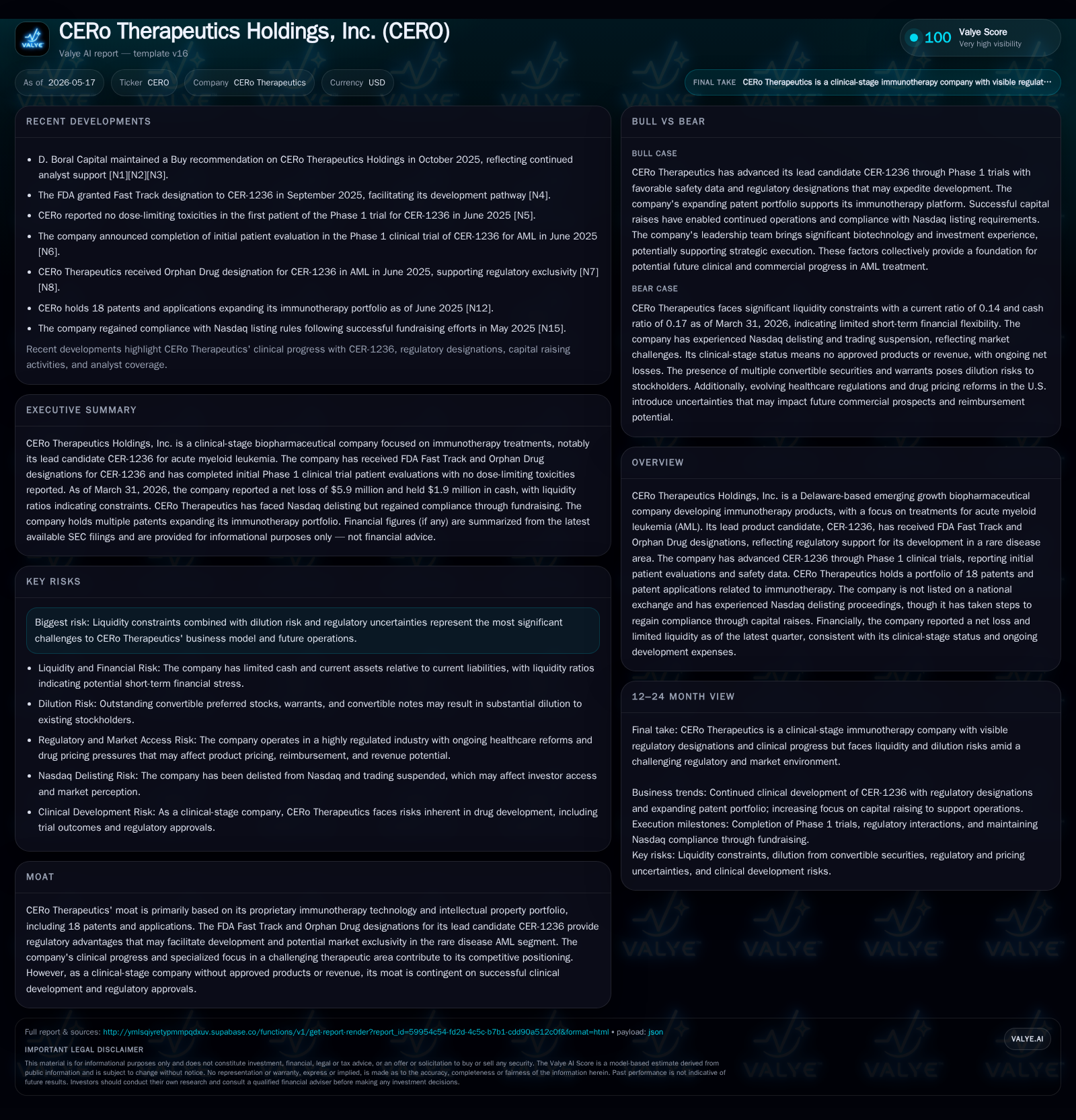
CERo Therapeutics Holdings, Inc., a clinical-stage immunotherapy biopharma focused on acute myeloid leukemia (AML), reported its latest quarterly update in May 2026. The company continues to develop its CER-1236 candidate, benefiting from FDA Fast Track and Orphan Drug designations, while navigating Nasdaq delisting and tight liquidity conditions. Its business model relies on advancing proprietary immunotherapies through costly clinical stages supported by an IP portfolio comprising 18 patents. Key growth catalysts hinge on successful product development and regulatory approvals, but risks abound from financing dilution, minimal current revenues, and healthcare reimbursement changes.
Recent Operating Update: April–May 2026
CERo Therapeutics' most recent quarterly filing dated May 15, 2026, provides insight into its operational environment as a clinical-stage biopharmaceutical company [S2]. Despite no revenue generation consistent with its early-stage status, the company is advancing its core immunotherapy program targeting acute myeloid leukemia (AML). The lead candidate CER-1236 holds FDA Fast Track and Orphan Drug designations reflecting regulatory support critical for rare disease drug development [S1]. Phase 1 clinical trial data reported highlight initial patient safety assessments including a noteworthy platelet transfusion-free interval in a patient with overlapping myelodysplastic syndrome/AML [S5]. This preliminary efficacy signal reinforces the therapeutic potential but subsequent trial phases remain necessary.
Liquidity challenges persist as evidenced by a cash balance of approximately $1.9 million reported at end-September 2025 and continuing working capital deficits highlighted by a current ratio of about 0.14 as of March 31, 2026 [F1]. The firm’s total debt remains low ($137k) but current liabilities exceed $11 million reflecting accrued expenses, deferred costs related to ongoing trials, and possibly convertible security obligations [F1]. To manage runway constraints, CERO has issued several convertible promissory notes during early 2026 totaling in the millions across multiple tranches with Keystone Capital Partners LLC bearing substantial conversion rights around $0.05 per share or discounted recent market prices [S8],[S11],[S16],[S19],[S24].
A significant corporate headwind is the effective delisting from the Nasdaq Stock Market following October 2025 panel decisions subsequently affirmed by the Listing Council in January 2026 [S20]. This disconnected CERO from more liquid capital markets complicating fundraising prospects though management continues efforts to restore compliant status. This context underscores an acute need for strategic financings to support continued operation.
Business Model
CERo Therapeutics operates as a pre-commercial biopharmaceutical developer specializing in immuno-oncology treatments focused primarily on AML. Its revenues are nonexistent at present; instead, value creation hinges entirely on research & development progression backed by patent protection. The company's intellectual property estate includes 18 patents/applications concentrated on novel immunotherapeutic mechanisms [S1]. Revenue mechanics are contingent upon successful regulatory approvals leading to commercialization or out-licensing agreements once sufficiently advanced clinical data is available.
The lengthy timeline inherent in oncology drug development means recurring R&D expenditure drives operating losses until one or more product candidates can generate marketable sales. Consequently, CERO’s financial strategy revolves around equity issuance combined with convertible debt instruments that dilute existing shareholders but provide immediate working capital [S2], [S3]. Its product pipeline primarily orbits CER-1236; thus pipeline diversification is limited which concentrates risk.
Pricing power post-approval could benefit from orphan drug exclusivity given AML's rarity; however, evolving government healthcare policies like Medicare negotiation programs introduced under Inflation Reduction Act variants could compress long-term pricing if broader indications emerge or orphan-dedicated protections shift [S23]
Industry Structure and Competitive Position
The immunotherapy space targeting hematological malignancies is both scientifically complex and intensely competitive — populated by established pharmaceuticals with marketed CAR-T therapies (e.g., Novartis’ Kymriah) plus a host of mid-sized biotech firms pursuing novel modalities. Unlike large integrated firms leveraging broad oncology portfolios and commercialization infrastructure, CERo Therapeutics is focused narrowly on early-stage research requiring successful milestone achievements to attract partners or acquirers.
The FDA Fast Track and Orphan Drug designations confer tangible competitive advantages enabling potentially expedited clinical development timelines and market exclusivity upon approval [S1]. Yet these must translate into meaningful clinical benefits demonstrable via robust later-phase trials before CERo can secure commercial foothold.
Capital markets scrutiny due to delisting curtails external validation commonly benchmarked among peers public on NASDAQ or NYSE. This dynamic arguably places additional pressure on CERo's management execution relative to better-capitalized competitors.
Growth Drivers
- Successful Clinical Progression: Demonstrating safety/efficacy in Phase 2/3 trials for CER-1236 is pivotal. Positive trial outcomes serve as launchpads for regulatory filings.
- Regulatory Advantages: Leveraging Fast Track pathways minimizes review timelines potentially accelerating market entry in AML’s underserved population.
- Intellectual Property Protection: Maintaining and expanding patent coverage fortifies barriers against biosimilar competition aiding longer-term market exclusivity.
- Strategic Partnerships: Collaborations or licensing deals could inject non-dilutive capital, broaden development expertise, or improve commercialization capabilities.
- Healthcare Policy Adaptation: Navigating evolving drug pricing reforms while exploiting orphan drug exemptions will shape pricing models and reimbursement negotiations.
Risks / Watchpoints / Growth Constraints
What to Watch Next
Investors should track several critical operational milestones:
- Updates on Phase 1 or initiation/completion of subsequent clinical phases for CER-1236 potentially yielding early efficacy/safety data [N/A - implied by filings].
- Announcements regarding additional financings or amendments/conversions under existing promissory notes that affect liquidity runway duration.
- Any progress in Nasdaq compliance measures or alternative listing attempts impacting capital market access.
- Expansion of intellectual property portfolio reflecting ongoing innovation efforts.
- Management commentary addressing regulatory landscape shifts specifically affecting orphan drug pricing eligibility following recent federal healthcare laws application nuance [S23]
Financial Profile Contextual Summary
Latest companyfacts data reveal operating losses continue without revenue generation aligned with a developmental-stage biopharma profile (operating income negative $15m+ as per prior annual filings) [F1],[S1]. Cash reserves are limited ($1.9 million at Sept-end), drastically trailing current liabilities exceeding $11 million at quarter-end Mar ‘26—indicating urgent funding requirements [F1]. Total debt remains modest ($137k) but recent issuance of convertible promissory notes introduces complex conversion rights with discounted share prices below recent trading levels — a tactic aimed at extending runway while risking shareholder dilution substantially [S8][S16][S19][S24]
In summary, CERO Therapeutics remains a high-risk/high-reward clinical-stage biopharmaceutical endeavor centered around innovative AML immunotherapy development but grappling with severe liquidity stress and market access challenges amid an evolving regulatory environment.
Disclaimer: This is research-only, informational analysis and not investment advice. It may include AI-generated interpretation and general industry context. Always verify important details using primary sources.

Comments