
ChampionsGate Acquisition Faces Time and Liquidity Pressure Ahead of Initial Business Combination Deadline
As a SPAC with no operating history, ChampionsGate Acquisition Corp's value hinges on completing its initial business combination before liquidity constraints intensify.
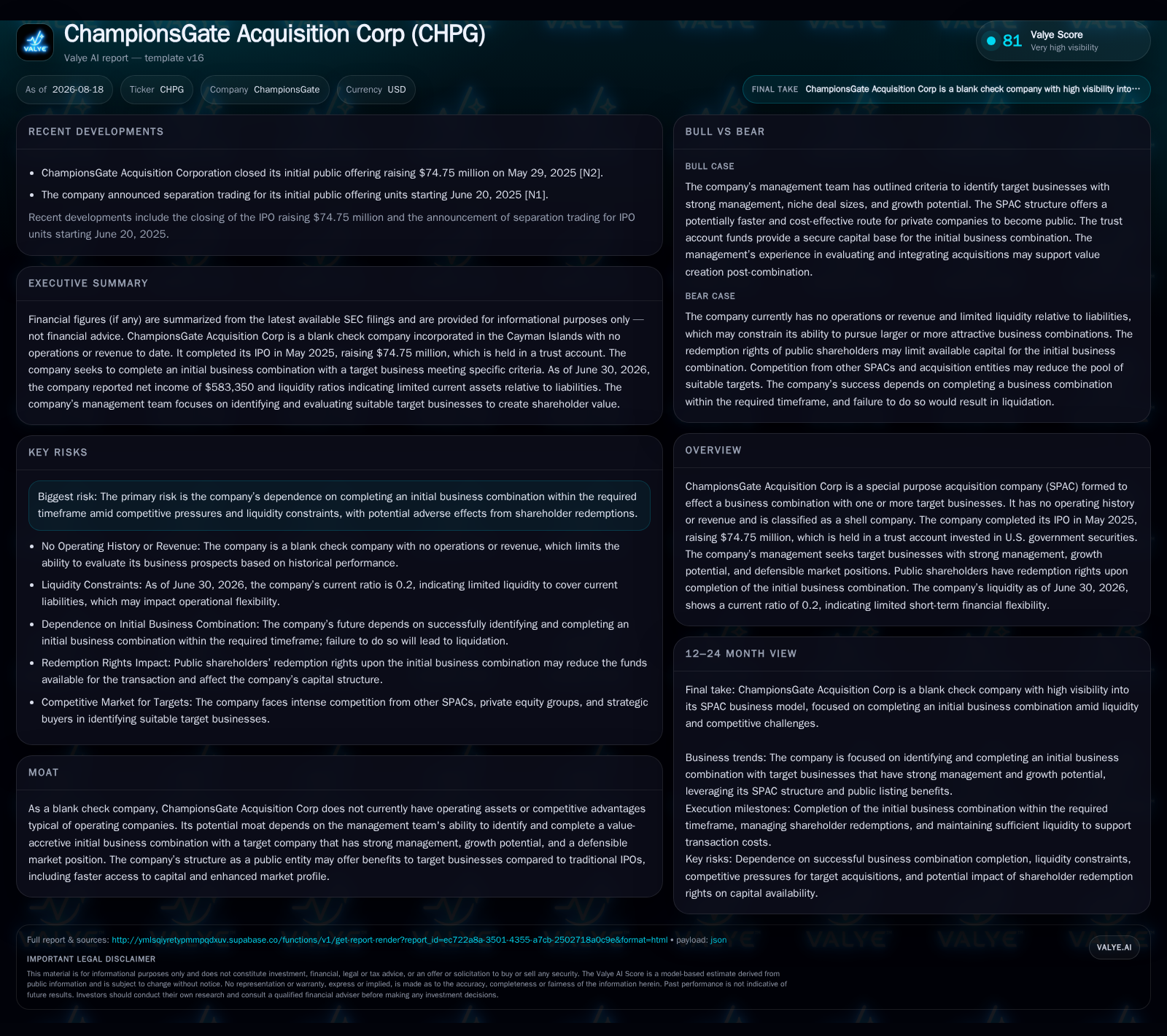
ChampionsGate Acquisition Corp (CHPG) is a blank check company formed to merge with or acquire private businesses and take them public. Having raised $74.75 million in its May 2025 IPO held in a trust account, the company remains pre-combination with no revenue or operations. Its latest quarterly filing highlights a current ratio of 0.2 as of June 30, 2026, revealing tight short-term liquidity and increasing pressure to complete a qualifying business combination by the November 2026 deadline. The company's competitive positioning depends heavily on management’s ability to identify targets amid an intensifying SPAC market and investor redemption risk. Given these constraints, monitoring trust account balances, shareholder redemption rates, and timing toward the combination deadline will be critical demand markers.
Recent Operating Update
nsor loans or other infusions for day-to-day expenses.
The looming deadline to complete an initial business combination—currently scheduled for November 29, 2026—adds acute time pressure [S1]. Failure would require liquidation and return of trust funds to investors at approximately $10 per share but with warrants expiring worthless [S24]. Management may seek to extend this deadline until August 29, 2027 if charter amendments are approved; however, this is uncertain and adds complexity to deal negotiations [S24].
Business Model and Offering Overview
ChampionsGate Acquisition Corp operates as a blank check company formed under Cayman Islands law primarily to raise capital through an IPO issuance of units consisting of one Class A ordinary share plus fractional warrants exercisable post-combination [S1]. The IPO raised gross proceeds of $74.75 million at $10 per unit in May 2025 along with a $2.3 million private placement sold to Sponsor HoldCo [S1]. Under the SPAC model archetype, these proceeds are placed into a segregated trust account invested conservatively pending identification and completion of an acquisition or merger with one or more private companies that collectively constitute the "initial business combination" [S6]. Revenue is not generated pre-combination; rather value accrues based on management’s skill in sourcing attractive targets that can be public-listed via merger with the SPAC vehicle.
Monetization arises post-combination through equity stakes retained by sponsors from founder shares or warrants issued alongside IPO units; sponsor upside depends on successful deal closing and subsequent appreciation in market value of combined enterprise shares. The company’s economics also depend on managing redemption rights held by public investors who may elect cash-out upon deal announcement—creating dilution or financing strain depending on redemption rates [S16]. The SPAC structure provides target companies benefits over traditional IPOs including shorter transaction timelines, reduced underwriting fees, greater valuation flexibility via negotiation rather than fixed price offerings, and access to sponsor expertise [S6].
Industry Structure and Competitive Position
ChampionsGate occupies the upstream end of capital formation within the SPAC sector ecosystem—acting as an intermediary connecting private target companies with public investors via de-SPAC transactions. Its peer set includes numerous other blank check companies taking similar approaches amid increased market supply of SPAC vehicles over recent years. Larger peers such as Pershing Square Tontine Holdings (PSTH) have demonstrated higher scale fundraising capabilities and broader deal sourcing networks but also face challenges around shareholder redemptions and regulatory scrutiny.
Competition for high-quality targets is intense given numerous active SPACs vying simultaneously amid sustained private capital availability from private equity firms and traditional IPO windows recovering unevenly due to macroeconomic volatility [S14]. This competition elevates acquisition costs risks and compresses potential equity returns offered through de-SPAC processes.
ChampionGate’s declared target criteria emphasize acquiring businesses with strong operational management teams capable of driving organic growth and strategic expansions either through follow-on acquisitions or improved cost structures; these businesses should enjoy defensible market positions near anticipated growth inflection points where public listing can unlock incremental value [S7]. This niche focus aims at balancing manageable deal sizes against compelling growth prospects—a prudent strategy given limited internal resources relative to larger competitors.
Growth Drivers
SPAC growth fundamentally ties to several macro drivers: (i) increasing demand among private firms seeking alternative public market routes to traditional IPOs amidst market uncertainty; (ii) investor appetite for exposure to emerging growth sectors via public vehicles offering embedded warrants alongside equity shares; (iii) favorable regulatory frameworks supporting SPAC operations while adapting disclosure requirements; and (iv) innovation in deal structuring enabling sponsor incentives alignment.
For ChampionsGate specifically, successful growth depends on timely identification and closure of attractive combinations leveraging its management team’s experience evaluating synergy potentials between targets and post-transaction operational efficiencies [S7]. Progress will be measured in evaluating multiple candidate targets rigorously while balancing shareholder redemption dynamics that influence net capital available for purchase consideration.
Risks and Watchpoints
The critical risk for ChampionsGate lies in completing an initial business combination before the contractual deadline amid liquidity constraints manifested by its current low current ratio (0.2) [F1]. Escalating operating costs relative to limited liquid working capital outside the trust account amplify dependency on sponsor loans for continuation funding—introducing execution risk if additional financing proves challenged.
Further risks include:
- Shareholder redemptions reducing funds available for acquisition financing potentially forcing suboptimal deals or prioritizing smaller targets closer to liquidity thresholds [S24].
- Competitive pressures driving up acquisition prices reducing equity uplift potential.
- Sponsor-management conflicts arising from incentives skewed towards transaction completion versus maximizing long-term shareholder value.
- Regulatory developments tightening disclosure rules impacting deal attractiveness or timing.
- Market volatility affecting post-combination stock performance undermining investor confidence post-de-SPAC.
Each risk intertwines with governance mechanisms such as shareholder vote protocols or tender offer redemptions affecting deal viability. Monitoring redemption levels ahead of votes will provide leading insight into possible financing shortfalls.
What To Watch Next
Key near-term milestones include:
- Updates on target evaluation progress or announcement thereof indicating tangible pipeline health.
- Trends in public shareholder redemption intentions around proposed combinations indicating net capital impact.
- Any charter amendment proposals extending timeframes beyond November 29, 2026 signaling increased urgency/pressure internally.
- Sponsor loans or private placements disclosed evidencing supplemental liquidity measures supporting ongoing operations.
- Changes in regulatory environment affecting SPAC transactions broadly impacting procedural timeline expectations.
Operational KPIs such as number of active target screens ongoing alongside perceived valuation metrics shape understanding management’s ability to execute effectively under constraints. Timing relative to deadlines will highlight if transaction terms may skew favorably towards sellers leveraging impending dissolution risk.
Financial Profile Discussion
As reflected in its June 30, 2026 balance sheet snapshot, ChampionsGate has total current assets including primarily cash-like items at approximately $70,700 against current liabilities exceeding $356,000 producing a notably low current ratio close to 0.2 [F1]. This financial profile exemplifies typical pre-combination liquidity pressures many small-scale SPACs encounter after sustaining operating costs without revenue inflows. The bulk of capital raised remains sequestered within the trust account ($74.75 million) held separately from general corporate use but inaccessible until combination completion conditions are met or liquidation triggered [S1, S6].
Operating income was negative $603,185 as of December 31, 2025 reflecting ongoing administrative expenses without offsetting revenues [F1]. The company recorded positive net income during that period due to certain non-operating items totaling approximately $1.17 million but this does not reflect sustainable profitability linked to core activities [F1].
Effective capital stewardship pre-combination centers around balancing outlays supporting target search efforts while preserving runway until transactional closure; failure risks triggering involuntary liquidation passing back principal amounts near IPO pricing minus fees subjecting warrants owned by sponsors/public shareholders to expiry worthless status [S24]
This analysis reflects information available as of mid-August 2026 based on SEC periodic filings without speculative assertions regarding future specific transaction outcomes or target identities. The risks inherent in blank check companies emphasize monitoring milestones biometric markers such as liquidity position evolution alongside external environment signals shaping viable deal flow opportunities for ChampionGate Acquisition Corp.
Disclaimer: This is research-only, informational analysis and not investment advice. It may include AI-generated interpretation and general industry context. Always verify important details using primary sources.

Comments