
ChargePoint Holdings: Navigating Challenges in the Expanding EV Charging Market
ChargePoint faces intensifying competition and operational hurdles amid a rapidly evolving electric vehicle charging industry.
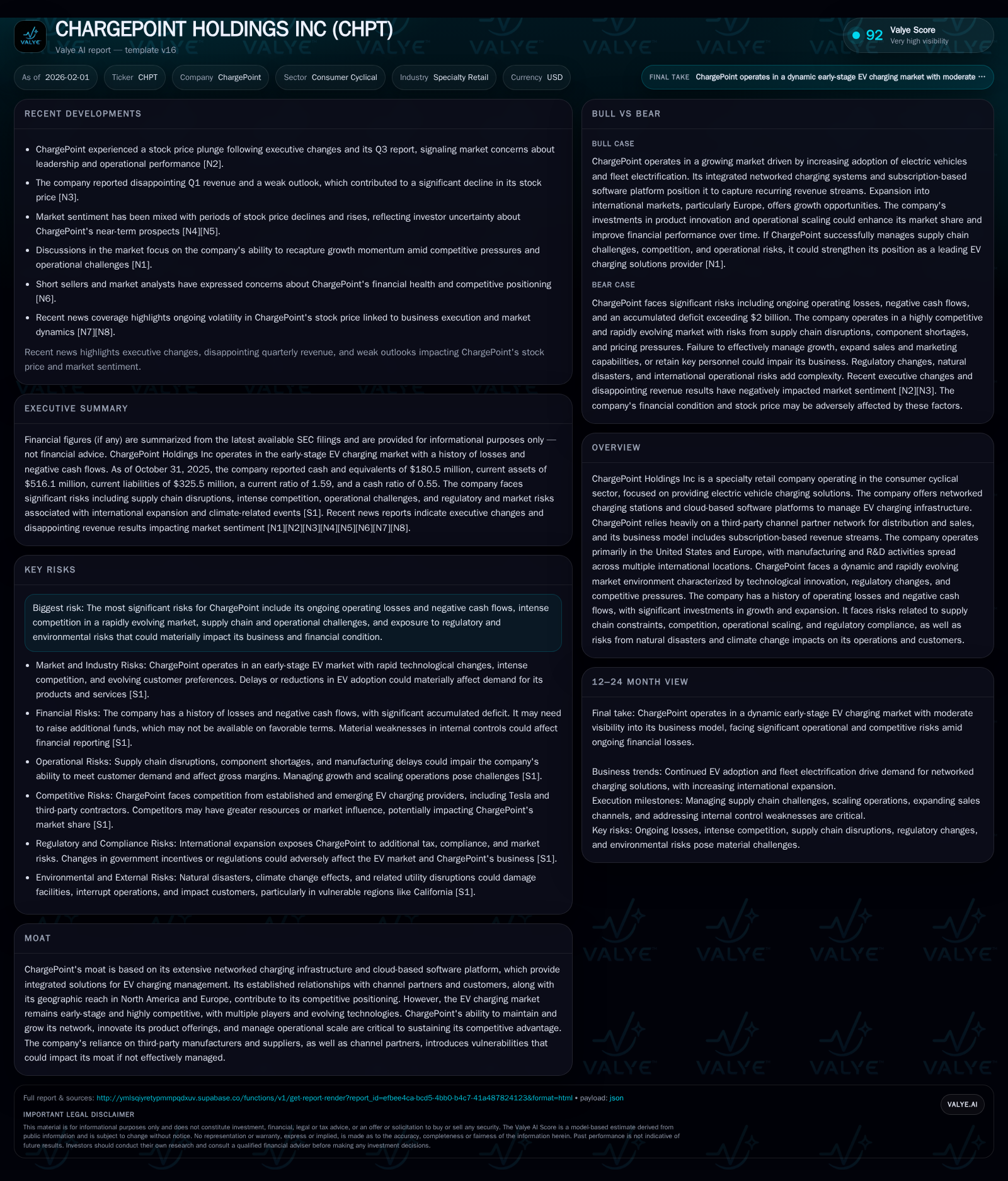
ChargePoint Holdings operates a comprehensive EV charging network and software platform but faces near-term headwinds including disappointing revenue results and a weak outlook that have pressured its stock. The company’s business model relies heavily on a third-party channel partner network and supply chain stability, both of which are sources of operational risk. Industry competition is fierce, with both legacy charging providers and new entrants pushing innovation and scale. ChargePoint’s ability to improve unit economics, secure channel commitment, and manage supply chain challenges will be critical in converting market opportunity into sustainable profitability.
What Changed Recently
ChargePoint reported disappointing first-quarter results that fell short of revenue expectations, accompanied by a cautious outlook for the remainder of the year. This triggered a notable drop in the stock price as investors reacted to the company’s inability to recapture prior growth momentum [N2][N3]. The earnings miss was compounded by concerns about execution risks, particularly in the sales channel and supply chain. Previous quarters also saw volatility around executive changes and operational reorganizations intended to curb costs and improve efficiency [N8]. Despite these efforts, the market’s reaction indicates skepticism about near-term scalability and profitability.
Business Model as a System
ChargePoint operates a networked EV charging system comprising hardware charging stations and a cloud-based software platform to manage infrastructure and customer usage. Its primary revenue streams are generated through sales of charging stations and recurring subscription fees for software management and services. The company’s go-to-market approach is predominantly indirect via a network of third-party channel partners — distributors and resellers — who market and sell ChargePoint’s solutions to end customers, complemented by a direct sales force [S1][S3][S5].
This multi-layered distribution relies heavily on channel partners’ commitment and effectiveness, which introduces risk if partners prioritize competing solutions or fail to scale sales adequately. ChargePoint invests significant resources in training and supporting these partners, but returns on this investment are not guaranteed [S1][S5].
Manufacturing is outsourced to a limited set of suppliers, sometimes single-source, which makes ChargePoint vulnerable to supply chain disruptions, component shortages, and increased costs. Lead times for components can be lengthy, and prior inventory management challenges have led to write-downs [S2][S8][S10].
International operations extend the business complexity, with R&D centers across India, Europe, and North America supporting product adaptation and innovation. However, geographic expansion exposes ChargePoint to multiple regulatory, tax, and compliance risks, alongside cultural and operational challenges [S4][S7].
The company also dedicates substantial expenditures to R&D to stay competitive technologically and to develop new products aligned with evolving customer and regulatory requirements. These investments, while necessary, pressure profitability and require efficient execution to generate future returns [S15][S16].
Industry Map & Competitive Battlefield
ChargePoint operates within the burgeoning electric vehicle infrastructure market, which is characterized by rapid growth projections but intense competition. Key competitors include Tesla’s expanding supercharger network, which recently opened to non-Tesla vehicles, potentially reducing demand for third-party charging providers [S22]. Traditional utility companies, automotive OEMs, and tech firms are entering the space, often leveraging greater capital resources and scale advantages.
Competitive dynamics are shaped by:
- Technological Innovation: Faster charging speeds, interoperable networks, and integrated software services are differentiators.
- Distribution Reach: Wide geographic presence and strong channel partnerships are critical for customer acquisition.
- Pricing Pressure: Competitors with lower cost manufacturing bases or subsidized capital can initiate aggressive price competition.
- Regulatory Influence: Government incentives and policies heavily impact market adoption rates and infrastructure investments.
ChargePoint’s moat rests on its integrated hardware-software platform and established channel relationships in North America and Europe. However, competitors’ ability to innovate or bundle services, plus potential alliances between charging providers and automotive companies, pose ongoing threats to market share [S22][S23].
Where the Economics Become Real
ChargePoint’s unit economics face pressure from several fronts. The company must balance inventory levels carefully to avoid write-downs amid fluctuating demand cycles [S2]. Supply chain constraints, including semiconductor shortages and raw material cost volatility, have historically compressed gross margins and are expected to persist [S10].
Sales and marketing expenses represent a significant portion of total costs, and their effectiveness in expanding the customer base is vital. The indirect sales model coupled with a direct sales force requires ongoing investment in partner enablement and hiring of specialized sales personnel, increasing fixed costs before revenue scales [S1][S5].
International expansion adds layers of cost and complexity, including compliance with local regulations, currency risk, and logistical challenges [S4][S7].
On the product side, R&D investments are necessary to maintain competitiveness and comply with evolving standards but reduce near-term profitability [S15][S16].
Financially, ChargePoint maintains a cash balance of approximately $180 million and a current ratio near 1.6, indicating reasonable liquidity. However, the company is subject to restrictive covenants under its revolving credit agreement and carries convertible notes that could dilute equity and add accounting complexity [S11][S12]. These factors constrain financial flexibility.
Diligence Questions / Disconfirming Signals
- How sustainable is ChargePoint’s reliance on a third-party channel network given competitive pressure for partner attention and potential channel conflicts?
- Can ChargePoint improve sales productivity and channel partner performance to drive meaningful revenue growth without disproportionate increases in sales and marketing spend?
- What contingency plans exist to mitigate supply chain risks, especially given single-source suppliers and long lead times?
- How effectively can ChargePoint scale international operations amid regulatory, cultural, and logistical challenges?
- Are the benefits from recent reorganizations and cost-cutting initiatives materializing, and how dependent is future profitability on these efforts?
- What is the trajectory of customer adoption rates for ChargePoint’s subscription software services versus hardware sales?
- How vulnerable is ChargePoint’s market position to Tesla’s supercharger expansion and other ecosystem competitors offering bundled or lower-cost solutions?
- What impact could evolving regulatory requirements around environmental disclosures, data privacy, and EV incentives have on operational costs and demand?
- How does ChargePoint plan to manage potential equity dilution and liquidity constraints related to convertible notes and credit facility covenants?
- To what extent have recent stock price declines affected employee morale, retention, and the ability to attract talent critical for R&D and sales?
ChargePoint Holdings faces a challenging environment balancing growth ambitions against operational and market risks inherent in the nascent and rapidly evolving EV charging sector. Its integrated platform and channel strategy provide a foundation, but execution on supply chain resilience, sales effectiveness, cost management, and competitive positioning will be decisive. Observers should watch for evidence of improved unit economics, channel partner productivity, and operational discipline alongside market share trends amid intensifying competition.
This analysis is based on publicly available information and does not constitute investment advice or recommendations.
Disclaimer: This is research-only, informational analysis and not investment advice. It may include AI-generated interpretation and general industry context. Always verify important details using primary sources.

Comments