
Civista Bancshares Inc: Navigating Regional Banking with Diversified Loan Portfolios and Stable Operations
Civista Bancshares operates as a regional bank offering diversified lending solutions while facing economic and competitive pressures typical of its industry.
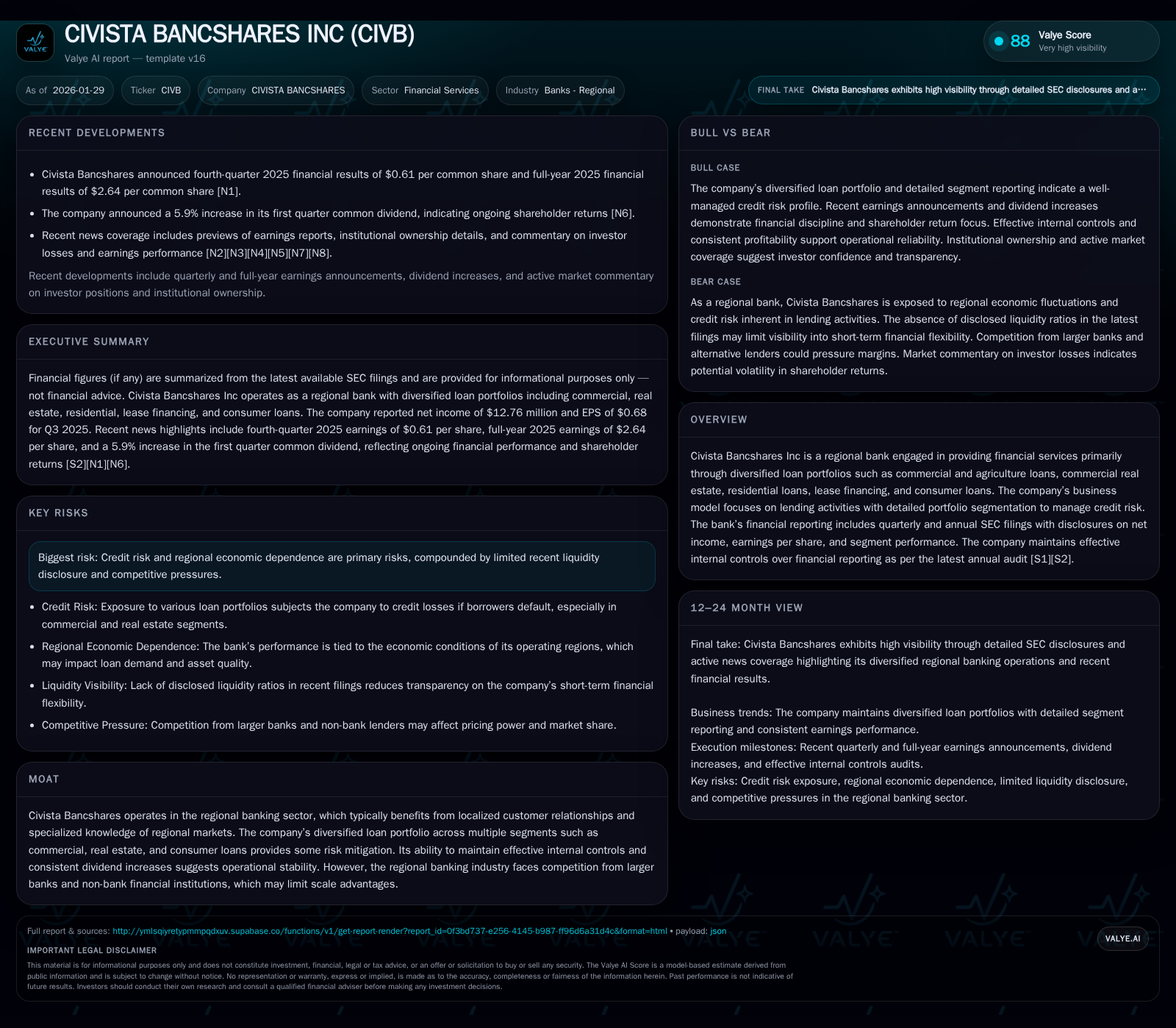
Civista Bancshares Inc reported solid financial results for full-year 2025, driven by its diversified loan portfolio encompassing commercial, agriculture, real estate, and consumer segments. The company’s business model centers on specialized regional lending with a focus on credit risk management and operational stability. However, the bank faces inherent challenges from regional economic sensitivity, credit risk exposure, and competition from larger banks and fintech disruptors. Recent dividend increases and earnings beats indicate resilience, but liquidity disclosures remain limited.
What Changed Recently
Civista Bancshares Inc announced its fourth-quarter 2025 financial results on January 29, reporting earnings of $0.61 per common share and a full-year 2025 EPS of $2.64, both surpassing analyst expectations by a meaningful margin [N1][N4][N9]. Notably, the company declared a 5.9% increase in its common dividend for Q1 2026, signaling confidence in its earnings and free cash flow generation capability amid a challenging banking landscape [N7]. Despite these positive signals, the equity performance has lagged, with investors experiencing a 33% loss over an unspecified period, reflecting broader market skepticism towards regional banks [N6].
This earnings update followed a period of scrutiny on Civista's exposure to various lending segments and its ability to manage credit risks effectively. The company’s institutional investor base remains substantial, potentially shaping strategic priorities towards stability and return of capital [N8].
Business Model as a System
Civista Bancshares operates as a regional bank focused on providing financial services primarily through lending activities. Its loan portfolio is segmented into commercial and agriculture loans, commercial real estate (including non-owner occupied properties), residential mortgages, lease financing, and consumer loans [S1][S4]. This diversification helps mitigate risk concentration but also requires specialized expertise for underwriting and portfolio monitoring across heterogeneous borrower profiles.
The company generates revenue through interest income derived from its loan portfolio and fee income, including wealth management fees which, while smaller in scale, add to diversified income streams [S3]. On the liability side, Civista funds loans through deposits and debt instruments, including advances from the Federal Home Loan Bank, as well as equity capital. The bank maintains effective internal controls over financial reporting, underscoring operational discipline [S1][Valye report excerpt].
Risk management is central to the business model, with credit risk controls in place to monitor delinquencies, particularly in sensitive segments such as commercial real estate and lease financing, where 30-59 days past due loans are tracked [S1]. The company also manages interest rate risk through balance sheet positioning, although detailed disclosures on hedging strategies are not clear from available information.
Profitability depends on net interest margin, which is a function of loan yields and funding costs, alongside non-interest income and operating expense management. The bank’s ability to incrementally grow its loan portfolio in target markets while containing credit losses and operational costs will determine long-term viability.
Industry Map & Competitive Battlefield
Civista Bancshares operates in the regional banking industry—a sector characterized by localized lending, personalized customer relationships, and moderate scale. Regional banks typically compete against large national banks with broader footprints and digital capabilities, as well as emerging fintech lenders offering streamlined credit products. Competition also arises from non-bank financial institutions in commercial and consumer lending.
The regional banking landscape is fragmented, with players differentiating through geographic focus, sector expertise, customer service, and relationship banking. Civista’s emphasis on agriculture and commercial real estate lending aligns with the economic profile of its regional markets, leveraging local knowledge as a competitive advantage.
However, these advantages come with inherent limitations: regional banks often lack scale benefits, face higher regulatory compliance costs per dollar of assets, and are more vulnerable to localized economic downturns or sectoral stress. Additionally, the digital transformation wave demands investments in technology to meet evolving customer expectations and compete on efficiency.
In this competitive context, Civista’s operational stability, diversified loan portfolio, and steady dividend policy position it as a traditional, relationship-driven bank. Yet, the company must navigate risks from credit cycles, interest rate volatility, and competitive pressures from larger banks and alternative lenders.
Where the Economics Become Real
At the unit level, Civista’s economics hinge on net interest margin, credit quality, and operational efficiency. Loan yields differ across segments, with commercial and agriculture loans typically commanding higher spreads due to risk profiles, whereas residential and consumer loans feature more standardized pricing and regulatory constraints.
Interest expense on funding sources, including deposits and Federal Home Loan Bank advances, impacts net interest income. Civista’s interest expense was approximately $3.78 million for a recent period, reflecting its cost of funds [S9]. Meanwhile, the bank generated wealth management fees of around $5.5 million, contributing modestly to fee income [S3].
Credit costs are a significant drag on profitability, with monitoring of delinquencies and non-performing assets critical to sustaining earnings. The bank’s disclosures indicate ongoing vigilance over 30-59 days past due loans, particularly in commercial real estate and lease financing segments [S1].
Operational leverage is modest, with costs driven by branch networks, personnel, compliance, and technology investments. The incremental capital required for loan growth and regulatory capital buffers constrains rapid expansion.
Dividend increases, such as the recent 5.9% raise, suggest the bank generates stable excess capital, albeit within the constraints of regulatory capital adequacy and earnings variability. The reported net income of $12.76 million in Q3 2025 underscores modest profitability, emphasizing the need for disciplined credit and cost management [Sxbrl].
Diligence Questions / Disconfirming Signals
What is the detailed composition of Civista’s funding mix, including deposits by type and stability, and reliance on wholesale funding such as Federal Home Loan Bank advances? Limited liquidity disclosure restricts visibility into financial flexibility.
How does the bank specifically manage interest rate risk amid fluctuating rate environments? Are there hedging strategies in place, and what is the impact on net interest margin?
What are the trends in non-performing loans and charge-offs, particularly in higher-risk segments such as non-owner occupied commercial real estate and lease financing? How quickly does the bank resolve problem loans?
How does Civista plan to invest in digital capabilities to counter competitive pressures from larger banks and fintech lenders? Are there measurable initiatives underway?
What is the geographic concentration of the loan portfolio, and how susceptible is the bank to regional economic downturns or sectoral stress, especially agriculture and real estate markets?
Given the substantial institutional ownership, what are the governance dynamics influencing capital allocation, strategic priorities, and risk appetite?
How sustainable is the dividend growth in the face of economic volatility and regulatory constraints?
Is there any information on operational cost trends and efficiency ratios? How is the bank balancing cost control with necessary investments?
What is the pipeline or strategy for loan portfolio growth in 2026 and beyond? Are there targets for segment or geographic expansion?
Conclusion
Civista Bancshares Inc exemplifies a traditional regional bank with a diversified lending portfolio designed to balance risk and opportunity across commercial, agriculture, real estate, and consumer sectors. The company’s recent earnings beats and dividend increase highlight operational stability and disciplined management. Nonetheless, the regional banking environment poses challenges including regional economic sensitivity, credit risks inherent in specific loan segments, and intensifying competition from larger banks and fintech alternatives.
Going forward, Civista’s ability to sustain earnings growth and manage risks will depend on its credit portfolio quality, funding and liquidity management, and strategic investments in technology and customer engagement. Transparency around liquidity metrics and detailed risk management strategies would enhance understanding of its resilience. The company’s steady dividend policy and institutional backing suggest a measured approach to capital deployment.
This analysis is based on publicly available information as of January 29, 2026, including recent news releases and summarized SEC filings. It does not constitute investment advice or recommendations.
Disclaimer: This is research-only, informational analysis and not investment advice. It may include AI-generated interpretation and general industry context. Always verify important details using primary sources.

Comments