
Collab Z Advances Community-Driven Property Management with Scalable Platform
Latest quarterly update underscores Collab Z's operational momentum and technological progress in transforming property management through tenant engagement and AI integration.
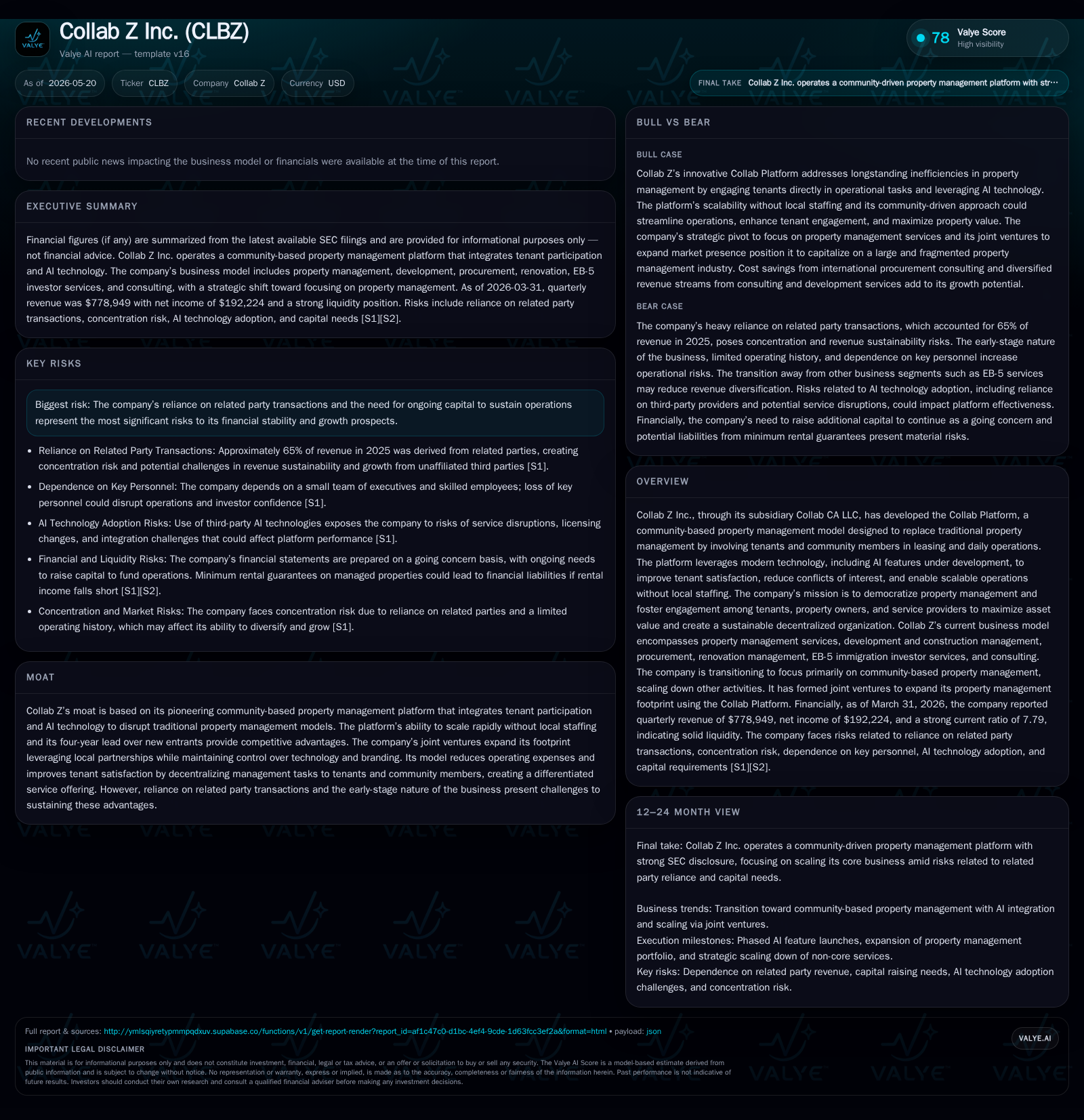
Collab Z’s recent 10-Q filing confirms steady advancement in its community-focused property management business, leveraging a novel platform that disintermediates traditional managers by directly involving tenants and community members. The firm's strategy centers on scaling via technology-enabled decentralization and joint ventures while gradually rolling out AI features to enhance operational efficiency. Risks linked to related-party dependencies and capital requirements persist, but the company’s high current liquidity ratio supports near-term runway. Monitoring execution on AI deployment, JV expansion, and tenant engagement metrics will be critical triggers for validating the innovative model’s scalability.
Recent Quarterly Update: Operational Momentum and Strategic Progress
This quarter’s disclosure underscores the company’s steady advance in tenant-centric property management utilizing technology to replace traditional hands-on staffing models. It also references the continued deployment of Joint Ventures established earlier in 2025 providing footholds in key regional markets through equity partnerships.
Business Model and Service Quality: The Collab Platform Approach
At its core, Collab Z monetizes primarily through fees generated by managing residential properties via its Collab Platform. This platform diverges from conventional models by actively engaging tenants—referred to as Community Pros (CPs)—to perform or coordinate functions traditionally reserved for property managers or third-party vendors. These tasks include lease coordination, routine maintenance communications, and minor repairs. By harnessing willingness within tenant communities to self-manage operational tasks, Collab Z reduces overhead costs tied to local staffing while enhancing service responsiveness and satisfaction.
Moreover, the platform integrates artificial intelligence capabilities currently under development to further automate leasing processes, conflict resolution, and maintenance prioritization. This blend of human-centered community involvement supplemented by AI aims to align stakeholder incentives better, raise tenant retention rates, and improve asset performance.
Revenue is driven by contracts with property owners paying management fees that depend on volume of units managed and service scope [S1]. Diversification into development/construction management, procurement, renovation oversight, immigration investor services (EB-5), and consulting provide supplementary income streams but remain secondary relative to property management fees which represented around 44% of total revenue in FY2025
While early-stage as a business model innovation and reliant on proprietary technology still maturing into full commercial rollout, Collab Z’s approach targets critical pain points such as misaligned incentives in traditional agencies, slow service responses due to layered middlemen, and the costly necessity for local offices.
Industry Structure and Competitive Dynamics in Property Management
The broader property management industry suffers from entrenched inefficiencies characterized by excessive human layers—managers overseeing third-party service providers—and high fixed costs stemming from distributed local offices required for hands-on operations. This legacy structure raises operational expenses, limits scalability across regions, generates transparency issues among stakeholders, and often results in lower tenant satisfaction.
Technology adoption lags significantly behind other real estate segments or tech-enabled service industries. While SaaS PropTech platforms have emerged offering digital tools for managers or landlords (e.g., rent collection portals or maintenance ticketing), few have reengineered the fundamental value chain to decentralize everyday operational tasks directly onto tenants or localized community contributors.
Collab Z occupies an emergent niche aiming to transform this market dynamic with a four-year lead over potential followers noted in filings [S1]. The company’s joint venture model further expands its geographic footprint without the heavy escalation of local staff costs typical for legacy firms.
Despite several established players dominating conventional property management at scale nationally or regionally (not specified here due to evidence constraints), Collab Z’s pioneering community-based platform coupled with advanced AI integration offers a differentiated competitive position resisting commoditization typical in this sector.
Growth Drivers: Scaling, Technology, and Joint Ventures
Several levers underpin expected growth trajectory:
Scalability Without Local Staffing: The community-driven model drastically reduces dependency on expensive local personnel by empowering tenants themselves to act as operational nodes—a structural cost advantage supporting expansion across multiple properties/markets quickly.
AI Integration: The ongoing rollout of artificial intelligence modules promises improved automation for routine tasks like lease document handling or maintenance triage. Successful implementation could enhance margins and user experience.
Joint Ventures: Established in early 2025 with five unrelated partners holding 40% stakes each [S1], these JVs provide accelerated market penetration leveraging partners’ local expertise and capital while retaining technological control. This enhances distribution reach without proportional overhead growth.
Tenant Engagement Metrics: As adoption deepens within communities served, improving KPIs such as tenant retention rates or average time-to-resolution on requests could validate model efficacy driving referral growth or contract renewals.
Combined, these drivers support a transition from proof-of-concept toward broader commercial viability beyond niche pilot deployments.
Risks and Constraints: Related Parties, Capital Needs, and Early-Stage Challenges
Several embedded risks temper enthusiasm:
Related Party Transactions: The firm’s documented reliance on related parties for development support elevates counterparty risk [S1]. Such dependencies can complicate governance transparency or impose unfavorable terms limiting operational independence.
Capital Requirements: Ongoing losses necessitate additional funding rounds to maintain operations as the accounting statements are prepared on a going concern basis [S1]. Future raises risk dilution or pressure on growth investment capacity.
Technology Risks: Early-stage AI features still under development carry execution uncertainties including potential licensing challenges from reliance on external open-source software frameworks which could impose unforeseen limitations or legal exposure [S1].
Operational Track Record: Limited operating history makes forecasting durable demand challenging alongside susceptibility to economic cycles influencing property management volumes and margins [S1].
These risks require continuous mitigation through prudent capital management, transparent operations with related entities, cautious AI integration roadmaps addressing intellectual property risks, and measured scaling pacing aligned with market feedback loops.
Outlook and What to Watch: Execution Milestones and Market Adoption
Key forthcoming indicators defining momentum include:
AI Feature Commercial Rollout: Timing against developers’ milestones remains critical; successful integration promises material uplifts in operational efficiency if delivered without major hiccups.
Joint Venture Expansion Trajectory: Further JV agreements or scaling existing partnerships will reflect market receptiveness as well as execution capability outside primary corporate cores.
Tenant Participation Metrics: Increases in active CP involvement rates or corresponding reductions in complaints/turnover would empirically demonstrate platform value creation driving sustainable revenue growth.
Liquidity Events: Potential capital raises will be necessary; announcements thereof provide insight into solvency outlooks affecting investment confidence [S2]
Investor attention should remain centered on these observable milestones rather than speculative long-term projections given prevailing early-stage factors.[S2][S1]
Financial Snapshot: Liquidity Position and Profitability Trends
As of March 31, 2026 [F1], Collab Z reported $4.59 million in current assets against $0.59 million of current liabilities yielding a robust current ratio of approximately 7.8x—signaling ample short-term liquidity cushioning ongoing cash burn inherent in the firm’s developmental stage. However, profitability remains elusive; the latest available period ending September 2025 reflected operating income losses around $115 thousand alongside net losses exceeding $102 thousand [F1]. These figures align with stated needs for additional capital infusion reported under going concern considerations [S1].
In summary, while liquidity appears sufficient near term to fund platform enhancement initiatives and JV expansions presently underway, sustained loss-incurrence signals continuation of capital-dependent growth phase until scale efficiencies materialize from broader adoption of Collab Z's innovative decentralized property management ecosystem.
This analysis synthesizes information extracted exclusively from Collab Z Inc.'s SEC filings dated May 20, 2026 (10-Q) [S2], December 23, 2025 (10-K) [S1], and current financial snapshot data [F1]. It avoids speculation beyond documented disclosures while contextualizing business model relevance within established industry structural dynamics consistent with buy-side analytical standards. No investment research views are expressed or implied.
Disclaimer: This is research-only, informational analysis and not investment advice. It may include AI-generated interpretation and general industry context. Always verify important details using primary sources.

Comments