
Caledonia Mining’s Growth and Resilience in Zimbabwe’s Gold Sector
Caledonia Mining advances its Zimbabwean gold operations with steady production and strategic project development amid challenging geopolitical and currency dynamics.
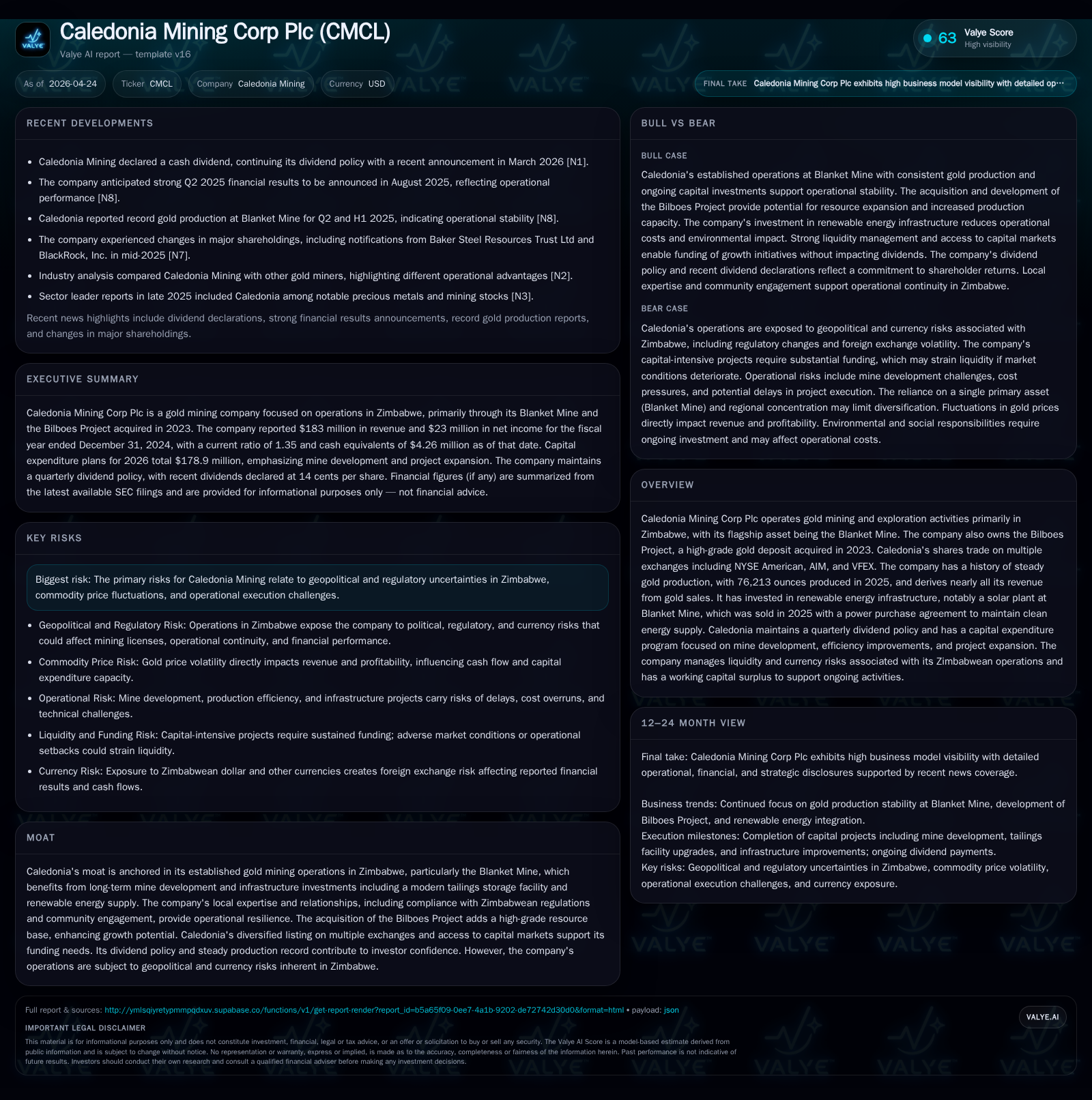
In Q1 2026, Caledonia Mining demonstrated resilience with sustained gold production at its flagship Blanket Mine despite a slight production dip from rising tonnage milled, driven by lower grades and recoveries. Costs increased notably due to the sale of its renewable solar asset, now managed under a power purchase agreement, and electricity expenses. The recent acquisition of the high-grade Bilboes Project underpins future growth potential. While operational execution remains solid and consistent dividend policy supports investor confidence, geopolitical and currency risks inherent to Zimbabwe continue to shape the company’s opportunity set. The January 2026 convertible senior notes issuance improves financial flexibility to propel project development beyond current operations.
Latest Quarterly Operating Highlights: Production, Costs, and Revenue Trends
The April 2026 quarterly filings ([S2], [S3]) provide an updated operational snapshot critical for assessing Caledonia Mining’s immediate trajectory. During Q1 2026, the company reports continued gold output from its flagship Blanket Mine, though production recorded a modest decline relative to prior quarters. This contraction occurred despite a marginal increase in tonnes milled — suggesting the impact of lower gold head grades (down to approximately 3.07 g/t) and slightly reduced recovery rates (hovering around 93%) typical in underground mining cycles.
Total ounces produced in 2025 were approximately 76,213 oz, down slightly by 0.6% YoY compared to full-year 2024 figures but still within the company’s revised guidance range ([S1]). Notably, revenue increased significantly due to a higher average realized gold price per ounce — moving from $2,347 in 2024 to $3,383 in 2025 — driving substantial top-line growth over the last fiscal year despite small volume setbacks.
Operating costs reflect substantial rises in key categories: salaries & wages increased as employee headcount expanded alongside bonus accruals tied to performance metrics; consumables showed significant inflationary pressures; and electricity costs escalated sharply to $19.3 million in 2025 from $14.9 million in 2024. This electricity cost surge stems primarily from the sale of Caledonia’s solar plant in late 2025—an asset contributing to cleaner energy usage—which was replaced by a power purchase agreement (PPA) ensuring reliable renewables access but transferring asset ownership out of company books ([S1], [S2]).
Currency risk remains salient as approximately 70% of revenue is settled in USD while the balance is paid in local Zimbabwean dollars linked to export lodgment rules—a regulatory framework requiring deliveries to be processed through Fidelity toll refining with subsequent export payments denominated partly in USD via offshore refiners. The filings note ongoing management of foreign exchange volatility including losses on Zimbabwean dollar conversions via the Willing Buyer Willing Seller (WBWS) platform ([S1]). These factors underscore why Caledonia's near-term revenue recognition timings can fluctuate depending on export/local lodgment dates.
Core Business Model: Gold Mining in Zimbabwe with Flagship Blanket Mine
Caledonia's business model principally revolves around gold extraction and processing at the Blanket Mine near Gwanda, Zimbabwe—a mature underground operation producing high-grade ore averaging roughly 3g/t with recovery rates close to mid-90%s ([S1]). Revenue is almost exclusively generated through precious metals sales—gold comprising nearly all income with negligible silver by-product credit.
The Company also owns the Bilboes Project, acquired in 2023 as a strategically important high-grade deposit complementing Blanket’s resource base ([S1]). Bilboes operates using similar infrastructure associated with local refining via Fidelity on a toll treatment basis before physical export; however, Bilboes sales carry a slight pricing discount due to small-scale producer classification.
Gold extracted is refined using an established system involving Fidelity as an intermediary refining entity that complies with Zimbabwe regulatory mandates ensuring local visibility of metal flows while enabling compliant international shipment ([S1]). Pricing follows LBMA benchmarks adjusted for daily spot prices at both local lodgment date (within-country refining) and export lodgment date (refining offshore), thereby creating recognition timing nuances affecting short-term revenue patterns.
Caledonia executes ongoing capital expenditure programs focusing on sustainable mine development—especially advancing the new Central Shaft at Blanket—as well as upgrading tailings storage facilities (notably commissioning of modern TSF stages) to optimize throughput capacity while maintaining environmental compliance standards ([S1], [S2]). Efficiency improvements target reducing unit costs despite input inflation pressures especially energy consumption which was previously offset by owned renewable assets.
The company's dividend policy maintains consistency with quarterly payouts typically around 14 cents per share declared regularly reinforcing investor confidence predicated on stable free cash flow generation—a rarity among junior mid-tier African miners ([S12], [N1]).
Competitive Position and Industry Structure in African Gold Mining
Within Zimbabwe’s challenging mining sector marked by political sensitivity, scarce hard-currency liquidity, and complicated regulatory regimes governing mineral exports and foreign exchange control, Caledonia has carved out defensible competitive positioning grounded in long-term infrastructure investments and operational expertise (, [S1]).
Blanket Mine's comprehensive underground infrastructure—encompassing dewatering systems, ventilation controls, centralized processing plants—and modern tailings storage facilities provide resilience against typical supply chain disruptions that bedevil regional peers dependent on less-developed assets. Moreover, Caledonia’s proactive engagement with Zimbabwean authorities including securing export lodgment approvals annually affords regulatory predictability not universally shared across mid-sized competitors.
Pricing power remains tethered primarily to global gold market forces given product fungibility but operational efficiency gains sustain better margins than comparable domestic peers who often face higher production costs amid unstable service provision environments (). Meanwhile, Caledonia’s multi-exchange listing spanning NYSE American, AIM, and VFEX enhances liquidity avenues facilitating periodic capital raises supporting sustained investment strategy.
However, the broader industry remains cyclical with sensitivity to commodity pricing volatility compounded by country-specific risks including foreign currency convertibility constraints highlighted by RBZ approval requirements for remittances outside Zimbabwe ([S1], [S20]). Amid this landscape, Caledonia’s moat is less about scale than its integration of local knowledge, political relationships, infrastructure maturity, and project pipeline diversification.
Growth Opportunities from Bilboes Acquisition and Project Development
Caledonia's growth trajectory hinges substantially on assimilating Bilboes’ high-grade resource into its operating portfolio. Purchased in early 2023 for approximately $10.8 million equity raise partly funding the deal ([S1]), Bilboes offers exploration upside coupled with concentrated ore grades >4g/t supporting higher margin potential relative to blanket-average grade ore mined.
Capital deployment continues targeting expansion initiatives at Blanket including Central Shaft completion expected to improve stoping flexibility hence tonnage throughput possibly beyond current annual ranges (~800kt). Additionally, new stages of tailings storage facility construction sustain environmental compliance while providing capacity for incremental milling expansions envisaged over medium term ([S1]).
The company emphasizes efficiency projects aiming at labour productivity gains alongside selective mechanization—an approach designed precisely to counterbalance escalating consumable material inflation and electrical cost increases due post-renewable asset divestiture ([S2]). Together these initiatives collectively underpin path toward moderate volume growth complemented by stable or improving unit margins if head grade degradation trends can be counteracted effectively.
Exploration generally remains disciplined focusing on near-mine targets benefiting from existing infrastructure rather than speculative greenfield programs consistent with risk appetite calibrated against Zimbabwe operational realities ([S1]). These focused drills support reserve replacement vital for long-tail viability extending Blanket’s mine life beyond initial estimates amid constrained new discovery opportunities regionally.
Constraints: Geopolitical Risks, Currency Exposure, and Operational Execution
Zimbabwe poses multilayered constraints largely revolving around country risk—the confluence of politically sensitive resource nationalism agendas led by regulatory agencies controlling mineral exports compounded by frequent foreign exchange shortages potentially impeding timely repatriation of funds earned abroad (, [S1], [S20]).
The mixed revenue receipt composition—approximately 70% USD-denominated inflows with remaining balance settled locally—also triggers periodic translation losses between reporting periods influenced by WBWS platform exchange fluctuations reported during fiscal year FY25 losses totaling $3.3 million ([S1]), posing earnings volatility risks unrelated directly to underlying operational efficiencies.
Operationally maintaining consistent grade feed amidst underground mining geometries presents execution complexity especially balancing increased tonnes milled against diminishing head grades noted recently. Variability in metallurgical recoveries even minor percentage points materially shifts final payable ounces impacting quarterly financial outcomes tightly monitored via key performance indicators internally.
Execution hazards compound when sequencing major capital projects such as Central Shaft completion intersect ongoing production schedules necessitating seamless coordination limited by local skills availability—though Caledonia mitigates these factors through strong onsite expertise accumulation over prolonged presence since acquisition of Blanket Mine in early-2000s era ([S1]).
Monitoring Metrics: Production Targets, Capital Expenditure Progress, Dividend Policy
Key metrics investors should track include quarterly production volumes targeting upper half of revised annual guidance (75,500–79,500 oz), management commentary on grade/recovery stability through centralized reporting channels alongside capex envelope adherence approximating $7 million committed mainly toward development projects including TSF expansions according to latest consolidated financial notes ([S2], [S1], [N1], [S12]).
Dividend declarations remain uniform at quarterly payouts around C14 cents/share reaffirmed through March 2026 distributions preserving shareholder return continuity despite operational cost inflation pressures indicating robust retained earnings generation sustaining policy integrity ([N1], [S12]).
Tracking bilateral approval renewals for foreign currency flows through RBZ authorizations also constitutes an essential political/regulatory demand marker affecting liquidity/distribution prospects.[/N]
Financial Overview: Profitability, Liquidity, Capital Structure, and Cash Flow
Reflecting prior full-year data supplemented by quarterly updates leads to confirmation that Caledonia closed FY25 with revenues reaching $267.7 million up +25% YoY supported chiefly by notable realized gold price appreciation albeit offset partially by marginally lower produced ounces ([F1], [S1]). Net income rebounded strongly posting over $23 million positive compared to losses experienced prior years yielding an approximate ROE near 9.8%, signaling profitable leveraging of operational base despite cost rises.
Liquidity metrics indicate conservative working capital management comprising current assets near $61.3 million against liabilities $45.4 million producing a comfortable current ratio about 1.35 implying sound short-term solvency conditions ([F1]).
A pivotal financial catalyst arose January 2026 as Caledonia successfully completed an upsized offering of $150 million Convertible Senior Notes due in 2033 bearing fixed coupon interest rate approximately 5.875%, proceeds earmarked mainly for Bilboes development alongside general corporate purposes expanding available financial runway considerably without immediate dilution pressure due to embedded capped call options limiting share issuance above ~$56 strike price whereby conversion ratio incentivizes retention of equity value appreciation potential vs traditional debt financing load burdens ([S14], [S15]).
Operating cash flows remain strong enough under stable commodity prices enabling sustainable dividends whilst exercising prudent leverage control within covenant limits—demonstrating holistic financial stewardship apt for navigating Zimbabwe complexities coupled with modest expansion ambitions.
Historical performance (annual)
| FY | Rev ($mm) | Net ($mm) | Rev YoY | Net YoY |
|---|---|---|---|---|
| 2024 | 183 | 23 | +25.1% | +3830.4% |
| 2023 | 146 | -1 | +3.0% | -102.7% |
| 2022 | 142 | 23 | +17.1% | -1.2% |
| 2021 | 121 | 23 |
Source: SEC companyfacts cache [F1].
Capital returns and efficiency (annual)
| FY | Div ($mm) | ROE% |
|---|---|---|
| 2024 | 14 | 9.8 |
| 2023 | 10 | -0.2 |
| 2022 | 11 | 11.8 |
| 2021 | 8 | 12.8 |
Source: SEC companyfacts cache [F1]. *Estimates based on excerpts; exact values pending formal annual report release.[F1][S1]
In sum, Caledonia Mining retains robust operational fundamentals augmented through strategic financing instruments poised for measured growth supported by entrenched assets amid prevailing regional industry challenges.
This analysis is based solely on publicly disclosed SEC filings and company-reported data as specified above without any speculative assumptions or third-party insights beyond provided sourced documents.
Disclaimer: This is research-only, informational analysis and not investment advice. It may include AI-generated interpretation and general industry context. Always verify important details using primary sources.

Comments