
Comcast’s Strategic Fusion of Connectivity Infrastructure and Content Assets in 2025
An in-depth analysis of Comcast’s dual-business model highlighted by the Epic Universe launch and streaming momentum amid shifting connectivity trends.
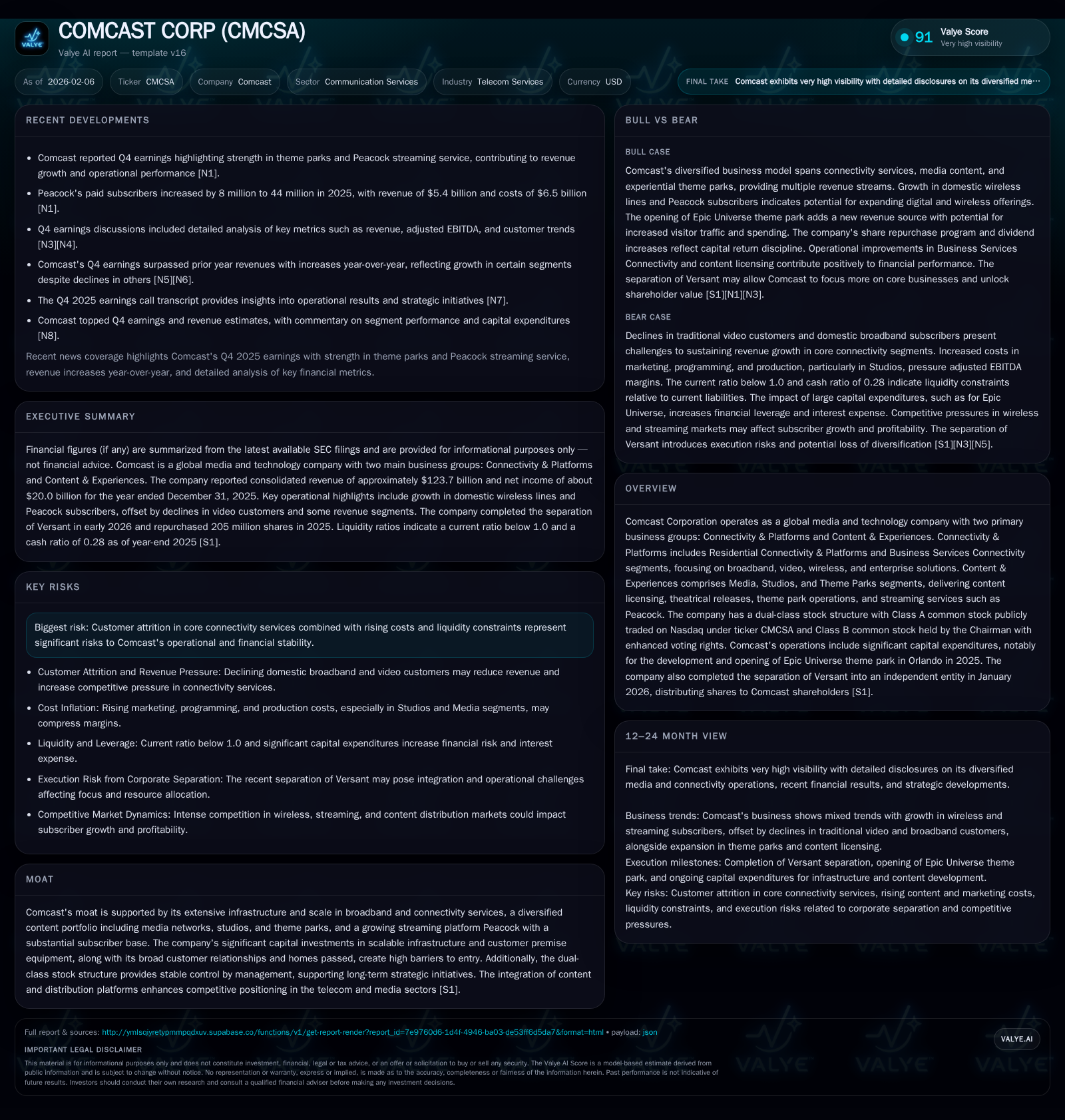
Comcast operates a uniquely integrated media and technology enterprise, balancing its Connectivity & Platforms business with a diverse Content & Experiences segment. The May 2025 opening of Epic Universe theme park has materially bolstered the Theme Parks division’s revenue and adjusted EBITDA, reflecting the company’s experiential content strategy. Meanwhile, Peacock has expanded its paid subscriber base to 44 million despite ongoing streaming market turbulence. However, Comcast faces headwinds from declines in broadband and video customers, rising capital expenditures, and liquidity challenges. The firm’s governance structure via dual-class shares provides stability but presents potential investor concerns.
Bridging Networks and Narratives: Comcast’s Integrated Enterprise
Comcast Corporation’s operational architecture revolves around two primary axes: Connectivity & Platforms and Content & Experiences. This bifurcation not only aligns with distinct customer value propositions but also forms a complex yet resilient moat that leverages scale and diversification. The Connectivity & Platforms group encompasses Residential Connectivity & Platforms alongside Business Services Connectivity, providing broadband internet, video distribution, wireless services, and enterprise solutions thereby covering multiple layers of digital communication infrastructure. Simultaneously, Content & Experiences aggregates media networks, television studios, theatrical releases, theme parks including the significant addition of Epic Universe in Orlando, as well as the streaming platform Peacock.
This dual business model benefits from both horizontal integration—spanning physical networks to digital content delivery—and vertical synergies where content drives demand for distribution channels while robust infrastructure supports expanding content reach. As of fiscal year-end 2025, Comcast reported revenue contributions across these sectors that underpinned its positioning as both a media giant and telecom powerhouse [S1].
Epic Universe Launch: Theme Parks as Growth Catalysts
May 2025 marked a pivotal milestone with the grand opening of Epic Universe in Orlando, representing Comcast’s latest foray into experiential entertainment within the Theme Parks segment. This investment exemplifies Comcast's strategic pivot toward immersive physical attractions that complement its digital-first content ventures.
Financially, revenues from the Theme Parks segment saw an uplift largely attributable to this new park's operations, accompanied by an increase in adjusted EBITDA despite correspondingly higher operating expenses linked to development costs. Such expansion enriches Comcast’s consumer engagement portfolio beyond traditional broadcast or streaming formats into tangible visitor experiences.
The timing of Epic Universe's debut captures pent-up consumer demand post-pandemic for destination leisure activities while also aligning with technological integrations within the parks offering enhanced guest interaction possibilities. This growth vector diversifies revenue streams beyond cyclical advertising or subscription markets and provides a durable asset contributing to long-term cash flow generation [S1][N1].
Peacock’s Subscription Surge Amid Streaming Turbulence
In an industry where formidable incumbents like Netflix wrestle with subscriber saturation and escalating content expenditures (notably on consolidation efforts such as potential WBD acquisitions [N2]), Comcast’s Peacock platform distinguishes itself through robust subscriber growth.
Expanding its paid subscriber base by approximately eight million to total 44 million in 2025 reflects consumer uptake driven by diversified content offerings including sports rights, original productions, and library assets. However, this expansion accompanies increased costs; Peacock's content-related expenses outpaced revenue growth — recording $6.5 billion in costs against $5.4 billion in revenue for the year — indicating ongoing margin pressures intrinsic to competitive streaming markets.
Notwithstanding these challenges, Peacock benefits from Comcast’s integrated ecosystem enabling cross-promotion via cable services and bundling options which potentiate subscriber acquisition efficiency absent in standalone platforms [S1][N1].
Connectivity Dynamics: Broadband Declines, Wireless Growth
Despite its foundational role in Connectivity & Platforms, Comcast faces divergent trends signaling shifting consumer behavior. Domestic broadband customers decreased by approximately 711,000 year-over-year to about 31.3 million while domestic video subscribers dropped by roughly 1.3 million to near 11.3 million — continuing losses partly reflecting cord-cutting phenomena.
Conversely, wireless lines expanded markedly by 1.5 million reaching roughly 9.3 million domestic lines serviced. Additionally, homes and businesses passed—the measure of network reach—grew by about 1.3 million to approximately 65 million units.
These figures suggest a paradigm shift where consumers prioritize mobile data services over traditional fixed-line bundle packages even as broadband household penetration remains sizable but no longer immune to contraction effects. For Comcast this necessitates strategic adaptations focusing on wireless offerings’ monetization while managing legacy video declines prudently [S1][F1].
Capital Spending: Infrastructure Investments vs. Financial Discipline
Capital expenditure outlays rose roughly 5.3% year-over-year reaching $8.7 billion centered on scalable infrastructure enhancement efforts including next-generation network equipment plus augmented customer premise installations aimed at improving service bandwidths.
This upward trajectory in capex underscores Comcast's commitment to maintaining technological leadership against competitors by investing in fiber optics expansions and wireless network densification essential for future service quality improvements.
Simultaneously, share repurchase programs persisted robustly with over $6.7 billion deployed in stock buybacks during calendar year 2025 alone under existing authorizations exceeding $8 billion remaining authorized yet unspent—revealing a balance between investing for growth and returning capital.
Such financial stewardship portrays management’s confidence in sustainable free cash flow generation but also highlights pressures on liquidity given increasing absolute capital commitments alongside operational cost inflation [S1][S2].
Financial Health Snapshot: Navigating Liquidity and Margins
For the full fiscal year ending December 2025, Comcast posted net income attributable to the corporation nearing $20 billion on revenues exceeding $121 billion—a testament to scale—but adjusted EBITDA margins narrowed notably compared to prior periods primarily due to rising cost bases especially within streaming operations.
Current assets totaled roughly $29.6 billion versus current liabilities of about $33.5 billion yielding a current ratio close to 0.88, suggesting some near-term liquidity constraints requiring attentive working capital management.
Overall profitability is nuanced by high fixed operating costs coupled with fluctuating subscriber metrics across divisions; navigating this landscape demands disciplined expense controls alongside leveraging high-margin segments such as Business Services Connectivity whose adjusted EBITDA margins remain comparatively elevated [F1][S1].
Governance Through Dual-Class Stock: Stability and Risks
Comcast maintains a dual-class stock structure wherein publicly traded Class A shares possess proportionately fewer votes relative to Class B shares held exclusively by Chairman Brian L. Roberts who commands about one-third of combined voting power yet exercises outsized control through fifteen votes per share.
This arrangement ensures executive continuity underpinning long-range strategic initiatives such as large-scale thematic investments or multi-year network upgrades without typical activist shareholder pressures.
However, this governance model carries inherent trade-offs around minority investor influence limitations potentially impacting perceptions among institutional shareholders sensitive to corporate accountability dimensions [S1].
Customer Retention Challenges in Core Services
Attrition among broadband and video subscribers remains a central vulnerability undermining top-line growth in core connectivity services.[S1] Losses are driven partly by intensely competitive telecom landscapes alongside consumers' pivot toward alternative entertainment platforms reducing demand for bundled pay-TV offerings.[F1]
While wireless subscriber gains partially offset some declines they do not fully compensate revenue-wise given lower average revenue per user relative to broadband/video packages.
The incremental homes passed metric signals ongoing network rollout success which could improve future penetration rates if effectively leveraged with compelling product bundles addressing next-gen consumer expectations.[S1]
Comcast in the Competitive Media-Streaming Arena
In media operations outside theme parks and connectivity lies an intricate web of competitive dynamics shaped by advertising market shifts including impacts from disruptions like reduced NBA viewership during Paris Olympics periods.[S1][N14]
Content licensing revenues showed some resilience though theatrical segments faced headwinds due partly to fluctuating box office performance.
Peacock contends with giants like Netflix adjusting strategies post-WBD merger speculations,[N2] nudging Comcast towards continuous innovation focused on bundled service differentiation plus leveraging unique sports assets held directly or via affiliations.
Advertising revamps increasingly drive margin focus as linear TV ad revenues undergo structural transformation towards digital targeting frameworks testing legacy media economics.[S1]
Looking Ahead: Risks, Opportunities, and Strategic Outlook
Comcast strides forward fortified by tangible milestones like Epic Universe's contributions enhancing experiential brand reach alongside Peacock's substantive subscription base growth affirming its multi-platform approach.[S1][N12]
Yet operational challenges persist notably around broadband subscriber erosion combined with rising programming costs impacting profitability zones demanding cautious capital deployment.[N14] ] Liquidity pressure indicators underscore the need for calibrated financial management amidst incremental investment pipelines including continued equity repurchases balancing market signals.[S1] ] Navigating this labyrinth involves harnessing convergent advantages between physical connectivity assets supporting digital media endeavors all while adapting dynamically to rapidly evolving consumer usage patterns within an intensely competitive telecom-media nexus.
Disclaimer: This analysis synthesizes publicly available information as of early February 2026 without offering investment recommendations or price targets.
Disclaimer: This is research-only, informational analysis and not investment advice. It may include AI-generated interpretation and general industry context. Always verify important details using primary sources.

Comments