
Chipotle's Strategic Tightrope: Balancing Growth, Brand Integrity, and Margin Pressures in 2026
Chipotle Mexican Grill’s Recipe for Growth highlights a bold push into innovation and expansion amid margin challenges and rising operational risks.
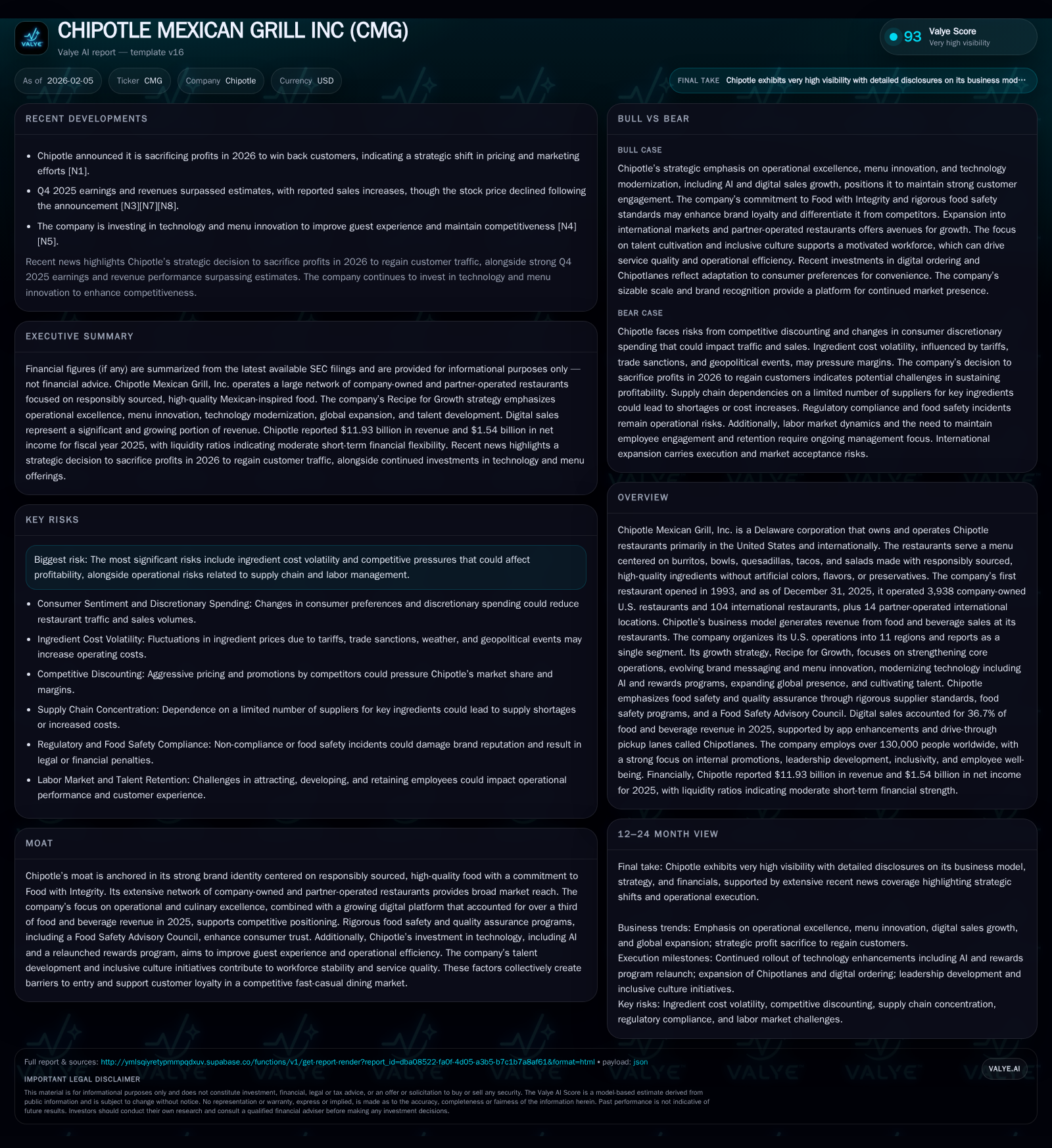
Despite delivering a strong Q4 2025 earnings beat with revenue surpassing expectations, Chipotle’s stock price declined, reflecting investor concerns about compressed margins and increased spending. The company’s five-pillar Recipe for Growth strategy doubles down on strengthening core operations, evolving the brand, innovating the menu, modernizing technology including AI, expanding globally through both company-owned and partner-operated restaurants, and cultivating talent. These initiatives aim to preserve Chipotle’s unique Food with Integrity ethos while driving competitive advantage amid cost volatility and food safety risks. Navigating these strategic priorities against an uncertain cost backdrop will define Chipotle’s capacity to sustain momentum through 2026.
Chipotle’s Brand Backbone: Food with Integrity in a Competitive Landscape
In an industry crowded with fast-casual concepts fiercely competing on speed, cost, and convenience, Chipotle Mexican Grill has distinguished itself through a resolute commitment to "Food with Integrity." This philosophy anchors the brand by emphasizing responsibly sourced ingredients free from artificial additives, aligning consumer values around sustainability and freshness [S1]. The results speak volumes: as of December 31, 2025, Chipotle operated nearly 4,000 company-owned U.S. restaurants alongside over 100 international sites, attesting to broad market penetration [F1].
This breadth not only enables scale but also fortifies a loyalty rooted in quality reassurance—a moat built over three decades since its inaugural Denver restaurant debuted in 1993. Customers who patronize Chipotle often identify it as more than mere sustenance; it reflects an ethos of transparency and environmental stewardship uncommon among peers. As detailed in SEC filings, the company rigorously vets suppliers for sustainability practices and animal welfare benchmarks under its "Responsibly Raised®" program [S1]. Such painstaking efforts underpin competitive differentiation in a marketplace where ingredient provenance can sway spending decisions.
Yet this very advantage imposes operational complexity. Unlike chains relying heavily on frozen or processed inputs, Chipotle's fresh ingredient mandate necessitates tight supply chain management to maintain quality consistency across regions—a persistent challenge magnified in international expansion efforts.
Recipe for Growth: Strategy Priorities Driving Expansion and Innovation
To navigate a dynamic consumer landscape that increasingly prizes convenience alongside integrity, Chipotle launched its comprehensive Recipe for Growth strategy. At its core lie five interrelated priorities:
- Protecting and enhancing core operations through culinary excellence,
- Evolving brand messaging while accelerating menu innovation,
- Modernizing business infrastructure via advanced technologies including artificial intelligence,
- Intentionally expanding global footprints using both wholly owned and partner-operated models,
- Cultivating top-tier talent energized toward agility and service excellence [S1][N9].
This multifaceted framework reflects a conscious balance between sustaining the defining qualities that built Chipotle's brand equity while embracing new growth vectors that meet shifting consumer behaviors.
Notably, technology serves as both enabler and differentiator. The integration of AI capabilities aims to personalize guest interaction within the relaunched rewards program—an effort designed not just for loyalty retention but also operational efficiency gains [S1][N9]. This modernization supports scaling demands while confronting challenges inherent to complex fresh food preparation processes.
However, these ambitions come at the cost of margin compression. The firm admits prioritizing long-term guest acquisition over near-term profitability — sacrificing profits strategically to win back customers amid intensifying competition [N9]. Such trade-offs underpin the nuanced tension threading through Chipotle’s narrative.
Navigating Q4 2025: Earnings Beat Overshadowed by Profit Sacrifices
The paradox of Chipotle’s recent performance crystallizes in its Q4 2025 results. The company reported revenue of approximately $11.9 billion alongside a net income north of $1.5 billion—both surpassing consensus expectations by notable margins [F1][N2][N3][N6]. Yet the stock traded lower post-announcement as investors wrestled with margin contraction tied to elevated costs.
Margins thinned not merely due to raw material inflation but deliberate investments across marketing spend aimed at recapturing lapsed traffic and bolstering digital engagement platforms [N4]. Such initiatives seek to revitalize demand momentum yet signal heightened near-term expense burdens. Meanwhile, user-experience improvements embedded within AI-driven technology rollouts reflect capital allocation toward future readiness rather than immediate financial returns.
Market reactions underscore this strategic balancing act—strong topline signals overshadowed by caution regarding sustainable profitability amidst escalating input costs [N2][N5]. For stakeholders monitoring longer-term trajectories, this dynamic exemplifies corporate prioritization of meaningful growth drivers over short-lived earnings beats.
Operational Excellence Meets Digital Modernization: The Tech and Talent Edge
Chipotle's evolution hinges critically on marrying traditional operational rigor with cutting-edge technology adoption. The company's digital business—now generating over one-third of total food and beverage sales—illustrates this shift vividly [S1]. From mobile ordering convenience to AI-powered personalized offers within its reimagined rewards ecosystem, technology facilitates enhanced guest experiences that are simultaneously scalable.
Behind the scenes lies substantial complexity: managing fresh ingredient inventory across nearly 4,000 outlets requires precision logistics coupled with agile labor deployment. Here talent development efforts emerge as pivotal factors; cultivating an experienced workforce capable of rapid service execution is essential to maintaining quality standards integral to brand promise [S1][N9]. Moreover, fostering an inclusive culture purportedly helps retain frontline staff amid historically high turnover prevalent in the restaurant industry.
This dual focus on human capital alongside intelligent automation reflects a forward-looking blueprint—one seeking operational resilience through technological sophistication without compromising service warmth or food quality.
Ingredient Cost Volatility and Food Safety: Persistent Risks to Margins and Reputation
No discussion of Chipotle's model would be complete without acknowledging its risk terrain—especially ingredient cost instability and food safety vigilance. The company explicitly recognizes that reliance on fresh produce grown without preservatives exposes it disproportionately to commodity price swings relative to more processed competitors [S1][S2]. Tariffs, weather disruptions affecting crops, or transportation bottlenecks may impose sudden cost spikes that compress margins unexpectedly.
More critically is the reputational risk tied to food safety incidents. Although Chipotle maintains stringent protocols—including oversight from a dedicated Food Safety Advisory Council—the potential for outbreaks linked to pathogens like E. coli poses continual threats [S1]. Given past industry-wide sensitivity around such issues nationally, even unsubstantiated reports can trigger swift consumer retrenchment affecting sales volume broadly.
Compounding this is increased regulatory scrutiny concerning pervasive environmental contaminants present within food supply chains (e.g., PFAS chemicals). While not unique to Chipotle per se, heightened attention raises the stakes around transparency and testing rigor [S1][N13]. Thus safeguarding guests’ trust demands unrelenting diligence alongside proactive communication strategies.
Global Reach Ambitions: Expanding with Care Beyond U.S. Borders
Capitalizing on domestic success while mitigating saturation risk underscores why international expansion figures prominently within Chipotle’s trajectory roadmap. With over 100 company-operated international restaurants complemented by 14 partner-operated locations as of year-end 2025 [F1], global growth represents both opportunity and challenge.
Choosing partner-operated formats where direct managerial control is limited allows judicious entry into diverse markets without overextending resources [S1]. This approach mitigates some ordinarily prohibitive costs associated with localization efforts such as supply chain adaptation or regulatory compliance while preserving brand standards.
Nonetheless scaling responsibly abroad requires navigating variable consumer tastes, competitive landscapes unfamiliar from U.S. experience sets, plus geopolitical-economic uncertainties exacerbated by logistics complexities inherent in perishable goods distribution worldwide. Each new market predicates layered investments addressing cultural alignment alongside operational robustness.
Investor Takeaways: Valuation, Risks, and Market Sentiment Into 2026
From an investor lens positioning Chipotle amid peers such as BJRI (BJ's Restaurants), valuation metrics delineate intriguing contrasts shaped by growth outlooks tempered by operating risks [N10]. The company reports a current ratio of approximately 1.23 indicating moderate liquidity buffers relative to short-term obligations [F1], suggesting reasonable financial stability amid ongoing investment phases.
Yet chief concerns remain around balancing ingredient inflation pressures against competitive discounting strategies deployed across casual dining sectors—a dynamic compelling active margin management while chasing sales velocity [S2][N13]. Additionally, sustaining brand integrity whilst evolving technologically entails careful calibration lest authenticity perceptions erode among core demographics.
Market sentiment appears cautious though constructive; enthusiasm for innovative digital initiatives contends with skepticism on profit impact timelines reflected in share price reactions post-Q4 earnings release [N2][N9]. Consequently stakeholders would do well to monitor rollout efficacy across technology platforms, manage expectations regarding margin restoration durability, and stay alert towards potential food safety developments that could swiftly alter consumer confidence narratives.
This analysis aims solely to elucidate structural dynamics shaping Chipotle Mexican Grill Inc.'s current positioning without providing investment advice or recommendations. Readers should consider this information alongside broader research tailored to their individual assessment objectives prior to decision-making.
Disclaimer: This is research-only, informational analysis and not investment advice. It may include AI-generated interpretation and general industry context. Always verify important details using primary sources.

Comments