
CMS Energy's 2025 Earnings Surge and Strategic Renewable Shift Amid Regulatory Complexities
CMS Energy's robust 2025 financial results and optimistic 2026 outlook underscore its resilience within a demanding utilities sector.
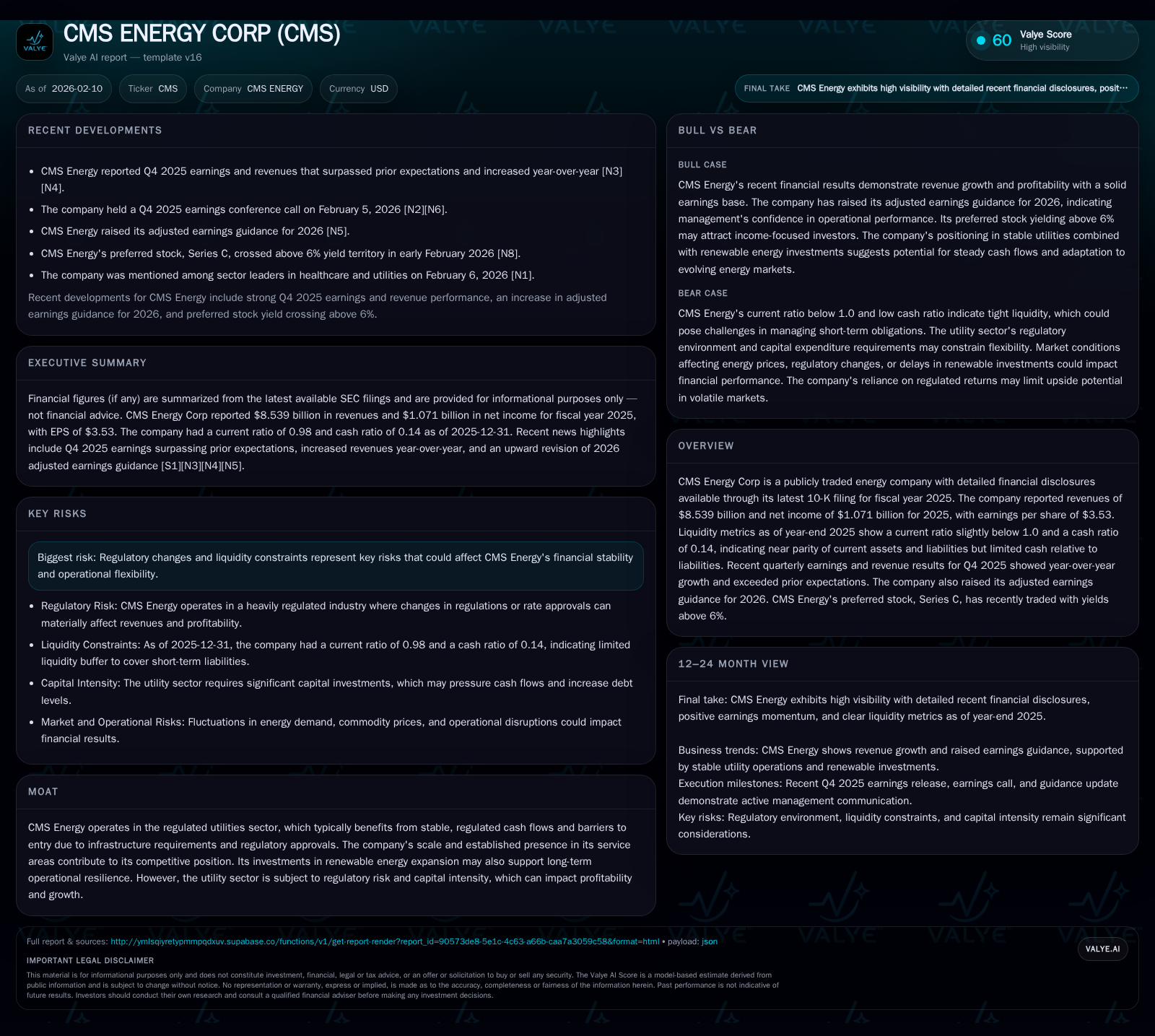
CMS Energy Corp reported strong fiscal 2025 results with $8.54 billion in revenue and over $1 billion in net income, surpassing expectations. The company’s liquidity reflects balance sheet tightness, with a current ratio just shy of 1.0 and limited cash reserves, signaling constrained flexibility. Its established regulatory moat, scale, and infrastructure barriers underpin stable cash flow, while a deliberate pivot toward renewables positions CMS for future resilience despite looming regulatory and capital intensity challenges. Preferred stock yields surpassing 6% attract attention, offset by measured credit profile considerations. Against peers, CMS displays competitive strengths that support the recent upward revision of its 2026 earnings guidance.
Breaking Down CMS Energy’s Solid 2025 Earnings and Revenue Growth
CMS Energy closed fiscal year 2025 demonstrating notable financial momentum. The company posted revenues reaching $8.54 billion along with net income exceeding $1.07 billion, translating to earnings per share of $3.53 — all figures that topped analyst expectations heading into the reporting season [F1][N2][N3]. The fourth quarter built on this strong footing, yielding year-over-year growth that exceeded prior forecasts [N1]. During the Q4 earnings call, management emphasized effective cost management coupled with favorable regulatory adjustments as key factors underlying this outperformance [N1]. These results epitomize CMS’s ability to leverage its regulated monopoly position while controlling operational expenses.
Financial Health at a Glance: Balancing Liquidity and Leverage
While profitability remains solid, CMS’s balance sheet reflects a delicate equilibrium in liquidity measures. The current ratio stands at approximately 0.98 (current assets of $3.47 billion versus current liabilities of $3.55 billion), signaling just under full coverage of short-term obligations by liquid assets [F1][S1]. Meanwhile, the cash ratio is markedly lower at around 0.14 due to cash & equivalents totaling $509 million relative to current liabilities—indicating limited immediate cash on hand [F1]. This tight liquidity posture may constrain the company’s ability to absorb unexpected financial shocks or capitalize nimbly on opportunities without increasing leverage or issuing new capital. Such constraints dovetail with concerns noted in CMS’s risk disclosures about potential liquidity pressures [valye_report_excerpt.risks]. Nevertheless, the firm maintains access to capital markets supported by its investment-grade credit profile.
Defensive Moat: Regulation, Scale, and Infrastructure Barriers
CMS Energy operates predominantly as a regulated utility—a sector intrinsically characterized by steady cash flows secured through rate-setting mechanisms overseen by public utility commissions [valye_report_excerpt.moat][S1]. These regulatory frameworks limit competition and create formidable barriers to entry given the extensive infrastructure investments required for energy delivery networks. CMS’s entrenched regional service footprint confers additional scale advantages alongside important regulatory approvals that are neither easily granted nor replicable by newcomers.
This combination provides CMS with a structural moat supporting predictable revenue streams even amidst economic fluctuations or transitional industry conditions. Moreover, the capital-intensive nature of utilities further dissuades potential entrants due to required upfront commitments for generation, transmission, and distribution assets.
Renewables Expansion: Investing in Future Resilience
Looking beyond traditional utility operations, CMS acknowledges the critical need to realign its asset base toward more sustainable energy sources to remain competitive over coming decades [valye_report_excerpt.moat][N12]. Recent strategic disclosures highlight increased deployment of renewable generation capacity — including wind and solar projects — as part of a broader transformation agenda [N12].
This pivot not only aligns with shifting regulatory mandates focused on emissions reductions but also positions CMS to capture growth opportunities in emerging energy markets where renewables increasingly dominate supply mixes. By investing proactively in clean energy infrastructure now, CMS aims to enhance long-term operational resilience against environmental policy shifts and evolving customer preferences.
Regulatory Risks and Capital Intensity: Potential Headwinds Ahead
Despite these strengths, the utility’s pathway forward is not without material headwinds stemming primarily from regulatory uncertainties and intense capital demands [valye_report_excerpt.risks][S1]. Changes in rate structures or environmental compliance requirements pose risks that could compress returns or delay recovery timelines on substantial infrastructure investments.
Moreover, the company’s sizable capital project pipeline necessitates continuous funding availability amidst already tight liquidity conditions — amplifying concerns around financial flexibility [S1]. Increased scrutiny from regulators or adverse policy shifts could further complicate approval processes or necessitate expensive retrofit programs for legacy assets.
Monitoring evolving regulatory landscapes will remain critical for stakeholders evaluating CMS’s risk profile.
Preferred Stock Spotlight: Attractive Yields versus Credit Profile
In parallel with its common equity performance, CMS’s Series C preferred stock has attracted investor attention due to yields climbing above 6% recently [N10]. Such elevated yield levels suggest an appealing income opportunity relative to comparable instruments in the sector.
However, this must be weighed against fundamentals underpinning credit quality — including leverage metrics influenced by the aforementioned liquidity constraints [F1]. While CMS generally exhibits investment-grade credit standings enabling reasonable borrowing costs, persistent balance sheet pressure could challenge sustained yield compression on preferred shares.
Investors considering preferred securities should therefore assess coupon attractiveness alongside underlying financial durability.
Peer Benchmarking: How CMS Stacks Against Competitors
Placed in context against peers within regulated utilities space, CMS compares favorably in several respects [N11]. Its solid scale coupled with proactive renewable investments offers differentiation versus some competitors slower to transition their portfolios.
Guidance revisions set against peers such as PPL resonate positively; CMS projects stronger adjusted earnings growth reflecting operational efficiencies and constructive regulatory outcomes [N11]. Nonetheless, some rivals may present distinct geographic or market risk profiles that merit consideration when weighing comparative valuations or exposure mixes.
Detailed peer analysis suggests CMS holds competitive advantages that reinforce its recent momentum yet also shares sector-wide challenges surrounding regulation and capital intensity.
2026 Guidance Lifted: What’s Driving Investor Optimism?
Reflecting confidence from sustained execution across earnings drivers and strategic initiatives, CMS raised its adjusted earnings guidance for fiscal year 2026 shortly after closing Q4 results [N4][N1][F1]. Management commentary underscored disciplined cost controls paired with the benefits derived from renewables investments as underlying catalysts for this upward revision.
Additionally, favorable regulatory developments shaped perceptions implying smoother path for rate base expansion and allowed returns [N1]. This more optimistic outlook reinforces themes outlined throughout this analysis — namely balancing resilient core utility operations with forward-looking sustainability commitments amid ongoing external risks.
Disclaimer: This report is for informational purposes only based on publicly available information including SEC filings and news reports as of February 2026. It does not constitute investment advice or recommendations. Readers should conduct their own due diligence before making any financial decisions relating to CMS Energy Corp or its securities.
Disclaimer: This is research-only, informational analysis and not investment advice. It may include AI-generated interpretation and general industry context. Always verify important details using primary sources.

Comments