
CNA Financial Corp: Resilience Tested Amid Regulatory Complexity and Earnings Volatility
A nuanced exploration of CNA Financial Corporation’s operational breadth, underwriting challenges, and strategic outlook following a recent earnings miss.
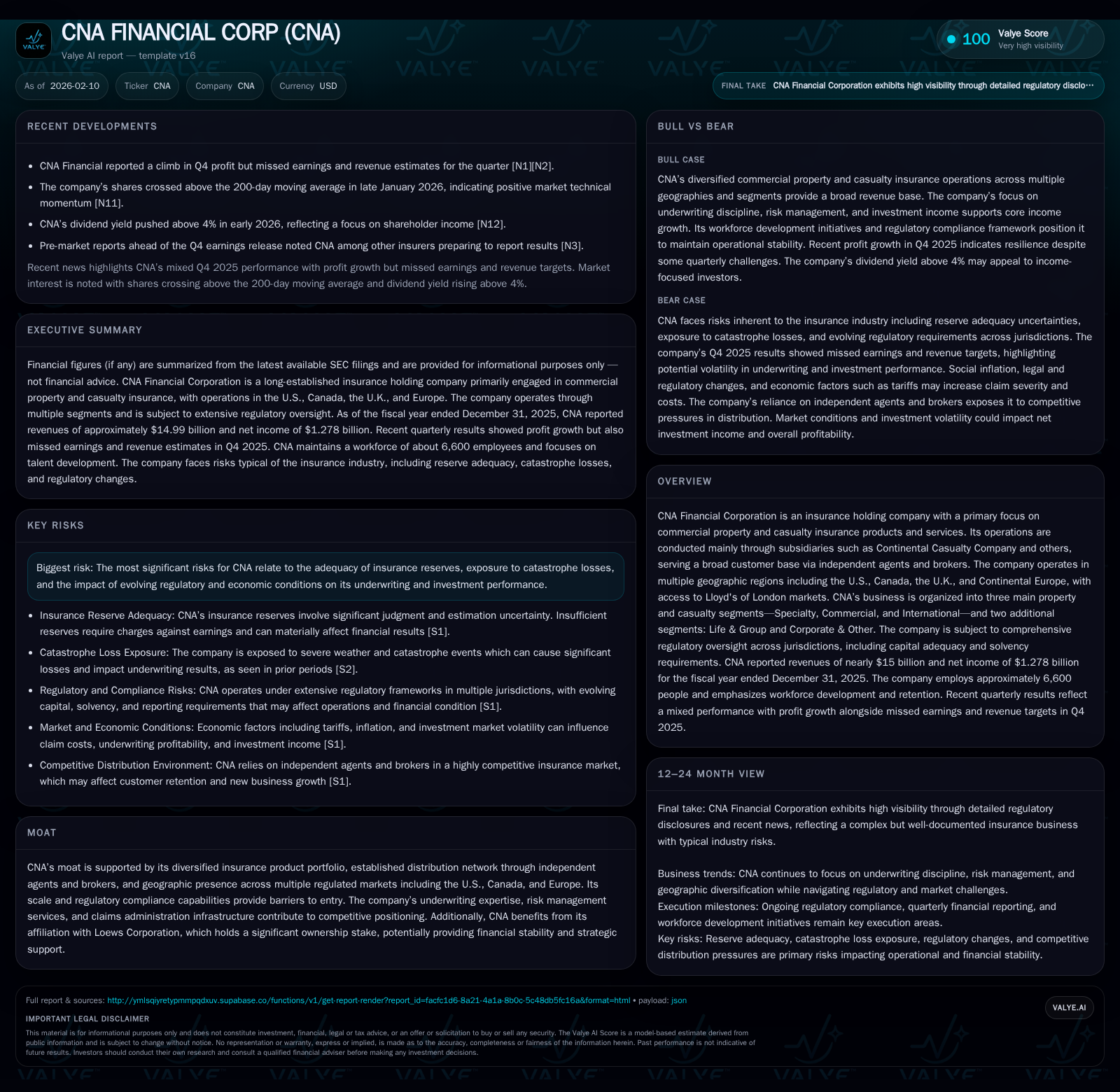
CNA Financial Corporation operates an extensive global property and casualty insurance franchise with a diversified portfolio spanning specialty, commercial, and international segments. Despite a solid revenue base near $15 billion and net income of $1.278 billion for fiscal 2025, the company recently missed fourth-quarter earnings expectations, reflecting ongoing challenges in underwriting volatility and reserve adequacy. Regulatory scrutiny across multiple jurisdictions further complicates capital management and operational decision-making. CNA benefits from its anchoring relationship with majority owner Loews Corporation, which supports financial stability amid industry headwinds. Navigating catastrophe exposures and evolving market dynamics remains central to its near-term strategic considerations.
Setting the Stage: CNA’s Global Insurance Franchise
CNA Financial Corporation stands as a major player in the commercial property and casualty insurance sector, conducting its business primarily through subsidiaries such as Continental Casualty Company. The company’s reach extends across multiple sizable geographies including the United States, Canada, the United Kingdom, Continental Europe, and access to Lloyd's of London markets via Syndicate 382. This broad geographic presence coupled with a diversified set of insurance products underpins CNA’s moat—anchored in an expansive distribution network largely driven by independent agents and brokers serving diverse client profiles from small businesses to large associations.
Organizationally, CNA segments its operations into three primary property and casualty clusters—Specialty, Commercial, and International—while also managing Life & Group as well as Corporate & Other segments. This segmentation allows CNA to focus underwriting strategies distinctly by risk profiles and local market conditions. Furthermore, its centralized processing infrastructure supports underwriting efficiency across these varied markets.
The insurance industry’s competitive intensity is pronounced; CNA confronts significant rivalry not only from other stock insurers but also mutual companies competing for broker relationships and client retention. Nonetheless, CNA leverages scale advantages paired with sophisticated risk management services that add layers of customer value beyond pure price competition [S1].
Navigating Complex Risk: Underwriting and Reserve Uncertainties
A defining challenge for CNA — like many P&C insurers — lies in the inherent complexities of estimating insurance reserves. These reserves must cover the ultimate unpaid liability for both claims reported and those not yet reported (IBNR). The actuarial techniques involved rely heavily on assumptions regarding claim frequency, severity, judicial trends (including social inflation), medical cost trends, discount rates, and claim settlement timelines.
Social inflation particularly stands out as a volatile force amplifying claims costs through expanded litigation activity, higher jury awards, or broader interpretations of liability. Moreover, emergence of “reviver statutes” in certain states has extended the statute of limitations for claims related to sensitive matters like sexual abuse allegations. Such legislative shifts exacerbate reserve estimation difficulty as they potentially increase future claim frequency unpredictably.
The multi-year lag inherent in long-tail coverages such as workers’ compensation or professional liability adds further variability. CNA maintains protocols for regular review and adjustment of these reserves as actual experience develops but acknowledges that substantial reserve charges remain possible if prior estimates prove insufficient — directly impacting reported earnings volatility [S1].
Dissecting Recent Financial Performance: Earnings Miss and Market Reactions
In early February 2026, CNA disclosed fourth-quarter results that fell short of consensus expectations despite an overall annual net income tally of approximately $1.278 billion on revenues near $15 billion — a respectable scale by industry standards [F1][N9]. The earnings miss was primarily driven by pressure on underwriting margins due to unexpectedly elevated loss ratios affected by catastrophe events and reserve development unfavorable to prior year estimates.
Notably, while headline net income showed resilience compared with prior periods, quarterly revenue came in below forecasts prompting analyst recalibrations of near-term profitability projections [N1]. Market reaction was cautious with shares exhibiting muted movement despite previously crossing above key technical levels such as the 200-day moving average [N10]. Investors appear digesting the inherent tension between CNA’s extensive portfolio benefits against episodic underwriting headwinds.
The Regulatory Maze: Impact on Capital and Operational Strategy
Operating within highly regulated jurisdictions imposes complex oversight demands on CNA encompassing capital adequacy thresholds, reserving practices, premium rate filings, dividend restrictions at subsidiary levels, and investment constraints. Regulators wield broad authority including examinations of financial condition and market conduct along with licensing controls.
This regulatory lattice mandates careful capital management balancing growth ambitions against solvency preservation. Importantly, inter-company fund transfers within CNA’s group entities often require prior notice or approval from insurance regulators which can constrain liquidity flexibility.
Moreover, given that CNA’s U.S., Canadian, U.K., and European entities are subject to distinct yet overlapping supervisory frameworks—with varying standards on risk-based capital—the company must maintain granular oversight systems enabling compliance without sacrifice to operational agility [S1].
Segment Spotlight: Specialty, Commercial, and International Performance Dynamics
Breaking down segment-level performance reveals nuanced operational realities shaping overall financial results:
Specialty Segment: Typically characterized by more complex risk classes requiring specialized underwriting skillsets. This segment benefits from relatively higher premium rates reflecting tailored coverage solutions but faces pronounced exposure to catastrophe losses which tend to fluctuate unpredictably.
Commercial Segment: Encompasses broad-based P&C lines serving diverse industries; it generally exhibits steadier renewal patterns though exposed to economic cycles influencing retention rates and pricing power.
International Segment: Geographically dispersed operations carry currency risk considerations alongside variable regulatory regimes impacting return metrics; Lloyd’s access enhances market reach but subjects results to syndicate-specific volatility.
Renewal premiums across these segments demonstrate positive rate adjustments—a reflection of ongoing price hardening trends post-pandemic remediation—but this is partially offset by uneven retention levels amid client churn pressures. Catastrophe losses are explicitly excluded from underlying loss ratio calculations used internally to assess core underwriting performance though their episodic realization significantly affects reported period outcomes [S2].
Financial Stability Anchored by Loews Corporation
Loews Corporation holds approximately 92% ownership in CNA Financial Corp., positioning it as an influential stabilizing stakeholder providing substantial capital resources alongside governance oversight. This ownership structure grants CNA access to deep balance sheet strength advantageous when absorbing shocks such as unforeseen catastrophes or reserve deterioration.
While this affiliation does not mitigate fundamental underwriting risks intrinsic to insurance operations—where loss events themselves are difficult to anticipate—it delivers material comfort in terms of funding availability for capital initiatives or strategic investments during turbulent market phases [S1][N11].
Balancing Act: Growth Prospects Versus Catastrophe Exposures
CNA faces the classic insurer’s dilemma: pursuing profitable growth through measured premium increases while simultaneously managing exposure volatility driven by catastrophes—both natural disasters and emerging non-property claim types influenced by evolving litigation landscapes.
Growth opportunities exist given steady renewal premium rate upticks reflecting industry-wide recalibration pricing models supported by improved actuarial insights post-large loss events. However future earnings remain vulnerable to sizeable catastrophic events whose timing/intensity cannot be forecast precisely.
Peer comparisons indicate this pattern is consistent across the P&C sector where volatility compresses predictability even amid incremental market share gains. Thus disciplined risk selection combined with diversified product offerings assumes critical importance in moderating downside swings over full economic cycles [S2][N8].
Investor’s Lens: Valuation, Dividend Yield, and Relation to Peers
From an investor perspective, CNA commands attention partly due to its attractive dividend yield recently pushing above 4%, providing income appeal relative to other insurers whose payout yields often vary widely depending on growth-capital tradeoffs [N12].
The share price rallies approaching 52-week highs suggest market participants may be pricing in stabilization post-earnings miss while anticipating corporate governance reliability afforded by Loews backing [N10][N14]. Yet valuation remains sensitive to new underwriting loss developments or reserve adjustments given their direct impact on near-term profitability.
Comparisons against specialty-focused names like Kinsale Capital or broad commercial carriers such as Cincinnati Financial highlight relative strengths rooted in CNA's diversified global footprint but also signify competitive pressures necessitating continuous operational refinement [N3-N6].
Outlook & Strategic Considerations for the Coming Quarters
Looking ahead into 2026 quarters beyond the January filing date reveals several focal points shaping CNA’s trajectory:
- Continued vigilance around reserve adequacy will be paramount; management signals ongoing reassessment procedures aligned with recent claims experience trends.
- Navigating regulatory complexity will remain resource-intensive necessitating robust compliance infrastructures capable of reconciling divergent jurisdictional requirements.
- Competitive pressures require balanced premium rate discipline coupled with innovative underwriting adaptations responding swiftly to shifting risk landscapes.
- Investor attentiveness intensifies around quarterly results as markets assimilate these multifactor dynamics post-Q4 shortfall announcements.
Strategically leveraging Loews’ support while sustaining underwriting discipline appears central for navigating upcoming uncertainties so as not to compromise long-term franchise value creation potential [S1][N7][N1].
This analysis is intended for informational purposes only without recommendation regarding securities transactions. Readers should conduct independent due diligence before forming conclusions about investment suitability.
Disclaimer: This is research-only, informational analysis and not investment advice. It may include AI-generated interpretation and general industry context. Always verify important details using primary sources.

Comments