
CNBX Pharmaceuticals: Survival, Science, and Strategic Niche in Cannabinoid Oncology
With no FDA-approved products, minimal revenue, and a severe liquidity shortfall, CNBX Pharmaceuticals’ future hinges on scientific validation, capital access, and the viability of its licensing-driven business model in a fiercely competitive biotech landscape.
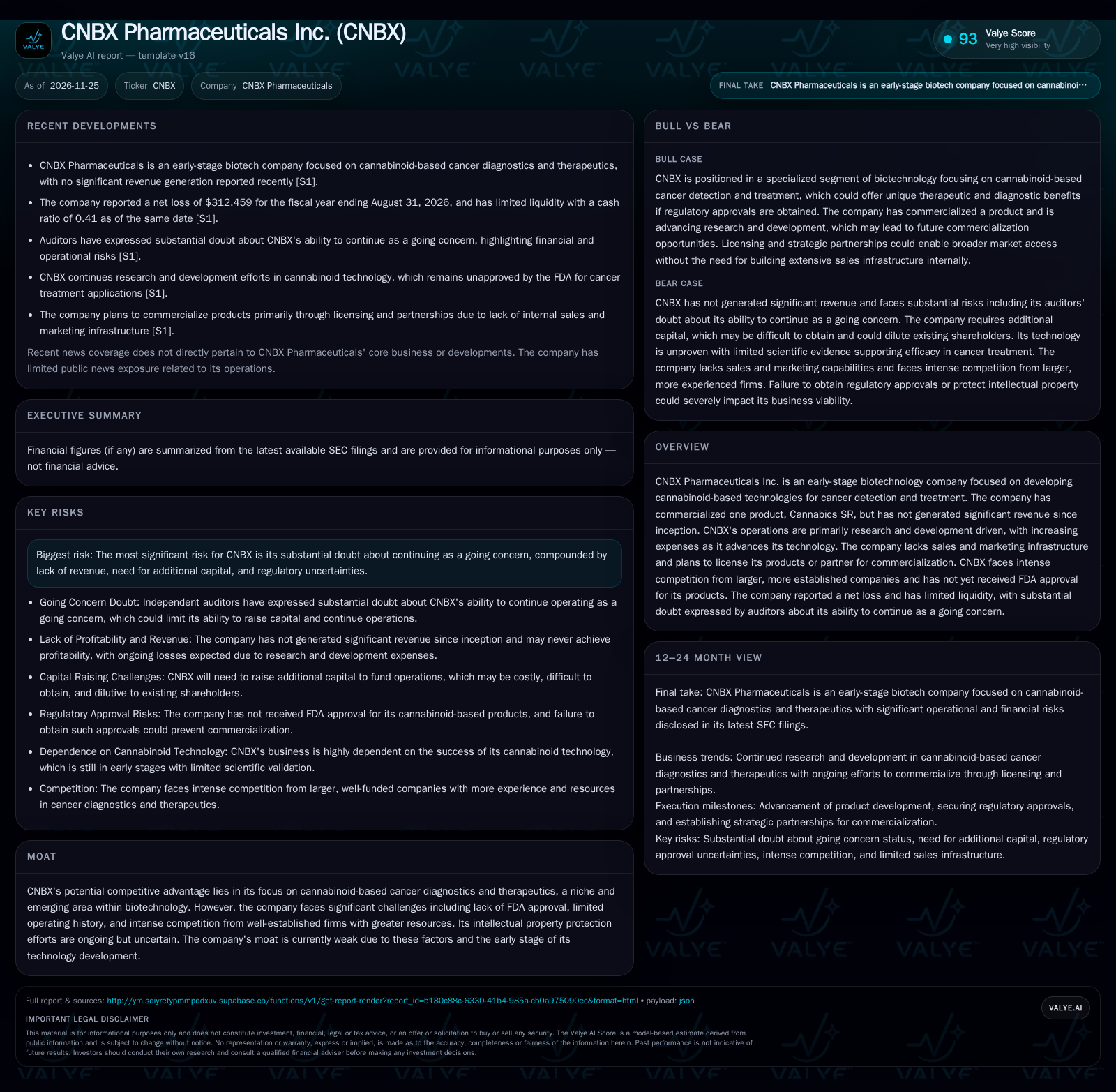
CNBX Pharmaceuticals is an early-stage biotech company focused on cannabinoid-based cancer diagnostics and therapeutics. The company’s ability to survive and create value now depends on securing capital, achieving scientific milestones, and executing a partnership/licensing strategy—each with significant uncertainty and execution risk. [S1]
CNBX Pharmaceuticals sits at the intersection of scientific ambition and acute financial distress. Focused on cannabinoid-based cancer diagnostics and therapeutics, the company has yet to achieve FDA approval, generate meaningful revenue, or establish a viable commercial infrastructure. With auditors doubting its ability to continue as a going concern and a cash ratio of just 0.41, CNBX is forced to pursue a capital-light, licensing-driven model in an industry dominated by larger, better-capitalized competitors. The company’s future now rests on its ability to deliver clinical and regulatory progress fast enough to attract partners and funding before its financial runway disappears.
Severe Financial Pressures Shape CNBX’s Immediate Outlook
The most material current facts for CNBX Pharmaceuticals are its severe liquidity shortage, lack of significant revenue, and auditor-expressed doubt about its ability to continue as a going concern. The company reported cash and liquidity metrics for the period; these figures do not by themselves establish operating runway, investment capacity, financial flexibility, or financing capacity. The net loss for the fiscal year was $312,459, and the company’s auditors explicitly flagged substantial doubt regarding its ability to sustain operations. CNBX has not achieved FDA approval for any of its cannabinoid-based cancer diagnostics or therapeutics, and its only commercialized product, Cannabics SR, has not generated meaningful sales. These realities put the company’s survival and strategic options under immediate pressure. [S1]
Capital-Light Licensing Model Faces Significant Barriers
CNBX’s business model is predicated on licensing its cannabinoid-based cancer detection and treatment technologies rather than building in-house sales, marketing, or distribution infrastructure. This approach is a necessity given its one-employee structure, lack of commercial capabilities, and financial constraints. In theory, licensing could allow CNBX to monetize intellectual property with lower fixed costs and reduced go-to-market risk, earning milestone payments, royalties, or upfront fees from established pharmaceutical or diagnostics partners.
However, licensing economics in biotech are highly contingent on the strength of scientific and clinical evidence. Without FDA approval or compelling clinical data, CNBX’s negotiating leverage with potential partners is likely to be weak, resulting in less favorable terms if deals can be secured at all. The company will also need to fund ongoing R&D and intellectual property protection, which are capital-intensive and not easily deferrable. Operating leverage is minimal at this stage: with only one employee and reliance on consultants, fixed costs are low, but so is organizational capacity. Capital needs remain urgent, as even a lean licensing model requires cash to sustain research, regulatory filings, and IP prosecution until a material partnership or licensing event can be achieved.
Focused Niche Strategy Confronts Strong Industry Challenges
CNBX is targeting a niche—cannabinoid-based oncology diagnostics and therapeutics—that is both emerging and highly contested. Larger, well-capitalized biotechnology and pharmaceutical firms already dominate the broader cancer diagnostics and therapeutics markets. Many of these competitors have the resources to conduct large-scale clinical trials, navigate regulatory processes, and invest in commercial infrastructure.
The cannabinoid segment itself faces regulatory skepticism, uneven scientific validation, and public perception challenges. While CNBX’s focus could offer some differentiation if its technologies prove clinically superior or uniquely efficacious, the company currently lacks the data or approvals needed to build a meaningful moat. Intellectual property could theoretically provide some protection, but patent risks and the potential for circumvention by better-funded rivals remain high. In short, CNBX’s current competitive position is structurally weak, with its only potential edge being early-mover status in an unproven therapeutic niche.
Potential Value Emerges from Scientific Breakthroughs and Strategic Alliances
The most optimistic scenario for CNBX hinges on two breakthroughs occurring in rapid succession: (1) credible scientific or clinical validation of its cannabinoid-based cancer platform, and (2) the signing of a significant licensing or partnership deal with a larger industry player. If the company’s ongoing R&D yields compelling preclinical or early clinical results, this could attract the attention of established diagnostics or therapeutics firms seeking to enter or expand in the cannabinoid oncology space.
Such validation might enable CNBX to negotiate upfront license fees, R&D funding, or milestone-based royalty agreements, providing both non-dilutive capital and external validation. This, in turn, could improve the company’s ability to raise additional financing on less punitive terms and potentially extend its operational runway. Confirmation of this scenario would require public disclosure of successful clinical milestones, regulatory progress (such as IND acceptance or Fast Track designation), and the announcement of a licensing or strategic partnership deal with a credible counterparty.
Sustained Losses and Capital Needs Define the Survival Scenario
The most plausible outcome under current conditions is a protracted struggle for survival. CNBX is likely to continue its R&D activities at a minimal level, seeking to generate enough scientific progress to attract interest from potential partners or investors. The company will almost certainly need to raise additional capital—likely on highly dilutive terms, given its going concern risk and weak balance sheet.
Incremental advances in preclinical or early-stage clinical research may provide some narrative momentum, but without a major breakthrough or partnership, revenue generation will remain negligible and losses will persist. The company’s ability to execute will be hampered by its skeletal staff and limited resources. Confirmation of this scenario would be ongoing disclosures of small financings, slow-moving R&D updates, and continued auditor warnings about going concern status.
Failure to Secure Funding or Validation Could Lead to Insolvency
If CNBX fails to secure additional capital or achieve meaningful scientific or regulatory progress, the company faces the real possibility of insolvency or forced asset liquidation. With cash on hand measured in thousands and liabilities exceeding $2.6 million, even minor operational setbacks or delays could exhaust remaining resources. In this scenario, CNBX may be unable to fund further R&D or maintain its intellectual property portfolio, leading to the loss of any residual value.
Shareholder dilution could become extreme if emergency financings are possible at all, and in the absence of a buyer for its technology or IP, the company could enter bankruptcy or wind down operations. Evidence confirming this scenario would include default notices, bankruptcy filings, or announcements of asset sales at distressed valuations.
Key Events and Progress That Could Alter CNBX’s Trajectory
Disclosure of any licensing, co-development, or partnership agreements with established pharmaceutical or diagnostics companies would be a critical test of the company’s commercial viability.
Announcements of successful preclinical or clinical trial results, or acceptance of regulatory filings (such as INDs) would provide essential validation for the technology platform.
Updates on capital-raising efforts, including terms, amounts, and sources of new financing, will directly affect runway and dilution risk.
If disclosed, detailed R&D milestones and timelines would help gauge the pace and credibility of scientific progress.
Any changes in auditor opinion regarding going concern status would signal improvement or deterioration in financial health.
Patent grants, litigation outcomes, or changes in IP strategy would impact the company’s defensibility and potential licensing value.
Hiring of experienced executives or expansion of the internal team could indicate a shift toward commercialization readiness, if funding permits.
Market or regulatory developments affecting the acceptance of cannabinoid-based therapies in oncology would influence the addressable opportunity and competitive landscape.
Disclaimer: This is research-only, informational analysis and not investment advice. It may include AI-generated interpretation and general industry context. Always verify important details using primary sources.

Comments