
Lexaria’s DehydraTECH Platform: Clinical Progress, Patent Leverage, and the Road to Commercialization
Lexaria Bioscience advances its DehydraTECH drug delivery technology with positive early clinical results and a robust patent estate, but faces the economic realities of minimal revenue, ongoing losses, and the challenges of scaling biotech innovation into sustainable licensing or product revenue.
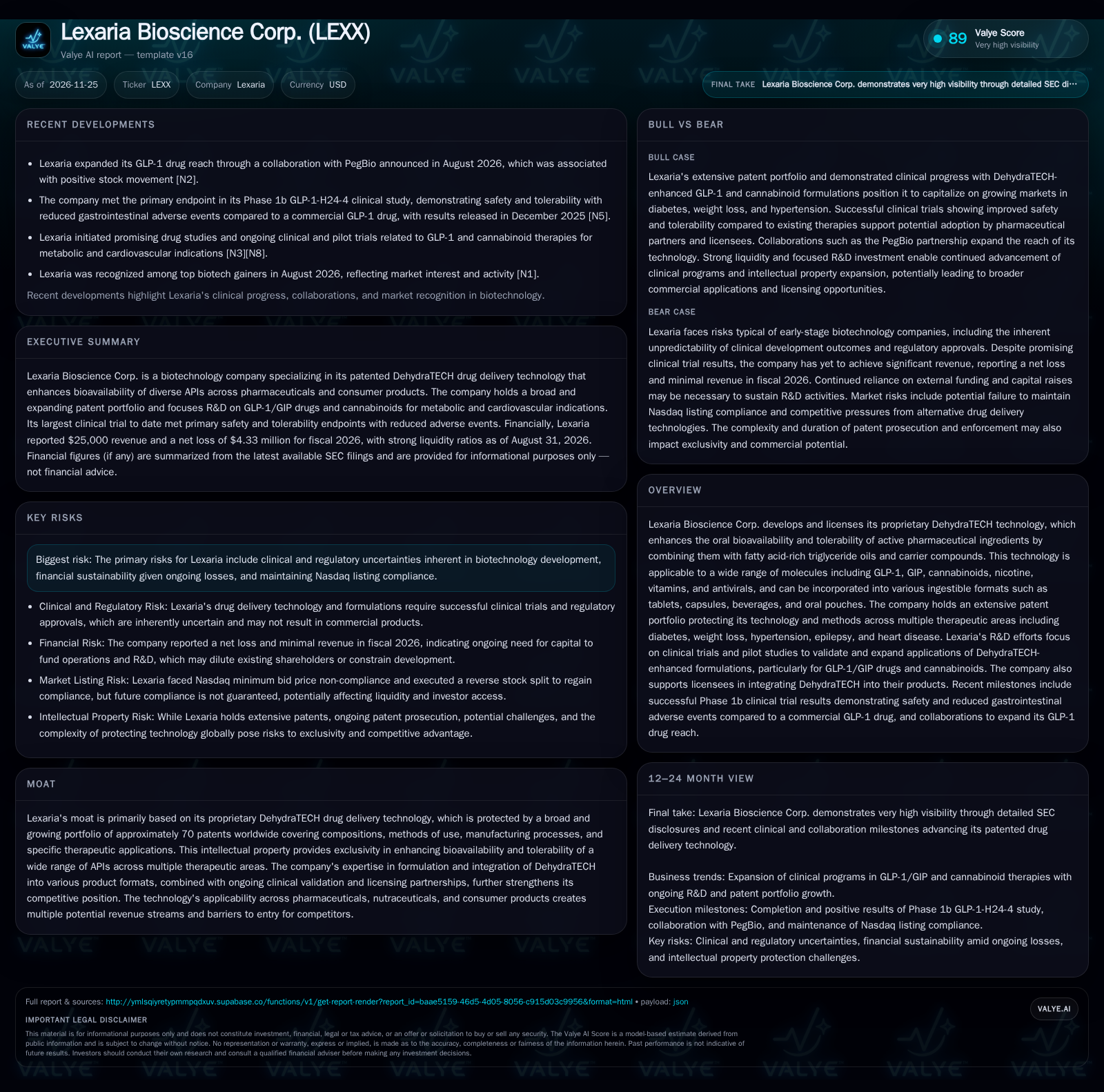
Lexaria Bioscience’s DehydraTECH platform has demonstrated notable reductions in gastrointestinal side effects versus a commercial GLP-1 drug in a 126-patient Phase 1b trial, supporting its thesis of improved tolerability for key metabolic indications. [S1] [N2] [N5]
Lexaria Bioscience stands at a critical inflection point: its proprietary DehydraTECH platform is showing tangible clinical promise in the competitive GLP-1 drug delivery space, with recent trial results highlighting improved patient tolerability over established brands. Yet, Lexaria’s business model—anchored in licensing and R&D—has yet to generate meaningful revenue, underscoring the long path from technical validation to commercial success. The company’s expanding patent estate and new industry collaborations offer credible optionality, but the core question is whether DehydraTECH can translate scientific advances into sustained, scalable economic value before capital needs outpace progress.
Recent Clinical Results and Strategic Moves: Why 2026 Is a Pivotal Year
Lexaria’s most material development is the completion and positive topline results of its Phase 1b GLP-1-H24-4 clinical trial, which enrolled 126 overweight, obese, pre-diabetic, and type-2 diabetic patients. The study demonstrated that DehydraTECH-enhanced semaglutide and tirzepatide formulations achieved the primary endpoint of safety and tolerability, with gastrointestinal adverse events reduced by 54.9% and 60.6% respectively, compared to the commercial Rybelsus® control [S1] [N5]. This outcome provides clinical evidence that DehydraTECH may enable better patient compliance and differentiate partner products in a crowded metabolic drug market.
On the strategic front, Lexaria expanded its GLP-1 drug reach through a new collaboration with PegBio in August 2026, signaling interest in out-licensing its platform for broader industry adoption [N2]. Patenting momentum continues, with the estate now at 70 grants globally and new patents covering next-generation GLP-1s, epilepsy, diabetes, hypertension, nicotine, and antivirals [S1].
Licensing Economics and the Challenge of Scaling a Drug Delivery Platform
Lexaria’s business model is primarily based on licensing its DehydraTECH drug delivery technology to pharmaceutical, nutraceutical, and consumer product companies. In theory, successful clinical validation allows for upfront licensing fees, milestone payments tied to development progress, and, eventually, royalties on commercial sales. The economic engine is thus highly levered to partner adoption and the pace of licensee product development.
The company’s cost structure is dominated by R&D, with $3.1 million in fiscal 2026 R&D spend targeting GLP-1/GIP drugs and cannabinoid therapies [S1]. Fixed costs are relatively modest compared to traditional biotech firms with in-house manufacturing or large clinical programs, but Lexaria’s negligible revenue base means losses will persist until partners reach commercial scale.
Operating leverage could be significant if DehydraTECH is adopted across multiple high-volume drugs or consumer products, as incremental licensing and royalty revenue would flow with low associated variable cost. However, until regulatory approvals and commercial launches are achieved by licensees, Lexaria’s revenue mix will remain lopsided—dominated by R&D outlays and patent prosecution expenses.
Patent Estate, Differentiation, and the Realities of Drug Delivery Competition
Lexaria’s core competitive asset is its DehydraTECH technology, protected by 70 patents covering a wide range of compositions, manufacturing methods, and therapeutic applications [S1]. This intellectual property could provide meaningful barriers to entry, especially if DehydraTECH’s clinical benefits—such as improved tolerability and bioavailability—are confirmed in further studies and real-world use.
Competition in the drug delivery sector is intense, with numerous established and emerging technologies targeting the same oral bioavailability and tolerability problems. Alternative approaches include nanoparticle carriers, lipid-based formulations, and proprietary oral delivery mechanisms developed by larger pharmaceutical companies. The key differentiator for Lexaria is the breadth of its patent coverage and the ability to demonstrate clinical outcomes (such as reduced gastrointestinal side effects) that translate into partner and patient value.
A major counterforce is the inertia of pharmaceutical incumbents: switching to new delivery technologies involves regulatory risk, reformulation costs, and the challenge of proving superiority over existing methods. Lexaria’s licensing model must overcome these hurdles by generating compelling data and forging deep collaborations, as seen in its recent PegBio partnership [N2].
How DehydraTECH Could Become a Standard in Oral Metabolic Drug Delivery
The bullish scenario for Lexaria centers on rapid validation and adoption of DehydraTECH as a preferred oral delivery platform for metabolic drugs, particularly GLP-1 agonists. If upcoming clinical trials (in larger and more diverse populations) replicate or improve upon the reduced gastrointestinal side effects seen in the Phase 1b GLP-1-H24-4 study, Lexaria could attract major pharmaceutical partners seeking to differentiate their products or extend patent life through reformulations.
Widespread licensing of DehydraTECH could generate upfront payments, development milestones, and ultimately, royalty streams from high-volume diabetes and weight loss drugs. Expansion into adjacent indications—such as cannabinoids for hypertension or epilepsy—could further broaden the addressable market. The PegBio collaboration may serve as a proof point, and additional deals with larger pharma would confirm the thesis.
Key confirming evidence would include new multi-year licensing agreements with material upfront and milestone economics, progress into later-stage clinical trials by partners, and regulatory approvals for DehydraTECH-enabled products. Commercial product launches or royalty disclosures would strongly validate the business model.
Incremental Progress: Clinical De-Risking but Slow Commercial Uptake
The most plausible trajectory is one of continued scientific and clinical advancement, but modest near-term revenue. Lexaria is likely to progress additional pilot and early-stage clinical studies across its GLP-1, GIP, and cannabinoid programs, gradually building a larger body of evidence for DehydraTECH’s utility. Patent coverage may continue to expand, and new collaborations or pilot projects with mid-sized industry players may materialize.
However, the pace of partner adoption will probably remain measured: pharmaceutical companies are slow to integrate new delivery technologies, particularly when existing drugs already have extensive safety and efficacy data. As a result, Lexaria may see some incremental licensing revenue and small pilot agreements, but not transformational deals or commercial royalties in the next 12–24 months.
Evidence for this scenario would be continued R&D investment, additional patent filings, and a steady pipeline of pilot studies or small-scale license announcements, but persistent operating losses and minimal top-line growth.
When Technical Validation Fails to Convert: The Risk of Prolonged Pre-Commercial Stagnation
The adverse scenario is one where Lexaria’s clinical results, while promising, fail to convince major pharmaceutical or consumer product partners to adopt DehydraTECH at scale. Regulatory delays, unforeseen adverse events in later-stage trials, or lack of clear commercial differentiation could stall licensing momentum.
Persistent minimal revenue and ongoing net losses would force Lexaria to seek dilutive capital raises or downsize operations. The company might struggle to maintain Nasdaq listing compliance or could be forced to monetize patents at suboptimal terms. Competitors with more established platforms or deeper industry relationships could capture the lion’s share of new delivery reformulation opportunities.
Evidence supporting this thesis would include failed or delayed clinical programs, lack of new licensing agreements, continued single-digit revenue figures, and public disclosures of financing constraints or restructuring.
Milestones That Will Determine If Lexaria’s Platform Becomes a Commercial Reality
Progression of DehydraTECH-enabled drugs into larger, later-stage clinical trials—especially GLP-1 or cannabinoid candidates—would be a critical indicator of regulatory and partner confidence.
Disclosure of new multi-year licensing agreements with significant upfront payments or milestones would demonstrate commercial validation beyond pilot studies.
Material increases in recognized revenue, especially from licensing or royalty streams tied to third-party product launches, would test the thesis that DehydraTECH can scale economically.
Updates on the PegBio collaboration—such as advancement into clinical programs or expansion of the partnership—would clarify the platform’s appeal to global pharma players.
Tracking R&D spend and cash burn rates (if disclosed) will provide early warning of capital needs or the necessity for new financing.
Monitoring Nasdaq listing compliance and any public communications about reverse splits, delisting risk, or restructuring.
Patent litigation outcomes, oppositions, or new grants—especially in key geographies—could affect the scope and duration of Lexaria’s competitive advantage.
If disclosed, metrics on partner pipeline size, number of active licensing discussions, or conversion rates from pilot to commercial agreements would help test adoption dynamics.
Disclaimer: This is research-only, informational analysis and not investment advice. It may include AI-generated interpretation and general industry context. Always verify important details using primary sources.

Comments