
Aspira Women's Health: Proprietary Diagnostics, Clinical Validation, and Capital Constraints Define the Next Chapter
Aspira Women's Health stands at the crossroads of clinical promise and financial vulnerability, with proprietary AI-driven diagnostics for gynecologic diseases, ongoing product development, and insufficient capital to sustain operations through 2026. The company's ability to convert clinical validation and market partnerships into durable revenue faces immediate challenges from cash scarcity and the competitive landscape.
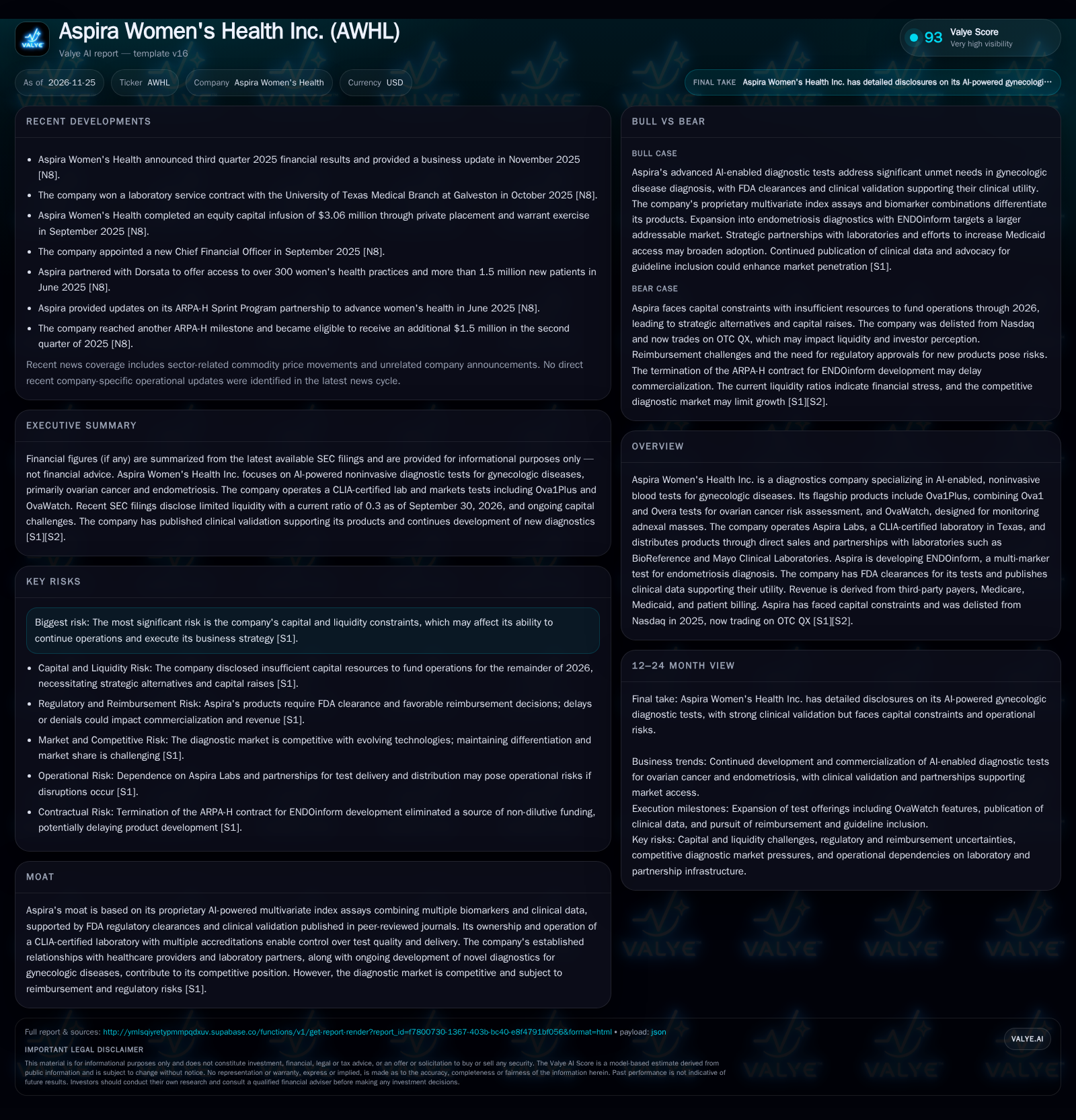
Aspira Women's Health commercializes FDA-cleared, AI-enabled blood tests for ovarian cancer and is developing diagnostics for endometriosis. Its proprietary assays and clinical data offer differentiation, but the company’s capital resources are insufficient for operations through 2026, forcing it to seek strategic alternatives. Market penetration depends on expanding payer access, guideline inclusion, and successful new product launches amid reimbursement and competitive pressures. [S1] [S2]
Aspira Women's Health Inc. exemplifies the tension between innovative clinical technology and financial fragility in the diagnostics sector. Its AI-enabled, noninvasive blood tests for ovarian cancer—validated by the FDA and supported by peer-reviewed studies—offer a differentiated solution in women's health. However, the company’s acute capital shortage and recent delisting from Nasdaq underscore the urgent need to translate clinical promise into sustainable business momentum. The next phase for Aspira will be determined not just by scientific progress but by its ability to secure funding, expand market access, and withstand reimbursement and competitive headwinds. [S1] [S2]
Liquidity Crisis Overshadows Clinical and Regulatory Achievements
Aspira Women's Health's financial position as of September 30, 2026, is precarious: cash and equivalents stood at just $12,000, with current assets of $1.85 million against current liabilities of $6.1 million, producing a current ratio of 0.3 and a cash ratio of zero. This capital insufficiency has forced the company to pursue strategic alternatives and additional capital raises, as it cannot fund operations through the remainder of 2026. [S2]
Despite these constraints, the company continues to operate Aspira Labs, a CLIA-certified laboratory, and markets FDA-cleared diagnostic tests—Ova1Plus and OvaWatch—for ovarian cancer risk assessment. OvaWatch remains the only commercially available blood test for risk assessment in women with indeterminate or benign adnexal masses. [S1]
Aspira was delisted from Nasdaq in April 2025 and now trades on OTC QX, a development that may impact liquidity and investor confidence. The company also suffered the termination of a key ARPA-H contract for ENDOinform, removing a source of non-dilutive funding for its endometriosis diagnostic pipeline. [S1] [S2]
Revenue Mechanics, Cost Structure, and the Challenge of Scaling Diagnostics
Aspira generates revenue from its proprietary diagnostic tests, primarily through third-party payers (including Medicare and Medicaid), direct patient billing, and client bill accounts. The company’s economics are shaped by test volumes, reimbursement rates, and the mix of payer types—factors that are highly variable and driven by payer coverage decisions, guideline inclusion, and physician adoption. [S1]
The existence of a CLIA-certified lab allows Aspira to capture a greater share of the testing value chain, but also commits the company to a fixed cost base (lab operations, regulatory compliance, sales force) that requires scale to achieve positive operating leverage. At low test volumes, laboratory diagnostics businesses typically face negative operating leverage, as fixed costs outweigh gross profit per test.
With cash near zero and liabilities exceeding current assets, Aspira has little room for error. The company’s ability to convert clinical validation into payer adoption and sustained test volumes is critical. If reimbursement is expanded—particularly among Medicaid and commercial insurers—Aspira could see improved revenue per test and margin expansion. Conversely, reimbursement delays or unfavorable coverage decisions may keep volumes and revenue subdued.
The loss of the ARPA-H contract for ENDOinform heightens reliance on internally funded R&D or dilutive capital raises to advance its endometriosis pipeline, raising the bar for sustainable investment in new product development. [S1]
Proprietary Assays and Clinical Data Offer Differentiation—But Not Immunity from Market Forces
Aspira’s moat rests on its proprietary AI-powered multivariate index assays—combining multiple biomarkers and clinical data—and its status as the only provider of a commercial blood test for ovarian cancer risk assessment in certain patient populations. FDA de novo and 510(k) clearances for Ova1 and Overa, plus peer-reviewed clinical validation, provide regulatory and scientific credibility. [S1]
The company’s distribution partnerships with major labs (BioReference, Mayo Clinical Laboratories) and a direct sales force expand its reach, but do not guarantee rapid adoption or recurring revenue. Payer coverage, physician awareness, and inclusion in professional guidelines are all required to drive durable demand.
Competition in the women’s health diagnostics space is intense, with established laboratory chains, academic centers, and emerging diagnostics startups all vying for share. The threat of new noninvasive tests, improvements in imaging, or broader adoption of alternative molecular diagnostics could erode Aspira’s first-mover advantage. Pricing pressure and the need to continually validate clinical utility may further challenge margins.
Longer-term, Aspira’s ability to expand into adjacent indications (like endometriosis with ENDOinform) could broaden its addressable market, but execution risk is elevated without robust funding and with the loss of external grant support.
Clinical Integration and Payer Adoption Unlock Revenue Inflection
The most favorable scenario for Aspira is predicated on a sequence where ongoing publication of clinical data and successful advocacy efforts win inclusion of Ova1Plus and OvaWatch in major professional society guidelines. This, in turn, drives broader payer coverage and reimbursement, especially among commercial insurers and Medicaid. As coverage expands, ordering physicians increase test utilization, driving higher volumes through Aspira Labs and partner networks.
If Aspira can secure additional non-dilutive funding or complete a strategic transaction (such as a partnership or acquisition), it could alleviate short-term capital pressures and fund the ENDOinform pipeline to commercial launch. This would expand the company's offering to the large and underserved endometriosis market, potentially unlocking a new revenue stream.
Confirmation of this scenario would come from new coverage decisions by major payers, positive guideline updates, and a sharp uptick in reported test volumes and revenue. Evidence of sustained, positive operating cash flow and new clinical partnerships would further validate the thesis.
Clinical Validation Maintains a Niche While Capital Constraints Limit Expansion
The most plausible middle path is one in which Aspira continues to operate at a subsistence level, relying on incremental test volume growth and piecemeal capital raises to fund operations. Clinical validation and FDA clearances maintain a differentiated position in ovarian cancer diagnostics, but lack of guideline inclusion and slow payer adoption keep volumes modest.
The company may be forced into further dilution or asset sales to extend its runway, potentially delaying ENDOinform commercialization. OvaWatch and Ova1Plus remain niche products, used primarily by a subset of physicians already familiar with the tests. Competitive encroachment and reimbursement headwinds cap growth, while the company’s operational footprint is sized to current demand.
This scenario would be confirmed by continued low revenue, minimal test volume growth, and ongoing disclosures of capital raises or strategic alternatives. Any improvement in payer coverage or professional guideline status would be incremental rather than transformative.
Liquidity Exhaustion Triggers Operational Disruption or Forced Sale
In the downside scenario, Aspira’s acute capital shortfall results in its inability to meet obligations, leading to operational disruption, layoffs, or cessation of laboratory activities. Without new funding or a strategic transaction, the company may be forced to pursue a distressed asset sale or bankruptcy protection.
Failure to achieve expanded payer coverage or guideline inclusion would leave test volumes stagnant, while competitive advances in diagnostics could capture any incremental market growth. The loss of the ARPA-H contract and lack of alternative funding would halt ENDOinform development, further eroding the company’s future prospects.
Clear signs of this scenario would include missed payments to suppliers, regulatory compliance lapses, abrupt staff reductions, or public disclosure of bankruptcy proceedings. A steep drop in reported test volumes or loss of key distribution partners would also signal imminent distress.
Milestones and Metrics That Will Determine Aspira’s Ability to Convert Science into a Sustainable Business
Reported test volumes for Ova1Plus and OvaWatch—if disclosed—will indicate whether clinical validation is translating into real-world adoption and revenue growth.
Updates on payer coverage expansion, particularly from commercial insurers and Medicaid, would provide evidence of improved reimbursement and pricing power.
Progress toward inclusion in professional society guidelines for ovarian cancer risk assessment would signal greater clinical acceptance and potential for market expansion.
Announcements regarding new capital raises, strategic partnerships, or non-dilutive funding will directly impact Aspira’s ability to sustain operations and advance its pipeline.
Development milestones and clinical study results for ENDOinform will clarify the likelihood and timing of commercial entry into the endometriosis diagnostics market.
Changes in operational footprint—such as lab consolidation, staff reductions, or shifts in sales strategy—may reflect either efficiency gains or distress-driven retrenchment.
Any evidence of asset sales, licensing deals, or overtures for acquisition could signal that management is prioritizing monetization over independent growth.
Disclosures of regulatory or accreditation status for Aspira Labs would help confirm ongoing operational viability.
Disclaimer: This is research-only, informational analysis and not investment advice. It may include AI-generated interpretation and general industry context. Always verify important details using primary sources.

Comments