
Magnera Corp: Restructuring, Leverage, and Converting Operating Gains into Sustainable Profitability
Magnera’s recent merger and ambitious cost-saving program have positioned it at a crossroads: while restructuring efforts and positive operating cash flow offer a pathway toward profitability, persistent net losses and high interest costs highlight the risk that gains at the operating level may not translate into lasting shareholder value without further structural change.
Near-term performance will hinge on the successful execution and realization of cost-savings, as well as the management of financial leverage. [S1] [S2] [N1] [N2]
Magnera Corp, recently formed through its merger with Glatfelter, is navigating a complex restructuring phase aimed at reversing persistent net losses and positioning the company for sustainable profitability.Despite achieving positive operating income and maintaining a reported current ratio, Magnera’s bottom line remains burdened by substantial interest expenses and restructuring costs. The ongoing Project CORE program is central to Magnera’s turnaround thesis, but its success will depend on the company’s ability to translate operational improvements into lasting net gains, reduce financial leverage, and manage the uncertainties inherent in large-scale organizational change.
Recent Financial Results Reflect Both Progress and Ongoing Obstacles
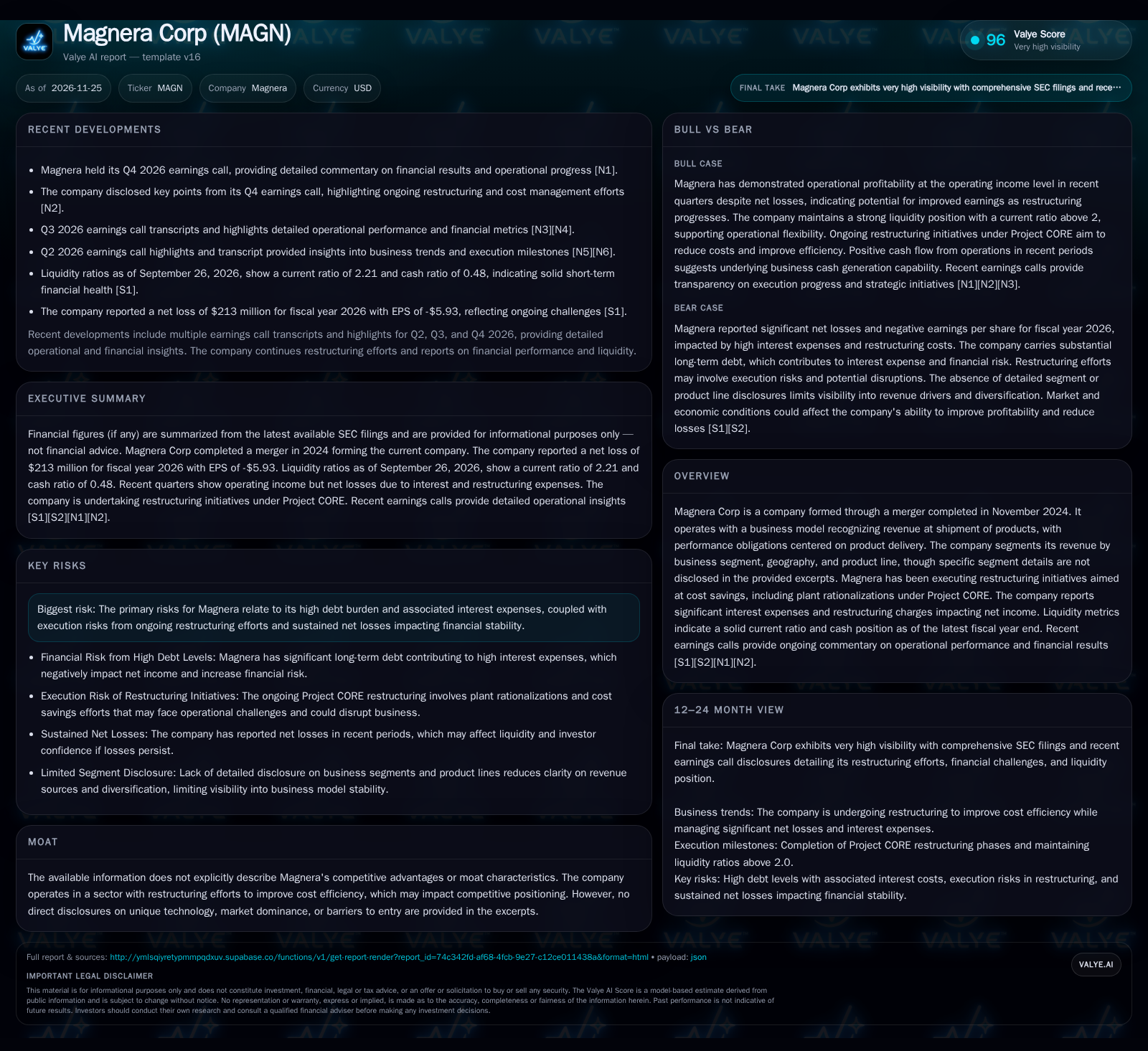
The most material current facts shaping Magnera’s outlook are: 1) a net loss of $213 million for fiscal 2026 with EPS of -$5.93, 2) positive operating income in recent quarters (e.g., $22 million in Q2 2026), 3) a current ratio of 2.21 and $294 million in cash as of September 2026, and 4) ongoing restructuring under Project CORE targeting cost savings via plant rationalizations. These facts matter because they reveal a company with underlying operational momentum and liquidity, but one still unable to deliver net profitability due to heavy interest and restructuring burdens. However, without further progress on cost reductions and debt management, the risk remains that operating gains will not translate into durable value. [S1] [S2] [N1] [N2]
Examining Magnera’s Revenue-to-Earnings Conversion Dynamics
Magnera’s core business economics are anchored in product sales, with revenue recognized at shipment. The company’s reported positive operating income in recent quarters signals that gross margins and basic operating leverage are at least sufficient to cover direct costs and some overhead, even under restructuring. However, high interest expense ($37 million in Q2 2026 alone) and ongoing restructuring charges are consuming all operating gains and driving net losses. The variable cost structure is likely dominated by raw materials, energy, and labor, making the business sensitive to input price volatility and efficiency gains from plant rationalizations.
Fixed costs are being actively addressed through Project CORE, which targets plant closures and other rationalizations to reduce structural overhead. Capital expenditures ($44 million in Q2 2026) reflect ongoing investment needs, though the absence of major new borrowing suggests a focus on internal funding.
Magnera’s funding needs are shaped by its debt load—substantial enough to generate ongoing high interest expense—and by the requirements of its restructuring program. If Project CORE delivers the targeted cost savings, and if operational cash generation continues, the company could gradually reduce leverage and improve net profitability. However, the absence of segment-level data makes it difficult to assess whether some business lines are cross-subsidizing weaker segments, or if there are hidden structural drags.
Competitive Impact of Restructuring Amid Uncertain Moat and Visibility
Magnera’s competitive position is defined less by explicit product or competitive position and more by its current restructuring drive. The merger with Glatfelter may offer untapped scale or synergy potential, but the available evidence does not establish clear technology, brand, or distribution advantages. In capital-intensive, manufacturing-driven sectors, cost structure is often a key competitive weapon, and Project CORE’s plant rationalizations could, in theory, lower Magnera’s cost base relative to peers.
However, this advantage is conditional: if competitors are also rationalizing or if cost savings are offset by revenue declines or execution disruptions, the benefits may prove transitory. The lack of segment disclosure makes it difficult to benchmark Magnera’s margins, growth, or exposure to specific end-markets against relevant competitors—whether these are specialty materials, packaging, or industrial manufacturers. Substitution risk is likely present if Magnera’s products are commoditized, and customer switching costs may be low absent proprietary technology or long-term contracts. True competitive advantages, such as proprietary processes, scale economies, or differentiated customer relationships, are not clearly evidenced in the supplied disclosures.
Unlocking Net Profitability Through Cost Reductions and Operating Leverage
The most favorable scenario for Magnera is that Project CORE achieves or exceeds its targeted cost savings, driving a step-change in structural margins and allowing positive operating income to flow through to the bottom line. This outcome would likely require: 1) successful execution of plant closures and rationalizations with minimal disruption, 2) stabilization or improvement in gross margins—perhaps through a combination of improved procurement, pricing discipline, or mix, and 3) sufficient operating cash flow to begin reducing debt and, correspondingly, interest expense.
Confirmation would come from several fronts: a sustained trend of positive net income (not just operating income), declining interest expense as debt is paid down, and evidence—if disclosed—of improved efficiency ratios or segment profitability. Additional signals would include management commentary on realized synergies from the merger and the completion of major Project CORE milestones. Falsification would be apparent if cost savings fail to materialize, if restructuring charges persistently offset any operating gains, or if competitive or macro headwinds erode top-line growth, making cost cuts insufficient to restore net profitability.
Incremental Improvements from Restructuring Tempered by Debt and Execution Risks
The most plausible middle path is that Magnera continues to generate positive operating income and operating cash flow, but progress on net profitability is slow and uneven. Project CORE delivers some cost savings, but execution challenges, ongoing restructuring charges, and the drag of high interest expense limit the pace and magnitude of improvement.
Evidence for this scenario would include continued positive operating income and cash flow, but only gradual narrowing of net losses. Interest expense remains a significant drag, and restructuring charges recur, albeit at a potentially declining rate. Management commentary may focus on incremental wins, partial completion of restructuring milestones, and careful cash management.
Operating Gains Threatened by Disruptions and Heavy Debt Load
The negative scenario is that Project CORE encounters significant execution problems—such as higher-than-expected costs, operational disruptions, or revenue loss from plant closures—while macroeconomic or competitive pressures further erode gross margins. In this case, positive operating income could evaporate, or restructuring charges could continue to offset any operational gains. High interest expense becomes an even larger percentage of shrinking cash flow, limiting the company’s ability to reduce leverage or invest for growth.
This scenario would be confirmed if operating income turns negative again, cash flow from operations turns flat or negative, and liquidity ratios begin to deteriorate. Additional warning signs would include an uptick in restructuring or impairment charges, management guidance revisions, or the need to seek new external financing.
Indicators of Magnera’s Restructuring Effectiveness and Financial Recovery
Sustained positive net income—not just operating income—across future quarters, which would indicate that cost savings and operational improvements are reaching the bottom line.
Trend in interest expense and total debt; a meaningful reduction would support the thesis that operating cash flow is being used to deleverage and strengthen the balance sheet.
Completion milestones and quantified cost savings from Project CORE, as disclosed in filings or earnings calls; these are critical to validating the restructuring thesis.
Segment-level or product-line profitability, if disclosed, to assess whether improvements are broad-based or concentrated in specific areas.
Operating cash flow consistency; deterioration here would raise questions about the sustainability of any reported operating income.
Magnitude and persistence of restructuring charges; a failure to wind these down would suggest ongoing disruption and limited progress.
Management commentary on realized synergies from the merger and specific execution risks, as detailed in future earnings calls or SEC filings.
Disclaimer: This is research-only, informational analysis and not investment advice. It may include AI-generated interpretation and general industry context. Always verify important details using primary sources.

Comments