
Compass Minerals: Navigating Mixed Profitability and Structural Liquidity Limits Amid Commodity Cycles
Compass Minerals International closed fiscal 2026 with positive net income, but recent quarters show widened losses and a notably reported cash balance. The company’s operational model hinges on commodity price dynamics, fixed-cost leverage, and the ability to fund working capital through cyclical swings—raising questions about resilience and upside potential in a volatile mining landscape.
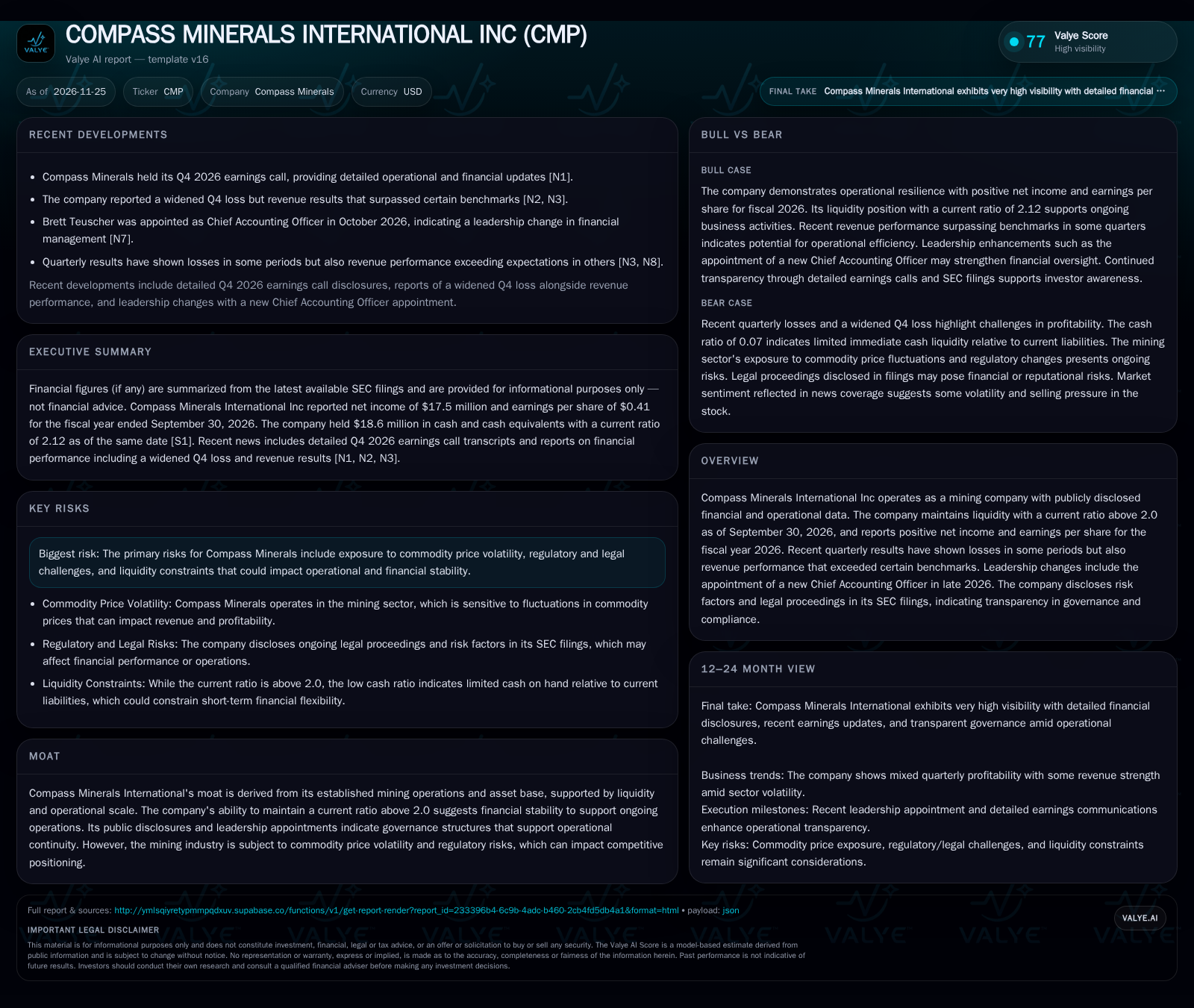
Compass Minerals reported $17.5 million in net income for fiscal 2026 and reported liquidity-ratio trends of 2.12, but quarterly losses widened in Q4 and the cash ratio remains low at 0.07.
Compass Minerals International (CMP) enters the end of 2026 with a complex financial profile: positive net income for the fiscal year, but a widened loss in the most recent quarter and a balance sheet that pairs ample current assets with a very reported cash balance. The company’s business model—rooted in commodity mining—exposes it to sharp swings in both input costs and end-market pricing, while its capital structure and liquidity management are under heightened scrutiny amid these cycles. The recent appointment of a new Chief Accounting Officer and continued disclosure of legal risks add further layers to Compass’s evolving operational story.
Fiscal 2026 Snapshot: Profitability, Liquidity, and Recent Performance Crosscurrents
Compass Minerals reported net income of $17.5 million and earnings per share of $0.41 for the year ended September 30, 2026, providing evidence of annual profitability [S1]. However, the company’s most recent quarter featured a widened loss, even as revenue results came in ahead of some expectations [N2] [N3]. At the end of the fiscal year, Compass held $18.6 million in cash and cash equivalents, with current assets totaling $537 million and current liabilities of $253.7 million, resulting in a current ratio of 2.12 but a cash ratio of just 0.07 [S1]. This juxtaposition underscores a business that, while able to cover current liabilities with overall liquid assets, operates with limited immediate cash on hand. The appointment of Brett Teuscher as Chief Accounting Officer in October 2026 suggests heightened attention to financial oversight and reporting [N7].
How Compass Minerals’ Cost Structure and Revenue Drivers Shape Earnings Volatility
Compass Minerals’ core business model revolves around the extraction and sale of minerals such as salt and specialty fertilizers—products whose pricing is driven by global commodity markets and regional demand cycles. Revenue is fundamentally a function of sales volumes and realized prices, which can swing sharply with weather patterns, agricultural cycles, and broader economic conditions. Fixed costs—particularly for mine operations, equipment maintenance, and labor—are significant, meaning that margin performance is highly sensitive to both production volumes and pricing realizations. When volumes or prices drop, fixed costs are spread over fewer units, compressing margins and increasing the risk of operating losses. Conversely, favorable price or volume environments can quickly expand margins due to operating leverage.
The company’s working capital needs are substantial, as inventory buildup and receivables can grow during periods of weak demand or slow customer payment. This structure can leave Compass exposed if sales are delayed or collections slow, especially during commodity downturns. Capital expenditures for mine maintenance and compliance are recurring, and legal proceedings or regulatory changes can trigger unplanned costs, further straining cash resources.
The sensitivity of Compass Minerals’ earnings to commodity price fluctuations is further amplified by the fixed-cost intensity of mining operations. This cost structure means that even modest declines in realized prices or production volumes can disproportionately erode profitability. Moreover, the company’s ability to adjust variable costs in response to market conditions is limited in the short term, constraining operational flexibility. In addition, the cyclical nature of capital expenditures—necessary to maintain asset integrity and regulatory compliance—introduces timing risks that can exacerbate cash flow volatility. Effective cost management and strategic timing of investments are therefore crucial to smoothing earnings across commodity cycles.
Competitive Dynamics: Asset Scale, Substitution Risk, and the Limits of Differentiation
In the mining sector, Compass Minerals’ competitive position is underpinned by its established asset base and operational scale, which can provide cost advantages in high-volume years. However, the commoditized nature of its main products—such as highway deicing salt and agricultural minerals—limits pricing power, as buyers can often switch to alternative suppliers or substitute products in response to price hikes or supply disruptions. Larger, diversified mining firms and regional producers represent the primary competitive set, with some niche players specializing in particular minerals or geographic markets.
Technological substitution risk is relatively low in the core salt business but could be more pronounced in specialty fertilizer markets, where synthetic or alternative soil amendments may gain share depending on price and regulatory trends. The ability to maintain long-term customer relationships depends on reliable delivery, cost competitiveness, and compliance with environmental and safety standards. Legal proceedings or regulatory scrutiny—both disclosed as ongoing risks—can also affect Compass’s reputation and customer retention.
From a competitive standpoint, Compass Minerals must navigate the tension between scale advantages and the commoditized nature of its products. While larger operations can achieve lower unit costs through economies of scale, the lack of significant product differentiation limits pricing autonomy. This dynamic places a premium on operational efficiency and supply chain reliability as key differentiators. Furthermore, geographic concentration of assets can expose the company to localized risks, such as regulatory changes or environmental constraints, which competitors with more diversified footprints might better absorb. Sustained investment in compliance and environmental stewardship may thus serve not only as risk mitigation but also as a competitive barrier to entry for smaller players.
Margin Expansion If Commodity Prices Rebound and Operational Discipline Holds
The most plausible upside scenario for Compass Minerals is a combination of rising commodity prices—driven by favorable demand in deicing, agriculture, or industrial end-markets—and improved cost control. Higher realized prices would allow Compass to spread its fixed costs over larger revenue streams, dramatically boosting margins due to the operating leverage inherent in its mining operations.
Confirmation of this scenario would come from sustained positive net income in upcoming quarters, improved cash generation, and evidence of reduced quarterly earnings volatility. Additional signs would include timely resolution of legal proceedings and minimal unplanned regulatory or compliance costs. A re-rating of the company’s credit standing or the ability to self-fund capital expenditures would further validate the upside case.
Volatility Persists: Navigating Commodity Swings and Funding Constraints
The most likely path for Compass Minerals is continued exposure to commodity price and volume swings, resulting in alternating periods of profitability and quarterly losses.
This scenario is supported if quarterly earnings continue to oscillate around breakeven, with sporadic revenue beats but persistent margin pressure. The company’s ability to avoid major legal or regulatory hits, maintain core customer relationships, and limit capital spending to maintenance levels would confirm this middle path. Any significant shift in commodity pricing or regulatory regime could, however, quickly tilt the outcome toward the upside or downside.
Liquidity Squeeze and Margin Compression from Prolonged Commodity Downturn
In a sustained commodity price downturn—potentially triggered by a mild winter (reducing salt demand), weak agricultural cycles, or global oversupply—Compass Minerals could face extended periods of negative operating cash flow. Fixed costs would weigh heavily on margins, and any escalation in legal or regulatory costs could exacerbate the situation.
Confirmation of this scenario would include several consecutive quarters of operating losses, declining current assets as inventories are drawn down, and increasing short-term borrowings or credit facility usage. Delays in legal resolutions, customer defections, or unplanned capital needs would further stress the balance sheet and could trigger covenant issues or asset sales. Persistent negative news coverage or management turnover would reinforce downside risk.
Testing Compass Minerals’ Resilience: What Will Confirm or Challenge the Investment Thesis?
Quarterly net income and operating cash flow trends: Consistent profitability or return to losses will indicate whether margin improvements are durable.
Cash conversion cycle and working capital efficiency: If disclosed, improvements or deterioration in inventory days, receivables collection, and payables management will signal liquidity health.
Commodity price indices for salt and specialty fertilizers: External benchmarks will provide real-time context for revenue expectations.
Legal proceeding updates and regulatory disclosures: Material developments here could create new costs or operational constraints.
Capital expenditure levels versus depreciation: If disclosed, this will reveal whether Compass is investing for growth or merely maintaining existing assets.
Management commentary on customer retention and contract renewals: Would help test whether the company is maintaining pricing power and customer loyalty.
Short-term borrowing or credit facility usage: If disclosed, increased reliance may signal liquidity stress.
Disclaimer: This is research-only, informational analysis and not investment advice. It may include AI-generated interpretation and general industry context. Always verify important details using primary sources.

Comments