
J&J Snack Foods: Margin Structure, Product Breadth, and the Levers of Durable Profitability
The long-term thesis rests on the company's ability to leverage its product and distribution network, while cost pressures and shifting consumer preferences test the limits of operating leverage.
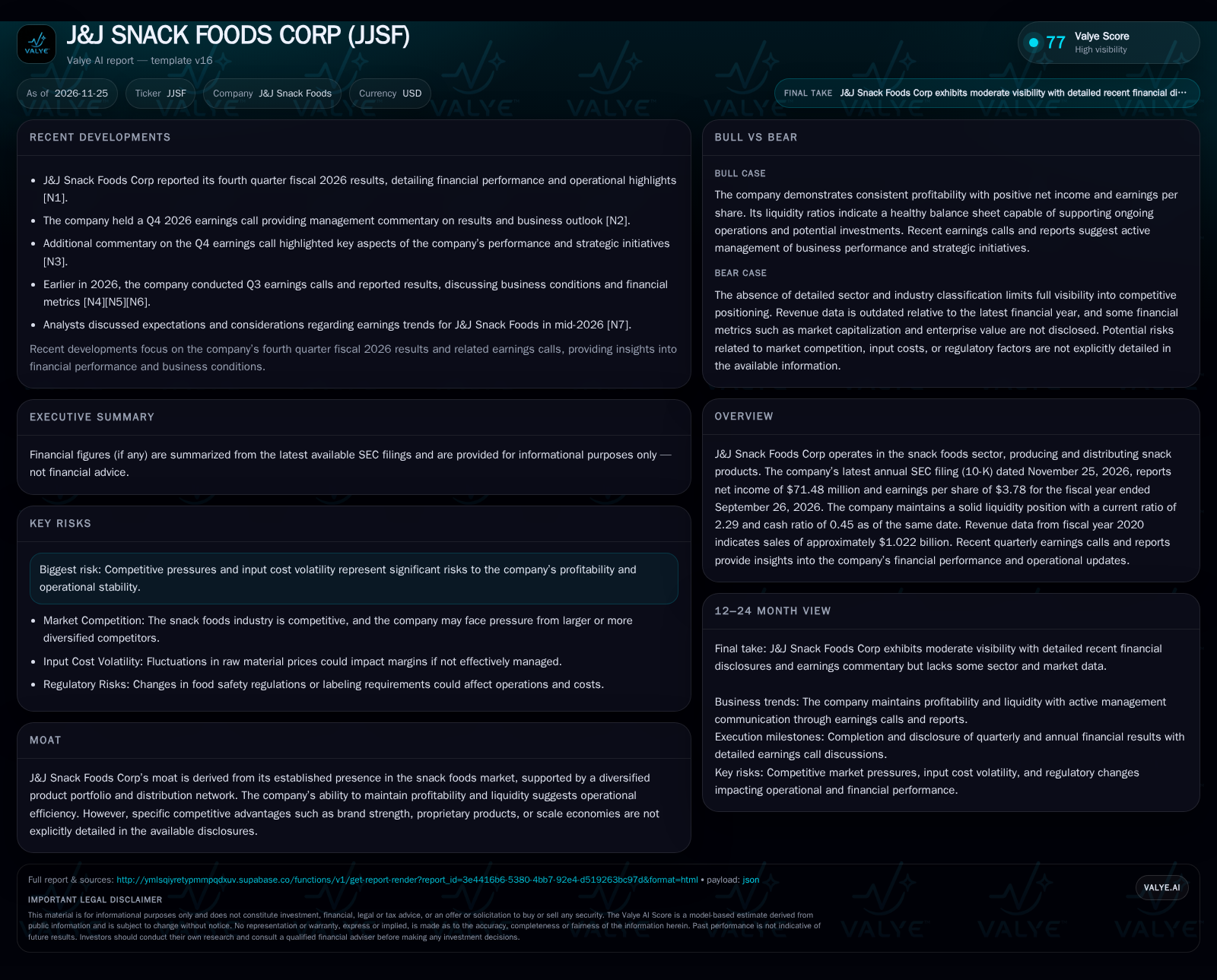
J&J Snack Foods posted $71.5 million in net income for FY26, with a reported current ratio and consistent profitability, but its competitive edge and real growth drivers are less clear. The core question is whether the company can defend or expand margins amid sector competition and input-cost volatility. Future value creation likely depends on product innovation, distribution leverage, and cost management.
J&J Snack Foods Corp closes fiscal 2026 with healthy profitability and liquidity, reporting $71.5 million in net income and a current ratio above 2. Yet the company operates in a fiercely competitive snack foods sector where shelf space, branding, and cost discipline are paramount. Without recent revenue figures or granular segment disclosure, the debate centers on whether J&J can sustain or expand margins—and thus long-term value—by leveraging its product and distribution network while navigating input cost swings and shifting consumer preferences.
Recent Financials Signal Stability, but Revenue Trajectory Is Opaque
J&J Snack Foods reported net income of $71.48 million for the fiscal year ended September 26, 2026, with basic and diluted EPS at $3.78 [S1]. As of the same date, the company had $90.25 million in cash and cash equivalents, current assets of $459.2 million, and current liabilities of $200.4 million—yielding a current ratio of 2.29 and a cash ratio of 0.45 [S1]. While these figures confirm continued profitability and a reported liquidity position, there is no updated revenue figure beyond the fiscal 2020 snapshot of $1.022 billion [S1]. This gap limits visibility into recent top-line growth or contraction, making it harder to assess the sustainability of earnings. The company’s ability to generate steady net income in a mature sector is notable, but the lack of current sales data leaves questions about underlying drivers—whether margin expansion, volume growth, or a shift in product mix is sustaining results.
How Profit Pools Are Built: Margins, Mix, and the Cost Puzzle
The economics of snack foods are shaped by a combination of high fixed costs (production, distribution) and intense price competition. Gross margins in this sector are highly sensitive to input costs—especially commodities like wheat, sugar, and oils—as well as to labor and logistics expenses. J&J Snack Foods’ ability to maintain profitability suggests effective cost management or pricing discipline, but without segment or product-level detail, it’s unclear whether this is driven by premium product mix, operational efficiency, or favorable contract structures.
Volume growth in snack foods tends to be incremental in mature markets, so margin expansion often becomes the primary lever for earnings growth. Companies that can innovate with new products, secure advantaged shelf space, or leverage scale in procurement and logistics have the potential for superior operating leverage. However, the sector is also exposed to promotional intensity and private-label encroachment, which can compress margins if companies are forced to compete primarily on price.
The company reported cash and liquidity metrics for the period; these figures do not by themselves establish operating runway, investment capacity, financial flexibility, or financing capacity.
Defending Share in a Crowded Marketplace: Advantages and Vulnerabilities
J&J Snack Foods competes in a fragmented, brand-driven food category where scale, distribution relationships, and consumer loyalty are key sources of advantage. The company’s moat is described as stemming from its established presence, diversified product portfolio, and broad distribution network. However, the absence of detail on proprietary products or unique brand assets means that true pricing power and customer stickiness remain uncertain.
Competitive pressure comes from both large multinational food conglomerates—who may benefit from greater scale in procurement and marketing—and from nimble private-label or regional players that can undercut on price or exploit local distribution. Private label has been a growing force in many snack categories, particularly as retailers seek margin and consumers trade down during inflationary periods.
Technology substitution risk is limited in core snack segments, but evolving consumer preferences—toward healthier, functional snacks or novel formats—could erode share for companies slow to innovate. The ability to respond to these shifts with new products or brand repositioning is a key test of competitive resilience.
Unlocking Value Through Mix Shift and Strategic Innovation
The strongest upside scenario for J&J Snack Foods is one where the company leverages its distribution reach and product development capabilities to launch higher-margin, on-trend snacks—such as better-for-you, allergen-free, or convenience-focused formats—gaining share in growing subcategories. Successful innovation would allow for selective pricing power and improved shelf positioning, translating into a richer product mix and expanded gross margins.
If management can also drive operational efficiencies—through automation, supply chain optimization, or procurement scale—incremental revenue growth could translate disproportionately into earnings and free cash flow, given the sector’s fixed-cost base. A positive confirmation would be disclosure of rising gross or operating margins, robust new product performance, or significant wins in new distribution channels.
Evidence that would falsify this scenario includes stagnating or shrinking margins, weak new product acceptance, or loss of key distribution partners.
Margin Stability in a Mature Market: The Most Likely Outcome
The most plausible trajectory is that J&J Snack Foods continues to operate as a solid, moderately growing company—generating stable profits and maintaining liquidity, but with limited ability to drive high single-digit or double-digit top-line growth. In this scenario, the company manages cost pressures through periodic price increases and incremental productivity gains, offsetting most but not all input volatility.
Earnings growth would be modest, reflecting the mature nature of the snack foods market and the company’s established (but not dominant) position. Market share would likely remain steady, with occasional gains or losses depending on category trends and promotional intensity. Confirmation would come from continued net income stability, current ratio maintenance, and lack of major negative surprises in earnings calls.
Falsification would be evident if the company experienced persistent margin erosion, a step-change in input costs it could not pass through, or material loss of distribution access.
Margin Compression and Share Loss: The Structural Risks
The primary downside risk is a sustained period of margin compression due to input cost spikes (e.g., commodities, labor, freight) that cannot be offset with pricing or mix improvements. In this scenario, J&J Snack Foods could be forced to compete more aggressively on price, eroding profitability. This dynamic could be exacerbated by private-label growth or a shift in consumer demand away from the company’s legacy products.
A second risk is operational disruption—such as supply chain bottlenecks or regulatory changes affecting food production or labeling—that increases costs or reduces flexibility. If the company lacks differentiated brands or innovation capacity, it could lose shelf space to better-capitalized or more agile rivals.
Evidence confirming this scenario would include declining gross and operating margins, negative net income trends, or warnings about cost pressures and lost contracts during earnings calls. Falsification would require evidence of margin resilience or successful cost pass-through.
Testing the J&J Snack Foods Thesis: What Will Reveal Enduring Strength or Weakness?
Disclosure of current-year and quarterly revenue growth versus industry benchmarks would help clarify whether J&J is gaining, holding, or losing share.
Product-level or segment margin trends—if disclosed—would illuminate the true source of profitability and signal where mix or innovation is driving value.
Gross and operating margin progression quarter-over-quarter, especially in relation to input cost movements, would test the company’s ability to defend margin.
New product launch performance or category expansion updates would indicate success in responding to evolving consumer preferences.
Customer and distribution partner retention rates—if disclosed—would reveal the stability of J&J’s commercial relationships and shelf presence.
Management commentary on input cost trends, pricing strategies, and cost pass-through effectiveness during earnings calls will be key for understanding future margin risk.
Capex and free cash flow disclosures would show whether the company is reinvesting for future growth or prioritizing cash conservation.
Disclaimer: This is research-only, informational analysis and not investment advice. It may include AI-generated interpretation and general industry context. Always verify important details using primary sources.

Comments