
Presidio Property Trust: Portfolio Diversification Meets Capital Market Pressure as Delisting Risk Intensifies
Presidio Property Trust’s unique blend of office, industrial, retail, and triple-net leased model home properties offers income diversity, but persistent losses, small scale, and an urgent Nasdaq compliance clock expose the company to existential capital market risk.
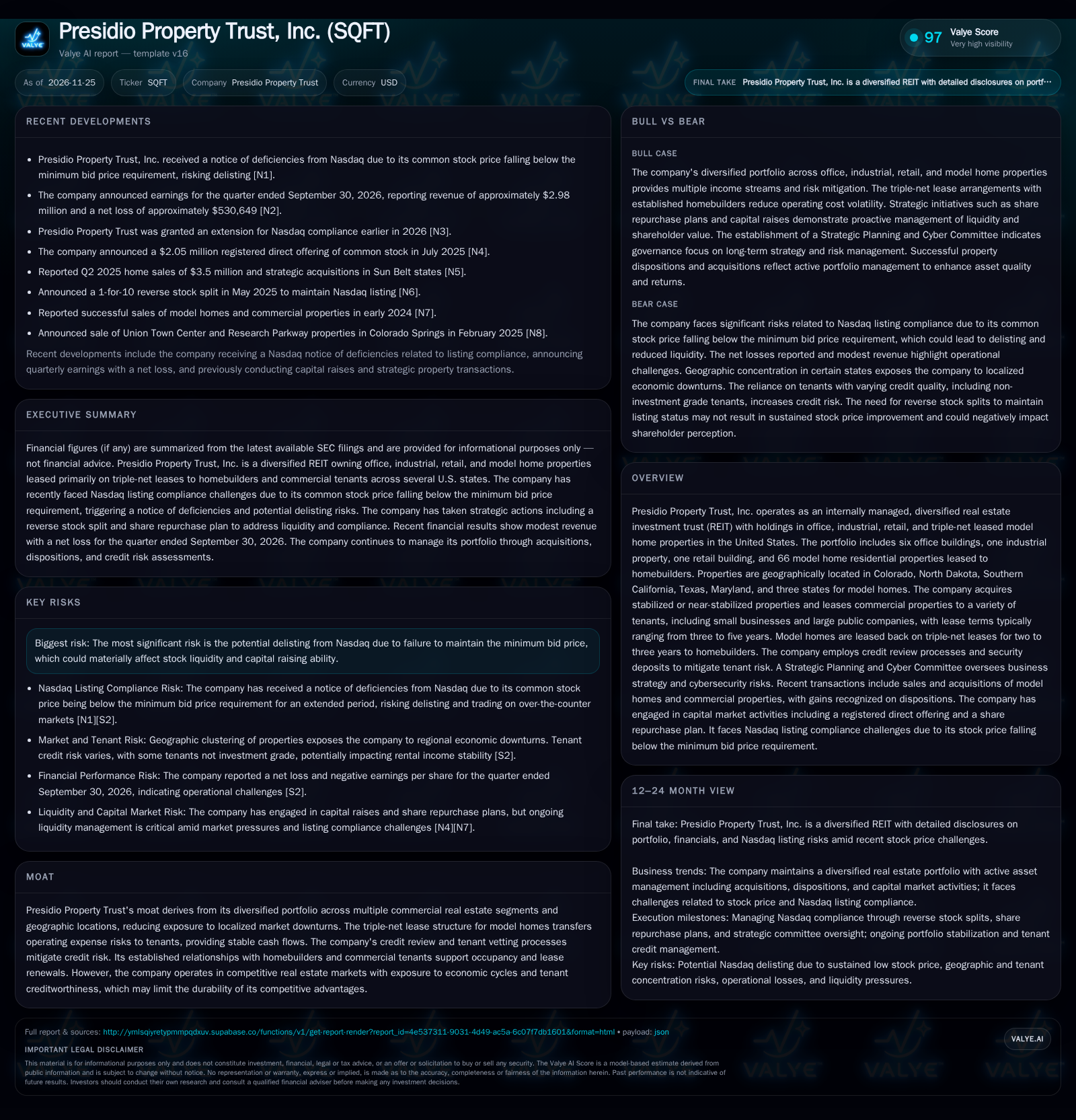
Presidio Property Trust’s diversified real estate holdings generate multiple income streams, but recent net losses and a sustained sub-$1 share price have triggered Nasdaq delisting warnings. The company’s active asset management—through property sales and acquisitions—has produced some gains, yet operational scale and tenant concentration leave it exposed to economic swings and limited access to equity capital. [S2] [N1]
Presidio Property Trust, Inc. stands at a crossroads where the logic of portfolio diversification collides with the unforgiving realities of public market compliance. Owning a blend of office, industrial, retail, and triple-net leased model home properties, the REIT has engineered some insulation from localized market shocks and tenant defaults. Yet, even as recent asset sales provided momentary relief, persistent net losses, a reported cash balance, and a shrinking market cap have put the company’s Nasdaq listing in jeopardy. With only months to regain compliance or face delisting, Presidio’s ability to maintain access to public equity capital—and thus its long-term viability as a listed REIT—hangs in the balance. [S2] [N1]
Nasdaq Compliance Crisis and Portfolio Shifts Define the Moment
As of September 30, 2026, Presidio Property Trust reported $2.98 million in revenue and a net loss of $530,649, with $6.1 million in cash and equivalents. The company owns or holds equity interests in six office buildings, one industrial property, one retail property, and 66 model homes leased to homebuilders, together totaling over 725,000 rentable square feet. [S2]
The most urgent development is the Nasdaq deficiency notice received in November 2026: Presidio’s stock price has traded below $1 for 27 consecutive business days, triggering a 180-day window to regain compliance or risk delisting. This follows a 1-for-10 reverse stock split in May 2025, which temporarily supported compliance but ultimately failed to prevent renewed price erosion. [N1] [N6] [S2]
Recent transactions highlight active asset management: the company sold the Dakota Center for $4.7 million (realizing a $3.4 million gain), disposed of 14 model homes for $6.3 million, and extinguished $16.4 million in debt via a foreclosure, posting a $1.0 million gain. These moves brought short-term capital and reduced liabilities, but did not materially change the company’s scale or loss trajectory. [S2]
How Presidio’s Income Streams and Cost Structure Shape Its Financial Reality
Presidio Property Trust’s revenue comes from leasing office, industrial, retail, and model home properties. Commercial office and industrial leases typically run three to five years with annual rental escalations, while model homes are leased back to homebuilders on two- to three-year triple-net terms, shifting operating costs, insurance, taxes, and maintenance to tenants. [S2]
The triple-net model for model homes is attractive from a margin perspective, as it reduces expense volatility and potential repair liability. However, the small scale—66 model homes and a handful of commercial buildings—means fixed costs (public company costs, property management, compliance) are spread thinly, dampening operating leverage and making profitability elusive if occupancy and rent levels slip.
Revenue mix is tilted toward office and model home segments, with geographic concentration in Colorado, North Dakota, Southern California, Texas, and Maryland. This concentration, combined with the lumpy nature of property sales and acquisitions, can produce volatile quarterly results. Presidio finances property acquisitions with a mix of cash and mortgage debt, as seen in its $9.4 million purchase of 22 model homes, partly debt-financed in 2025. [S2]
The public REIT structure imposes additional costs and the need for recurring access to capital markets. With a market cap of only $5.2 million as of June 2025 and recent registered offerings as small as $2.05 million, Presidio’s ability to scale or reposition its portfolio through equity issuance is increasingly constrained. [S1] [N4]
Diversification, Tenant Quality, and Market Exposure: Where Presidio Stands
Presidio’s primary competitive lever is diversification—across property types and regions—which is intended to buffer the company from localized downturns or tenant-specific shocks. The triple-net lease structure, particularly with established homebuilders as model home tenants, helps stabilize cash flows and reduces operational headaches. [S2]
However, the company’s small portfolio size means it lacks the scale-based cost advantages of large REITs. Its tenant base includes both investment grade and non-investment grade entities, exposing it to credit risk. The company attempts to mitigate this through credit reviews and security deposits, but in a downturn, non-investment grade tenants may default, jeopardizing cash flow.
Presidio operates in highly competitive real estate markets, facing pressure from larger, specialized REITs, private equity buyers, and local property owners. Its ability to source attractive, stabilized properties is constrained by capital availability and the need for properties to fit its diversification thesis. Geographic clustering in select states further raises vulnerability to regional recessions or sector-specific shocks (e.g., office demand shifts).
The REIT’s recent establishment of a Strategic Planning and Cyber Committee signals a governance focus on long-term resilience, but without significant scale or a truly unique asset niche, its moat remains limited and exposed to external shocks. [S2]
If Asset Management Delivers and Compliance Is Regained, What Could Change?
A favorable scenario for Presidio hinges on several events aligning: the company successfully regains Nasdaq compliance—perhaps through organic share price recovery, another reverse split, or a positive catalyst from asset dispositions or lease-up activity. This would preserve access to public equity markets, supporting future acquisitions and refinancing.
Operationally, continued gains on property sales (such as the $3.4 million gain on Dakota Center) and accretive acquisitions could improve the earnings profile. If office and model home occupancy rates remain high and rent escalations are realized, Presidio could edge toward breakeven or modest profitability, improving market perception and supporting a higher share price.
Evidence for this scenario would include: a sustained share price above $1, new property acquisitions that are immediately accretive, and a reduction in net losses or a shift to positive earnings per share. Announcements of long-term leases with strong tenants or successful refinancing at reasonable rates would also bolster the case.
Likely Trajectory: Asset Sales Plug Gaps, But Scale and Profitability Remain Elusive
The most plausible path for Presidio is a continuation of its recent pattern: opportunistic asset sales provide temporary liquidity and occasional gains, while small-scale acquisitions attempt to refresh the portfolio. However, the company remains subscale, with persistent net losses and limited operating leverage.
Nasdaq compliance remains a near-term overhang. While a technical solution (such as another reverse split) may postpone delisting, absent a fundamental improvement in earnings or scale, the share price is likely to remain volatile and vulnerable to further declines.
Confirmation of this scenario would be ongoing property churn, continued small registered offerings to raise cash, and recurring net losses. If the company fails to materially increase occupancy, rental rates, or scale, and if share price hovers near the $1 threshold, this base case will persist.
Delisting, Liquidity Squeeze, and Tenant Defaults: The Existential Threats
The adverse scenario is anchored by failure to regain Nasdaq compliance, resulting in delisting and transition to over-the-counter markets. This would sharply reduce liquidity for existing shareholders and likely constrain Presidio’s ability to raise equity capital at reasonable terms.
Such a move could trigger technical defaults or covenant breaches in certain credit facilities (if present), and may undermine tenant and lender confidence. If delisting coincides with a regional downturn or tenant defaults—especially among non-investment grade tenants—Presidio could face a cash crunch, forced asset sales at distressed prices, or even restructuring.
Confirmation would come from a formal Nasdaq delisting notice, sharp drops in trading volume, distressed asset sales, or evidence of covenant breaches. Increasing vacancy rates or non-payment by tenants would further accelerate the negative spiral.
Milestones and Metrics That Will Shape Presidio’s Next Chapter
The company’s ability to regain and sustain Nasdaq minimum bid price compliance—measured by share price consistently above $1.00 per share—within the 180-day window. [N1] [S2]
Trends in net operating income and net loss: Is there progress toward breakeven or are losses widening? [S2]
Volume and terms of property acquisitions and dispositions: Are asset sales generating meaningful gains or are they becoming distressed/liquidity-driven? [S2]
Occupancy rates and lease renewals, especially in the office and model home segments; a useful metric would be same-property occupancy if disclosed.
Debt service coverage and refinancing activity, including any signs of covenant pressure or difficulty rolling over maturing debt.
Success in sourcing long-term leases with investment grade tenants, and the evolving credit quality of the tenant base.
Announcement of any new capital raises, direct offerings, or further reverse stock splits, and the market’s reaction to such events.
Disclaimer: This is research-only, informational analysis and not investment advice. It may include AI-generated interpretation and general industry context. Always verify important details using primary sources.

Comments