
Lowe’s in Late 2026: Digital Expansion, Subscription Moves, and the Margin Squeeze Dilemma
Lowe’s is navigating macroeconomic headwinds and intensifying competition with digital innovation and new service models, even as margin pressures persist. The company’s latest results highlight resilience and adaptation, but the path to sustainable growth hinges on consumer sentiment and the success of its evolving offerings.
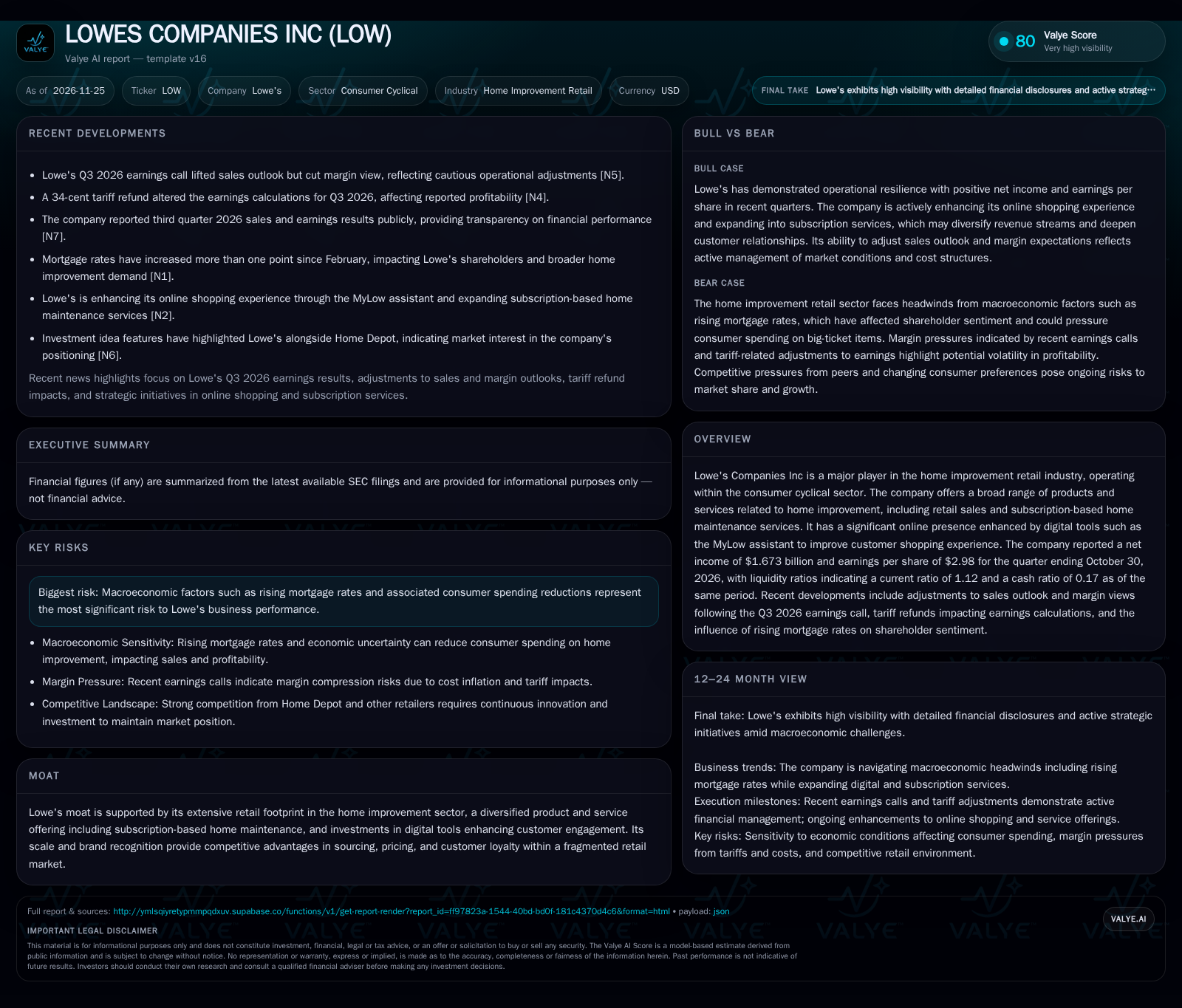
Lowe’s Companies Inc reported $1.673 billion in net income for Q3 2026, with a current ratio of 1.12 and ongoing investments in digital tools and subscription-based services. While the company raised its sales outlook, it trimmed margin expectations, reflecting a challenging consumer environment and cost pressures. Lowe’s strategic focus on digital engagement and recurring services aims to deepen customer relationships, but macroeconomic risks and competitive intensity remain central variables for its future trajectory. [S2] [N5] [N7]
Lowe’s enters the close of 2026 with a blend of financial resilience and strategic adaptation. With a sharpened focus on digital engagement and the rollout of subscription-based home maintenance services, Lowe’s is seeking to diversify revenue streams and reinforce its competitive position. However, margin compression and the unpredictable consumer environment mean that operational agility and innovation remain crucial to Lowe’s outlook.
Recent Financials and Strategic Moves Set the Stage
Lowe’s reported net income of $1.673 billion for the quarter ending October 30, 2026, and basic and diluted EPS of $2.98 per share, according to its latest 10-Q filing. The company’s current assets stood at $24.23 billion versus current liabilities of $21.69 billion, yielding a current ratio of 1.12 and a cash ratio of 0.17. The company reported cash and liquidity metrics for the period; these figures do not by themselves establish operating runway, investment capacity, financial flexibility, or financing capacity. [S2]
On the operational front, Lowe’s lifted its sales outlook in the Q3 2026 earnings call but trimmed margin guidance, signaling a cautiously optimistic approach amid cost and demand pressures. The company is investing in digital tools, notably the MyLow assistant, and launching subscription-based home maintenance services to capture new revenue streams and deepen customer engagement. [N5] [N7]
How Lowe’s Makes—and Could Lose—Money in a Changing Retail Landscape
Lowe’s core revenue is driven by retail sales of home improvement products, with gross margins influenced by product mix, supply chain efficiency, and pricing power. The company’s large fixed-cost base—stemming from its physical retail footprint and logistics infrastructure—creates potential for operating leverage when sales volumes grow, but also exposes it to downside risk if demand softens.
New digital initiatives and subscription-based services could shift revenue mix toward higher-margin, recurring streams if adopted at scale, but this hinges on consumer willingness to pay for ongoing home maintenance and the company’s ability to deliver differentiated value. Subscription models may require upfront investment in technology, service delivery, and marketing, potentially compressing margins in the near term before operational scale is achieved.
Rising input costs, wage inflation, and competitive pricing from major rivals exert pressure on gross and operating margins. In a high-interest-rate environment, consumers may defer big-ticket projects, reducing transaction size and frequency. Lowe’s must balance promotional activity to drive traffic with the need to protect profitability—a classic retail dilemma exacerbated by macroeconomic uncertainty.
The interplay between Lowe’s fixed and variable costs also warrants close examination. While the company benefits from economies of scale in procurement and distribution, the rigidity of its physical store network means that cost reductions are limited during downturns. This structural cost profile implies that margin resilience depends heavily on maintaining or growing sales volumes. Additionally, the shift toward digital and subscription services introduces a different cost structure, with potentially higher variable costs related to service delivery and customer support. Understanding how these cost dynamics evolve as the business model diversifies is critical to assessing Lowe’s future profitability.
Digital Expansion and Service Innovation: Will They Widen the Moat?
Lowe’s faces direct competition from other home improvement giants, mass merchants, and increasingly, digital-first retailers. Its competitive advantages historically include scale, brand recognition, and a broad physical presence. The company’s recent push into digital tools and subscription services is designed to differentiate its offering and cement customer loyalty.
However, the home improvement sector is highly competitive, and rivals are also investing in omnichannel capabilities and customer experience. The ability of MyLow and similar tools to drive incremental sales or improve retention is not yet proven at scale. Subscription-based services could increase switching costs and deepen relationships, but their impact will depend on consumer adoption rates and the effectiveness of execution.
The threat of substitutes—such as direct-to-consumer brands, online marketplaces, and even gig-economy home services—remains a persistent pressure. Maintaining price competitiveness while investing in innovation is critical for Lowe’s to avoid margin erosion and defend its market share.
If Digital and Subscription Strategies Take Hold, What Could Unlock Sustainable Growth?
The most optimistic scenario for Lowe’s involves successful scaling of its digital and subscription offerings, leading to higher customer lifetime value and a more defensible revenue base. If MyLow and related digital initiatives materially improve online conversion and in-store traffic, and if subscription services achieve strong uptake, Lowe’s could reduce customer churn and build a recurring-revenue engine that smooths out economic cycles.
Confirmation of this scenario would come from accelerating growth in digital sales, evidence of rising subscription enrollments, and improved gross margins attributable to higher-margin service revenue. Additional signals might include positive customer satisfaction scores linked to new digital tools, and a narrowing margin gap with leading competitors despite sector headwinds.
Adaptive Execution Amid Macro Pressures Remains the Most Likely Course
The most plausible path forward is that Lowe’s continues to manage through a sluggish macro environment with incremental gains from digital and service initiatives, but with only modest impact on overall margins in the near term. Retail sales may remain pressured by high mortgage rates and consumer uncertainty, while digital and subscription businesses contribute to engagement but do not yet drive step-change growth.
Evidence for this scenario would include steady, but not accelerating, digital sales growth, cautious margin guidance, and a continued focus on cost management. If the company maintains stable market share and avoids significant margin compression relative to competitors, it suggests the strategy is providing some insulation against sector headwinds, but not fully offsetting them.
Margin Compression Worsens as Consumer Demand Softens and Costs Rise
In a negative scenario, persistent high mortgage rates and economic uncertainty lead to a significant pullback in consumer spending on home improvement, disproportionately affecting big-ticket purchases. If digital and subscription initiatives fail to gain traction, Lowe’s could see flat or declining sales with little offset from new revenue streams.
Margin compression could intensify if the company is forced to increase promotional activity to drive traffic, while input costs remain elevated. This scenario would be confirmed by declining same-store sales, deteriorating gross and operating margins, and lackluster adoption of new services. A widening margin gap versus peers would also signal strategic underperformance.
What Will Determine if Lowe’s Digital and Service Bets Pay Off?
Trends in digital sales growth and the percentage of total revenue generated online, if disclosed, would provide insight into the effectiveness of MyLow and broader e-commerce investments.
Subscription enrollment numbers and renewal rates for home maintenance services would help test whether recurring revenue is materializing.
Quarterly gross margin trends, especially relative to competitors, will indicate whether digital and service initiatives are supporting profitability.
Same-store sales performance remains a key indicator of core demand and Lowe’s competitive position.
Customer satisfaction and Net Promoter Scores, if reported, could reveal whether digital tools and new services are improving loyalty.
Updates on capital expenditure plans—especially investments in technology and service infrastructure—will clarify management’s commitment to the strategy.
Management commentary on the impact of mortgage rates and macroeconomic conditions on consumer behavior will remain crucial for outlook calibration.
Any evidence of increased promotional intensity or rising inventory levels could signal demand weakness or execution challenges.
Disclaimer: This is research-only, informational analysis and not investment advice. It may include AI-generated interpretation and general industry context. Always verify important details using primary sources.

Comments