
Autodesk in 2026: Subscription Momentum, Platform Ambitions, and the Test of Renewal Economics
Autodesk’s robust Q3 performance, driven by strong subscription renewals and a 17% revenue jump, underscores the company’s resilience amid industry transformation. As Autodesk deepens its cloud, AI, and lifecycle platform strategy, the sustainability of renewal rates, the economics of its evolving channel model, and the integration of acquisitions like MaintainX will determine whether its competitive advantages can translate into lasting value.
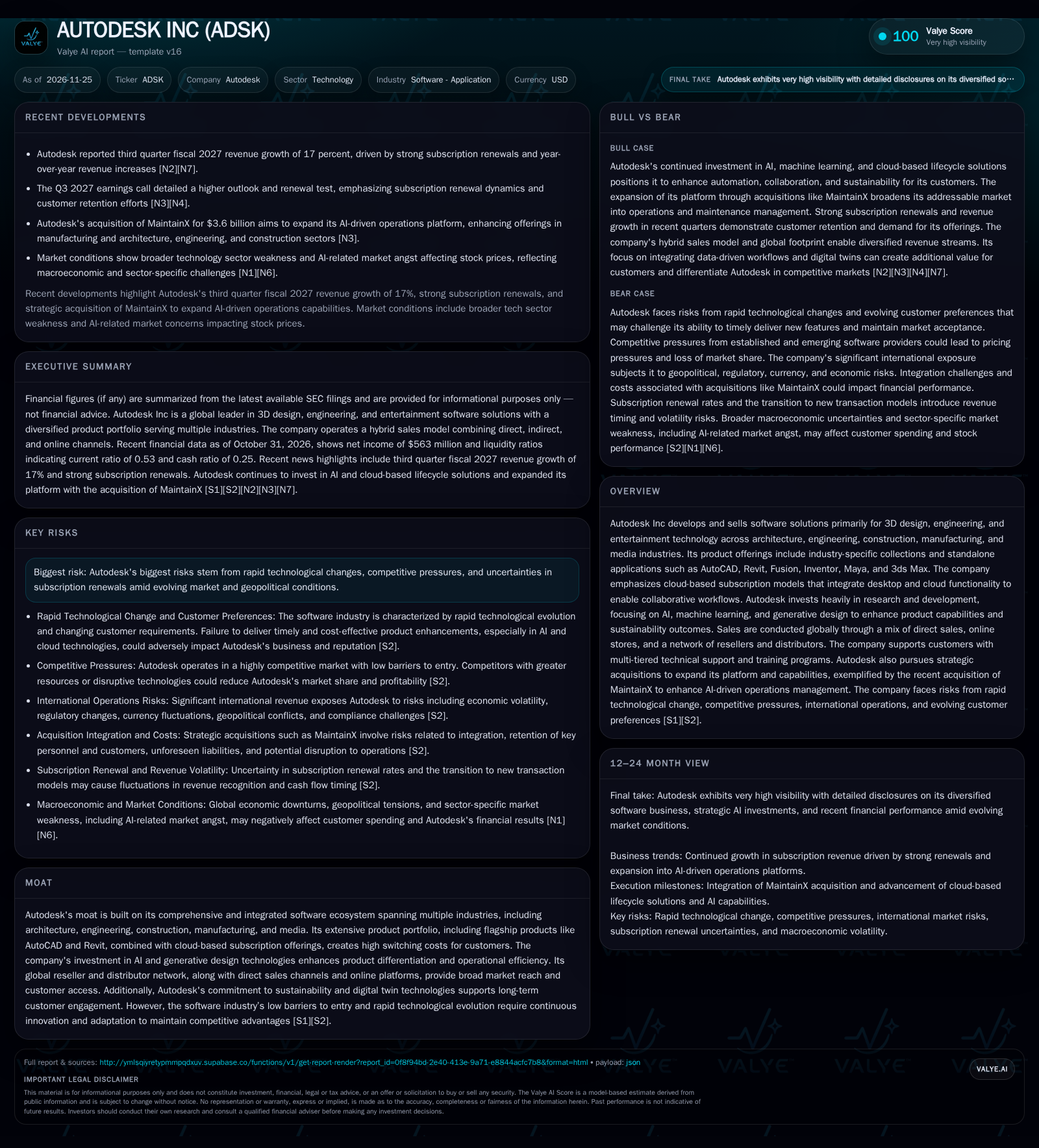
Autodesk posted 17% revenue growth in Q3 2027, fueled by strong subscription renewals and ongoing expansion of its cloud-based platform. The company’s shift toward direct customer relationships and investments in AI and lifecycle solutions aim to deepen customer lock-in and open new revenue streams. However, sustainability of renewal rates, the economics of its hybrid channel, and integration risks from acquisitions remain key variables for its long-term trajectory. Liquidity remains a watchpoint given a current ratio of 0.53 as of October 2026, though net income was strong at $563 million for the quarter. Watch for concrete progress in renewal retention, cloud adoption, and operational leverage to validate the bull case.
Autodesk’s third quarter of fiscal 2027 delivered a striking 17% revenue increase, powered by robust subscription renewal activity and year-over-year growth across core product lines. As the company pivots deeper into cloud, AI, and lifecycle management, its ability to sustain high renewal rates and expand its platform will be tested against competitive pressures, evolving customer expectations, and the operational complexities of integrating new acquisitions. The company’s financial strength, while evident in net income, is set against a backdrop of tighter liquidity—sharpening the focus on cash conversion and capital allocation as Autodesk seeks to defend and expand its moat in the next phase of industry transformation.
Subscription Renewals and Revenue Growth Define Autodesk’s Latest Quarter
Autodesk reported a 17% year-over-year revenue increase for the third quarter of fiscal 2027, a performance management attributes to strong subscription renewals and customer retention [N2] [N7]. This momentum signals effective execution on Autodesk’s cloud-centric, subscription-first strategy, which underpins both near-term revenue and long-term customer lock-in.
Net income for the quarter was $563 million, with basic EPS of $2.69 [S2]. These profitability levels reflect the company’s ability to scale its recurring revenue base, even as it invests heavily in R&D and platform expansion.
The company reported cash and liquidity metrics for the period; these figures do not by themselves establish operating runway, investment capacity, financial flexibility, or financing capacity. [S2] While this does not by itself indicate imminent liquidity stress, it raises the stakes for sustained cash flow and disciplined working capital management.
The Q3 earnings call and news coverage emphasized the importance of subscription renewal rates and the company’s evolving approach to customer engagement and channel mix [N3] [N4]. These dynamics will be central to Autodesk’s ability to maintain its growth trajectory.
The Subscription Model, Platform Expansion, and Autodesk’s Evolving Revenue Mix
Autodesk’s business model is rooted in recurring revenue from subscription-based software offerings, blending desktop and cloud functionality. The shift to subscription has redefined revenue recognition, smoothing out cash flows but making renewal rates the primary economic driver. Pricing power is influenced by Autodesk’s comprehensive, integrated product suite and the high switching costs for enterprise customers, particularly in architecture, engineering, and manufacturing.
The company’s hybrid go-to-market approach—direct sales, online store, and a sizable reseller/distributor network—creates both reach and complexity. Approximately 37% of revenue still flows through indirect channels, with the largest distributor, TD Synnex, accounting for 14% of net revenue [S1]. Moving more transactions direct or online may improve gross margins and customer insight, but could require up-front investments in sales, support, and digital infrastructure.
Operating leverage is inherent in the software model: as the installed base grows, incremental costs of serving each new subscriber are low, barring substantial support or cloud infrastructure outlays. However, Autodesk’s heavy investment in R&D, especially in AI and generative design, keeps fixed costs high. New platform initiatives—such as lifecycle management and data-driven services—could expand wallet share but may also require substantial up-front engineering and go-to-market spend before reaching scale.
Capital needs are relatively modest for a software business, but integration of acquisitions (e.g., MaintainX) and the development of new cloud-native offerings could temporarily elevate cash outflows.
Integrated Ecosystem, Switching Costs, and the Battle for Industry Cloud Leadership
Autodesk’s competitive edge historically rests on its deep, integrated product ecosystem—AutoCAD, Revit, Fusion, and collections tailored for architecture, engineering, construction, and manufacturing. This breadth could increase switching costs: enterprise customers build workflows, libraries, and training pipelines around Autodesk’s platforms, making migration disruptive and costly.
The strategic pivot toward cloud-based lifecycle solutions, powered by AI and generative design, aims to reinforce these barriers while unlocking new value for customers. If Autodesk can successfully enable data-driven workflows that span design, construction, and ongoing operations (augmented by acquisitions like MaintainX), it could entrench its platform as the backbone of digital transformation in its target industries.
However, the software sector’s low barriers to entry, rapid technological cycles, and the emergence of both vertical specialists and horizontal platform giants create constant competitive threats. Cloud-native upstarts, global software conglomerates, and open-source alternatives all represent credible substitutes in various niches. Autodesk’s ability to innovate faster than these rivals, while maintaining backward compatibility and customer trust, will determine the durability of its moat.
The evolving channel mix (direct, online, indirect) is another axis of competition. More direct engagement could deepen customer relationships and enable richer value-added services, but Autodesk must balance this with the risk of channel conflict and the need for global reach, especially in regions where local resellers remain critical.
Platform Expansion and AI-Driven Automation Unlock New Growth Levers
Autodesk’s upside scenario revolves around two reinforcing loops: first, continued high renewal rates and rising average contract values as customers adopt more cloud-based, AI-infused solutions; second, the successful integration of lifecycle management, operations, and maintenance (via MaintainX and similar acquisitions) into Autodesk’s core platform.
If the company can demonstrate accelerating adoption of its industry clouds, with measurable increases in multi-product engagement and upselling into operations and maintenance, the addressable market expands beyond design into the full asset lifecycle. AI and generative design could further boost productivity, driving higher willingness to pay and stickiness.
Confirmation of this scenario would include: sustained double-digit revenue growth with improving gross margins; increasing proportion of revenue from direct and online channels; disclosure of higher net retention rates; and customer case studies showcasing end-to-end digital workflows enabled by Autodesk’s platform.
Falsification would come from stalled adoption of new platform modules, customer pushback on pricing, or evidence that AI/automation benefits are being commoditized by competitors rather than captured by Autodesk.
Renewal Strength Offsets Channel and Integration Headwinds in a Maturing Software Landscape
The most plausible near-term outcome is that Autodesk maintains strong renewal rates and moderate growth as core customers continue to rely on its established products, with incremental adoption of new cloud-based and AI features. The company’s hybrid channel strategy persists, with a gradual but not dramatic shift toward more direct and online sales.
Integration of acquired assets like MaintainX delivers some cross-sell and workflow expansion, but the full vision of an integrated lifecycle platform takes longer to realize, with operational and product harmonization challenges. The company reported profitability for the period.
Evidence supporting this scenario would include steady (but not accelerating) revenue and net income growth, modest margin expansion, and renewal rates holding at or above historical averages.
This scenario would be challenged if renewal rates begin to slip, customer churn rises, or if indirect channel partners lose effectiveness faster than direct and online channels can compensate.
Erosion of Renewal Dynamics and Integration Stumbles Expose Autodesk to Competitive and Financial Pressure
The adverse scenario is triggered if Autodesk experiences a material decline in subscription renewal rates—whether due to customer dissatisfaction, competitive displacement, or macro-driven belt-tightening. As the subscription base is the chief engine of recurring revenue, even modest increases in churn would create disproportionate impacts on growth and profitability.
At the same time, if the integration of lifecycle and operations acquisitions like MaintainX proves more challenging than expected—due to product overlap, technical incompatibility, or organizational friction—the anticipated platform synergies may not materialize. This would leave Autodesk with higher costs and limited incremental revenue, undermining the case for recent investments.
Confirmation would include: declining renewal and retention rates, missed revenue or margin targets, negative cash flow from operations, or impairment charges related to acquisitions. A sharp rise in competitive win rates by cloud-native or low-cost rivals would also support this scenario.
Testing Autodesk’s Flywheel: Renewal Rates, Platform Adoption, and Integration Progress in Focus
Changes in subscription renewal and net retention rates, if disclosed, would be the most direct indicator of the health of Autodesk’s recurring revenue engine.
The proportion of total revenue derived from direct and online channels versus indirect/reseller channels—particularly any acceleration in this mix shift—would help test the efficacy of Autodesk’s new transaction model.
Gross margin trends, especially as cloud-based offerings expand, will reveal whether platform investments are translating into better economics or being offset by higher infrastructure and support costs.
Adoption rates and customer engagement metrics for new lifecycle management and operations modules (including MaintainX), if disclosed, would show whether Autodesk is successfully expanding its addressable market.
R&D expense as a percentage of revenue should be monitored to assess whether investment levels remain appropriate relative to growth and competitive threats.
Customer case studies or disclosures that demonstrate successful end-to-end digital workflows (from design through operations) would validate the platform strategy.
Disclaimer: This is research-only, informational analysis and not investment advice. It may include AI-generated interpretation and general industry context. Always verify important details using primary sources.

Comments