
Ingles Markets: Classic Regional Grocer Navigates Margin Pressures and Digital Shifts
Ingles Markets, a long-standing U.S. supermarket chain, enters fiscal 2027 with $5.42 billion in sales, resilient dividend continuity, and a reported current ratio. Management faces persistent margin compression risks and must adapt to an industry rapidly shifting toward omnichannel models, even as inflation and cost volatility test operational discipline.
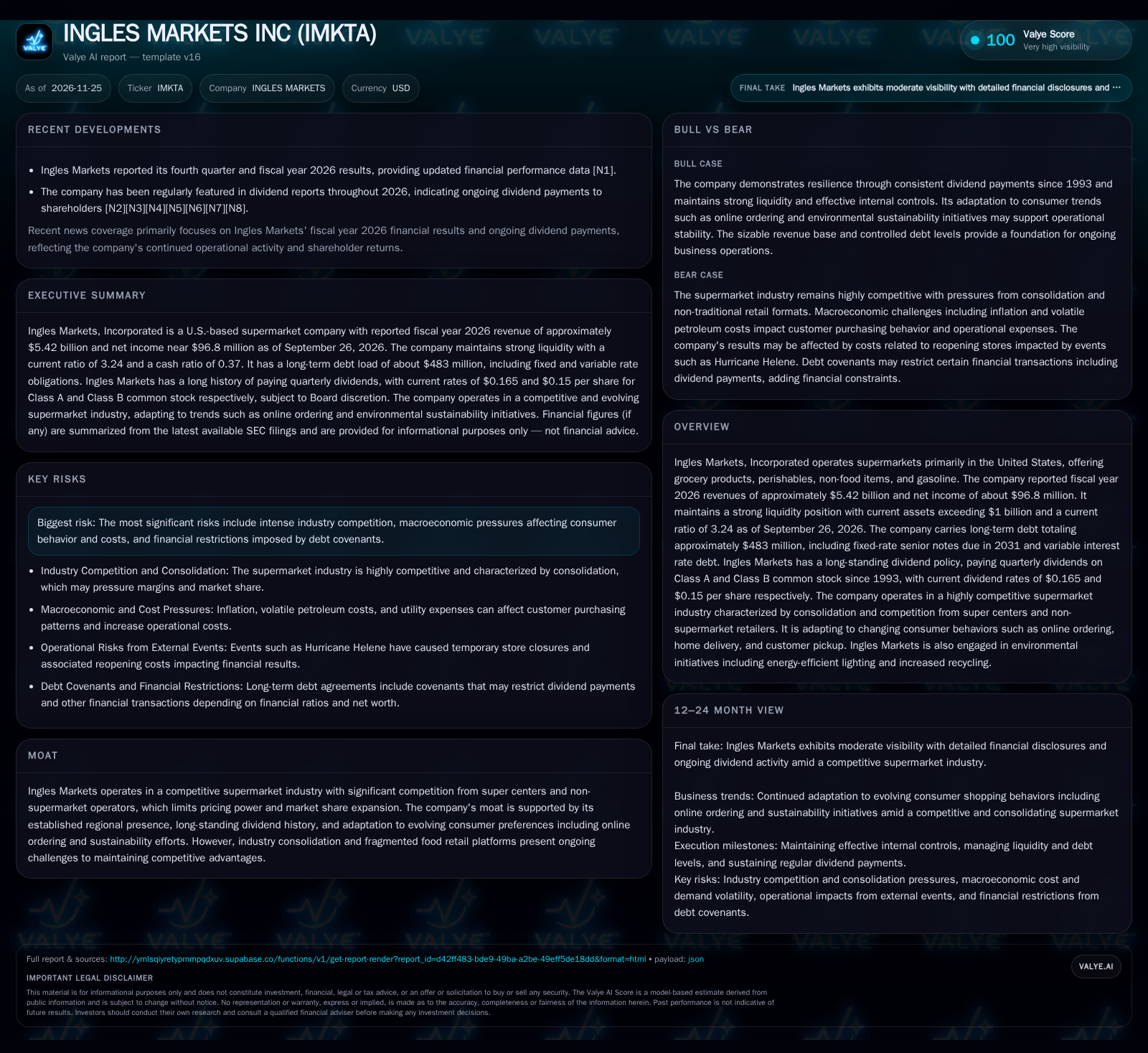
Ingles Markets reported $5.42 billion in revenue and $96.8 million in net income for fiscal 2026, maintaining a current ratio of 3.24 and steady quarterly dividends. The company’s reported liquidity position and established regional footprint help buffer intense competition from super centers and evolving consumer habits. However, margin pressures from industry consolidation, cost inflation, and digital adoption remain ongoing challenges. Ingles’ ability to adapt its cost structure and retail offering will determine its medium-term resilience and value creation ability. [S1] [N1]
Ingles Markets, Incorporated enters fiscal 2027 as a classic regional grocery operator with a $5.4 billion top line and a three-decade record of consistent dividends. With ongoing investments in online ordering, delivery, and sustainability, Ingles faces the challenge of adapting its legacy business model while defending profitability and capital discipline. The next phase will test whether a regional grocer can sustain its value proposition and margin profile amid structural industry change.
Recent Financial Performance and Liquidity Define Ingles’ Starting Point
Ingles Markets reported fiscal 2026 revenue of approximately $5.42 billion and net income of $96.8 million, reflecting the scale and low-margin nature of the traditional supermarket business. As of September 26, 2026, the company’s current assets stood at $1.08 billion versus current liabilities of $334 million, producing a current ratio of 3.24 and a cash ratio of 0.37. The company reported cash and liquidity metrics for the period; these figures do not by themselves establish operating runway, investment capacity, financial flexibility, or financing capacity. Ingles’ long-term debt totaled $483 million, including both variable and fixed-rate obligations, with the next major maturity in 2031. The company has maintained regular quarterly dividends on both share classes since 1993, with annualized rates of $0.66 and $0.60 per share on Class A and B stock, respectively. [S1] [N1] [N2] [N3] [N5] [N7] [N8]
How Ingles Markets Generates Cash Flow: Margins, Scale, and Capital Demands
Supermarkets like Ingles rely on high volume, low-margin operations. Gross margins in the sector are structurally constrained by price-sensitive consumers, competition from super centers and discounters, and the perishable nature of inventory. Revenue mix is typically dominated by grocery, perishables, and non-food items, supplemented by fuel sales. The company’s $5.42 billion in revenue against $96.8 million in net income underscores the industry’s razor-thin net margins, likely in the 1-2% range. Fixed costs—labor, rent, utilities, and logistics—are significant and only partially offset by economies of scale.
While dividend payments are a longstanding feature, debt covenants could restrict payouts if financial metrics deteriorate. Adoption of online ordering and delivery introduces incremental costs and requires technology and logistics investment, which may only be offset by increased basket size or share gains if executed efficiently. [S1]
The capital intensity of supermarket operations also warrants deeper consideration. Investment in store maintenance, technology upgrades, and supply chain infrastructure can be substantial, particularly as consumer expectations evolve. If Ingles prioritizes capital expenditures toward digital infrastructure—such as automated fulfillment centers or enhanced data analytics—this could improve long-term cost efficiency but may pressure near-term free cash flow. Conversely, underinvestment risks operational obsolescence and erosion of customer experience. Therefore, the company’s capital allocation strategy must carefully balance sustaining core store assets with funding innovation to remain competitive in a rapidly digitizing retail environment.
Super Center Threats and Digital Disruption Challenge Regional Moats
Ingles operates in a highly competitive and consolidating supermarket industry. The primary threats come from national super centers (such as Walmart and Target), discount grocers, and increasingly, digital-first grocery platforms and delivery intermediaries. These competitors often have greater scale, more advanced supply chains, and the ability to cross-subsidize grocery with higher-margin categories. Non-supermarket operators, including club stores and e-commerce platforms, further fragment the market.
While Ingles’ regional presence and local brand recognition offer some customer loyalty, these advantages are being eroded by price competition and the convenience of digital alternatives. The company’s adaptation to online ordering and home delivery is necessary, but unless digital penetration drives higher overall spend or customer retention, it risks margin dilution. Environmental initiatives may support brand perception and regulatory compliance but are unlikely to deliver a near-term competitive edge unless paired with cost savings or incremental revenue. [S1]
Moreover, the interplay between scale and supply chain sophistication is critical in determining Ingles’ competitive positioning. Larger competitors benefit from centralized procurement, logistics optimization, and vendor negotiation leverage, which can translate into lower input costs and improved product availability. For a regional player like Ingles, replicating these efficiencies is challenging but essential to preserving margin. Strategic partnerships, regional distribution hubs, or selective assortments may help mitigate scale disadvantages. Additionally, consumer preferences for local and fresh products could offer differentiation if integrated effectively into supply chain and merchandising strategies, potentially offsetting some pricing pressures from national chains.
If Digital Adoption and Operational Discipline Converge, Margin Expansion Is Plausible
A favorable scenario for Ingles would see successful digital adoption—online ordering, delivery, and customer pickup—driving incremental revenue and share gains in its core regional markets. If the company can leverage technology to increase average basket size and reduce labor or shrink costs (for example, through improved inventory management), operating leverage could modestly expand margins.
Confirmation would come from disclosed improvements in same-store sales growth, digital order penetration, and gross margin stability or expansion despite digital investment. Falsification would be signaled by sustained margin compression, rising digital fulfillment costs without corresponding sales gains, or a need to cut dividends or raise additional debt to fund operations.
Legacy Strengths and Industry Headwinds Offset Each Other in the Near Term
The most plausible outcome is that Ingles maintains its core customer base and steady revenue, but faces ongoing margin pressures from competition and cost inflation. Digital offerings may help retain some customers, but are unlikely to fully offset the pricing power and convenience advantages of larger, national chains. Environmental and operational initiatives will likely deliver incremental, rather than transformative, cost savings.
Margin Compression and Digital Execution Risks Could Force Strategic Retrenchment
A negative scenario would see accelerating margin compression from discounting, digital channel cannibalization, and rising costs (labor, utilities, fuel). If Ingles is unable to drive sufficient volume through its digital investments, or if digital sales erode in-store economics, the company may face declining profitability and potential covenant breaches on its long-term debt. A material increase in competitive intensity—such as new super center or e-commerce entrants in core markets—could exacerbate share losses.
Confirmation of this downside would come from shrinking net margins, negative same-store sales trends, increased leverage, or a dividend cut. Falsification would require evidence of cost containment, digital channel profitability, or successful defense of local market share despite industry headwinds.
What Will Determine Ingles Markets’ Adaptability and Margin Resilience?
Same-store sales growth rates—especially split between in-store and digital channels, if disclosed—would clarify demand trends and digital adoption impact.
Gross and net margin trends over consecutive quarters will reveal whether operational initiatives are offsetting inflation and competitive pricing pressure.
Digital order penetration and fulfillment economics (e.g., percent of revenue from online ordering, home delivery, or pickup), if disclosed, would help test whether digital investments are value-accretive.
SG&A expenses as a percent of sales—stability or improvement would suggest operating leverage or cost discipline; deterioration would signal pressure.
Working capital turns and inventory days—these metrics would clarify capital efficiency and susceptibility to perishable inventory losses.
Debt covenant headroom and any changes to financial covenants or restrictive language could signal stress or increasing financial risk.
Store count and square footage changes—net closures or expansions would indicate management’s confidence in local market opportunity and capital allocation discipline.
Disclaimer: This is research-only, informational analysis and not investment advice. It may include AI-generated interpretation and general industry context. Always verify important details using primary sources.

Comments