
TCGX Acquisition Corp. II: Post-IPO Capital Structure and the Clock on SPAC Value Creation
Fresh from its $100 million IPO, TCGX Acquisition Corp. II enters the critical search phase with no operating business, zero historical revenue, and a finite window to secure a business combination. The SPAC’s ability to generate value now hinges on target identification, deal execution, and capital stewardship amid a shifting SPAC market landscape.
TCGX Acquisition Corp. II is a newly public SPAC, having raised $100 million (plus $4.5 million from a private placement) after quarter-end. With no revenue, assets, or operating business disclosed prior to the IPO, its future depends on identifying and closing a value-accretive merger. The coming quarters will test its ability to deploy capital, manage costs, and execute a deal before the typical SPAC expiration.
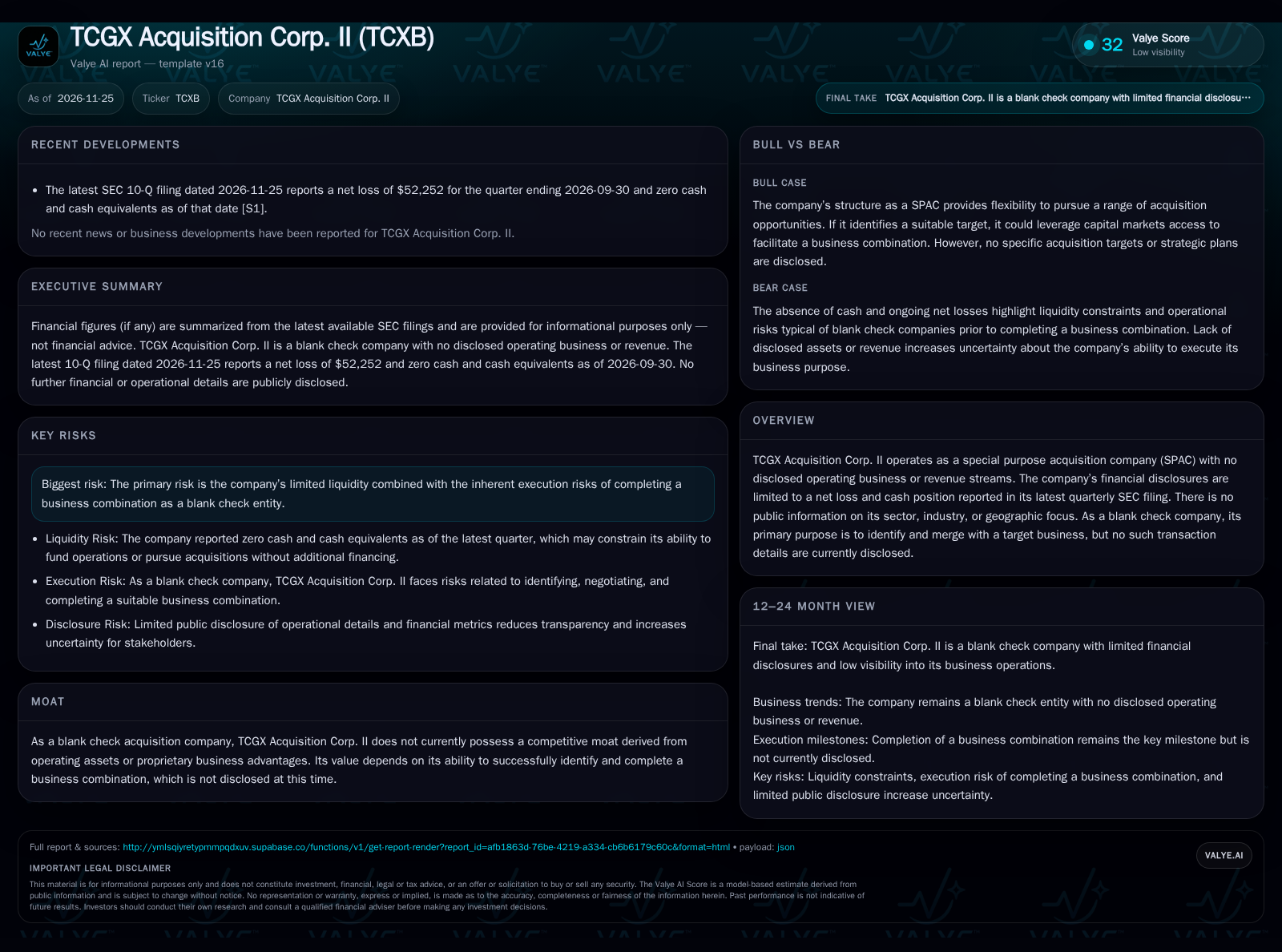
TCGX Acquisition Corp. II epitomizes the high-stakes nature of the SPAC model: flush with $100 million in fresh capital post-IPO but lacking an operating business, revenue, or disclosed sector focus. With a reported net loss of $52,252 for the September 2026 quarter and zero cash on hand before the offering, the company’s entire value proposition now rests on its ability to source, negotiate, and consummate a business combination within the typical SPAC lifecycle. The next year will be decisive, as market conditions, deal flow, and capital efficiency will determine whether TCGX can deliver value or join the growing ranks of SPACs returning cash to shareholders.
IPO Proceeds Reshape the Balance Sheet, But the Operating Void Remains
As of September 30, 2026, TCGX Acquisition Corp. II reported zero cash and cash equivalents and had not commenced any operating business or generated revenue [S1]. The subsequent completion of a $100 million IPO and $4.5 million private placement on October 19, 2026, fundamentally altered its financial position, providing the capital required for its acquisition mandate. However, with no disclosed operating activity, target, or sector focus, the company’s post-IPO financial resources are its only tangible asset. The net loss of $52,252 in the quarter reflects typical pre-deal SPAC expenses—primarily formation, legal, and administrative costs [S1]. In sum, TCGX is now a well-capitalized blank check entity, but its path to value creation remains entirely contingent on future execution.
SPAC Unit Economics: Capital in Search of a Deal
The economics of TCGX Acquisition Corp. II are defined by the SPAC structure: the company raises capital through an IPO, holds proceeds in trust, and seeks to merge with a private company, thereby taking it public. Until a business combination is completed, the SPAC earns negligible interest on trust assets (if permitted), while incurring ongoing legal, accounting, and administrative costs. The trust structure protects public shareholders, as funds are typically returned if no deal is consummated within a set timeframe (often 18-24 months post-IPO).
The capital structure post-offering—$100 million from public shares and $4.5 million from private placement—must cover both the acquisition consideration and operating expenses. Transaction costs for the offering totaled $4.56 million, including $1 million in cash underwriting fees and $3 million in deferred fees (payable only upon deal completion) [S1]. This leaves the majority of capital available for a target acquisition, but any deal must be sufficiently attractive to justify the dilution, fees, and risks inherent in the SPAC model. If no deal occurs, public shareholders are entitled to their pro-rata share of the trust, less any permissible deductions.
SPACs in a Crowded Market: Differentiation and Deal Sourcing Challenges
TCGX Acquisition Corp. II operates in a highly competitive environment populated by numerous SPACs, each vying for a limited pool of attractive private companies seeking public listings. The absence of a disclosed sector focus or management track record in the filing increases the challenge of differentiating TCGX from its peers. In recent years, market sentiment toward SPACs has cooled, with investors scrutinizing sponsor quality, alignment, and deal economics more closely.
The key potential advantages for any SPAC include experienced sponsors, access to proprietary deal flow, and a compelling value proposition for private companies. Without public information on TCGX’s sponsor team or target criteria, it is unclear whether the company possesses such advantages. Conversely, the lack of operating activity, business relationships, or sector specialization may put TCGX at a disadvantage compared to sector-focused SPACs or those led by high-profile sponsors. The risk of failing to secure a suitable deal within the allotted timeline is material, especially as the supply of SPAC capital continues to outstrip high-quality targets.
A Successful Business Combination Unlocks Shareholder Value
The favorable scenario for TCGX Acquisition Corp. II is straightforward: the company leverages its capital and sponsor network to identify and close a merger with a high-growth, well-managed private company. If the target demonstrates strong fundamentals, scalability, and a clear path to public market value creation, TCGX could deliver significant returns to shareholders, with sponsors benefiting from their promote structure.
Confirmation of this scenario would require disclosure of a signed letter of intent or definitive agreement with a credible target, positive market reception to the proposed deal, and evidence that the pro forma entity can achieve its business plan post-merger. Early signals would include press releases on deal negotiations, SEC filings outlining proposed transaction terms, and investor presentations with detailed financial projections. Conversely, a lack of deal progress, target withdrawals, or shareholder redemptions at high rates would undermine the upside case.
Deal Search, Cost Management, and the SPAC Lifecycle Play Out
The most plausible path for TCGX Acquisition Corp. II over the next 12-18 months is a period of active deal sourcing, ongoing administrative expense, and mounting pressure to announce a business combination. The company will likely incur steady costs as it evaluates targets and maintains compliance as a public entity. If a suitable target is identified and negotiations proceed, TCGX would announce a proposed merger, triggering a period of due diligence, regulatory review, and shareholder approval.
This scenario would be supported by incremental disclosures: updates on target search progress, engagement of financial advisors, and preliminary deal terms. A lack of news, persistent administrative costs, or missed self-imposed milestones would suggest execution risk is rising. The base scenario does not assume a failed SPAC but recognizes that many such vehicles ultimately return capital rather than complete a value-accretive transaction.
No Deal, Rising Costs, and Capital Returned to Shareholders
The adverse outcome for TCGX Acquisition Corp. II would involve the failure to identify or close a suitable business combination within the required timeframe. As administrative and due diligence costs accrue, the net asset value of the trust diminishes, reducing the amount returned to public shareholders upon liquidation. In this scenario, the company would wind up operations, redeem public shares at trust value (less allowable expenses), and the sponsor’s investment would likely be lost.
Indicators confirming this scenario would include prolonged periods without deal announcements, repeated extensions (if permitted), increasing expenses relative to trust assets, or explicit disclosures regarding difficulties in sourcing targets. An unfavorable market environment for SPAC mergers, negative investor sentiment, or regulatory headwinds could also accelerate this outcome.
Milestones and External Factors That Will Define TCGX’s Trajectory
Disclosure of a letter of intent or definitive agreement with a merger target would be the most concrete signal of progress.
Updates on the sponsor team’s background, deal sourcing networks, or sector focus—if disclosed—would clarify the company’s competitive positioning.
The pace and magnitude of ongoing administrative and due diligence expenses, as reported in future filings, will affect net asset value and redemption outcomes.
Any amendments to the SPAC’s timeline, such as extensions or changes to trust structure, would materially change the risk/reward calculus.
Redemption rates by public shareholders at the time of a proposed deal would indicate market confidence in the transaction.
SEC or regulatory developments affecting SPAC structures and merger approvals could impact deal execution and timelines.
A useful metric would be the effective interest income (if any) earned on trust assets, as this can slightly offset administrative expenses in the pre-combination period.
Disclaimer: This is research-only, informational analysis and not investment advice. It may include AI-generated interpretation and general industry context. Always verify important details using primary sources.

Comments