
Diginex Ltd: Ambitious ESG Platform Expansion Hinges on Acquisition Execution and Market Validation
Diginex’s aggressive pursuit of scale through acquisitions and partnerships in ESG and AI-powered compliance is reshaping its business mix, but integration challenges, profitability headwinds, and market competition remain central to the long-term thesis.
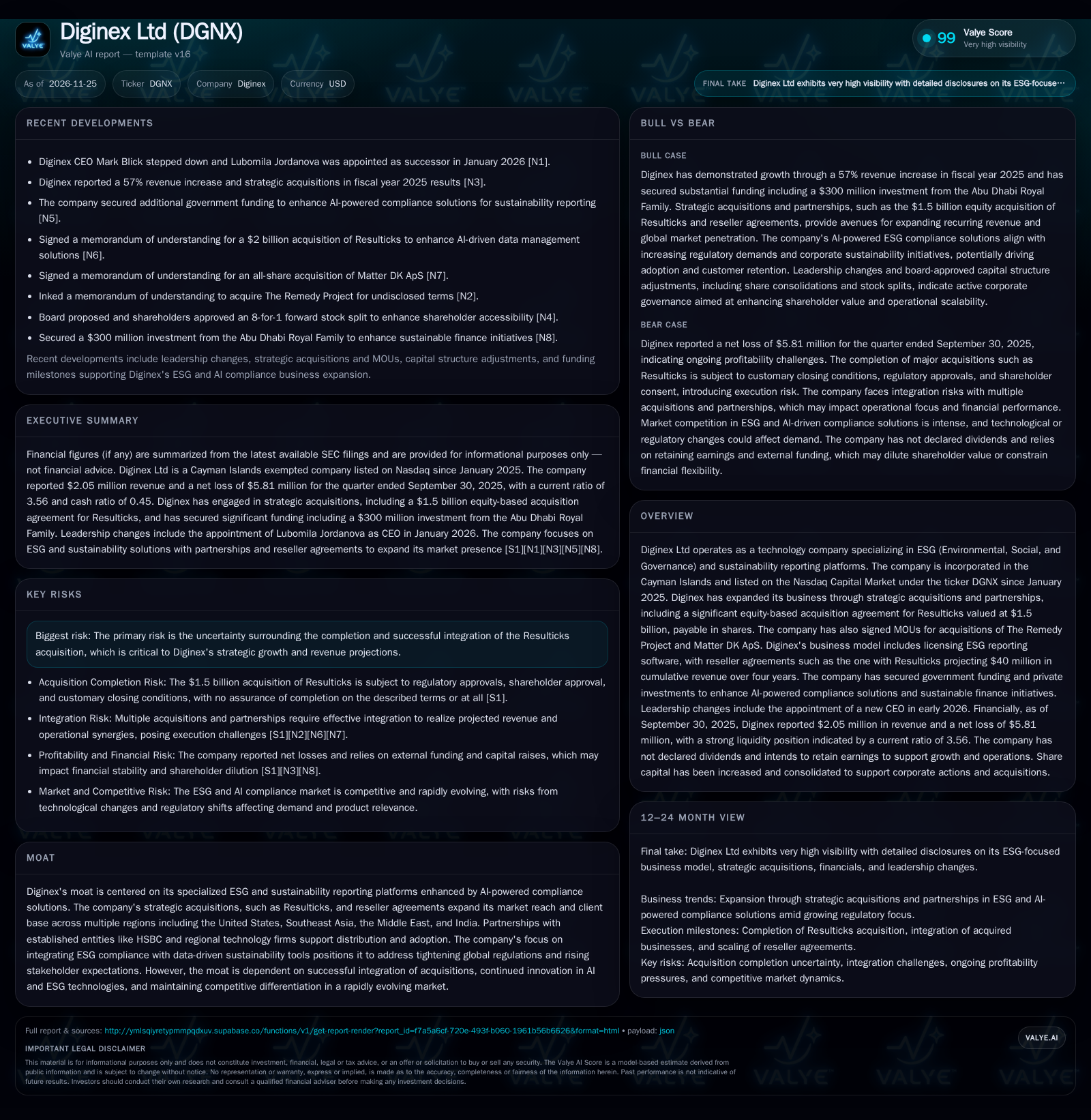
Diginex Ltd is rapidly expanding its footprint in ESG and sustainability reporting by pursuing high-profile acquisitions—most notably Resulticks—and entering strategic partnerships across multiple regions. While the company has secured substantial funding and reported strong top-line growth, it continues to operate at a loss, faces significant integration and execution risks, and competes in a crowded, fast-evolving market. The successful closing and integration of major acquisitions, particularly Resulticks, will likely determine whether Diginex can transform its business economics and achieve sustainable profitability in the coming years. [S1] [N3] [N8]
Diginex Ltd is positioning itself as a consolidator in the ESG and sustainability reporting space, leveraging a combination of strategic acquisitions, international partnerships, and AI-driven compliance solutions to scale its business. Recent headline moves—including the pending $1.5 billion Resulticks acquisition, major funding infusions, and the onboarding of a new CEO—suggest a company intent on rapid transformation. However, Diginex’s ability to convert these initiatives into durable growth and margin improvement will depend on its execution in integrating acquisitions, managing capital efficiently, and navigating a highly contested market.
Recent Moves Reflect High-Stakes Growth Strategy and Financial Pressure
Diginex reported $2.05 million in revenue and a net loss of $5.81 million for the quarter ended September 30, 2025, signaling ongoing profitability challenges even as the business expands [S1]. The company’s headline strategic move is a $1.5 billion equity-based acquisition agreement for Resulticks, which remains subject to regulatory and shareholder approvals and could reshape the scale and business mix if completed [S1]. Diginex’s capital-raising efforts include a $300 million investment from the Abu Dhabi Royal Family, intended to bolster its sustainable finance initiatives and support further expansion [N8]. Leadership transition has also occurred, with Lubomila Jordanova appointed CEO in January 2026, positioning the company for a new phase of integration and execution [N1]. These developments position Diginex at an inflection point, with future value creation riding on the completion and integration of these major transactions.
How Acquisitions and Platform Scale Could Transform Diginex’s Economics
Diginex’s core business model centers on licensing ESG and sustainability reporting software to enterprises and institutions, with a stated focus on AI-powered compliance solutions. The company’s economics are currently characterized by modest revenue and persistent net losses, suggesting high fixed costs relative to its current scale [S1]. The Resulticks acquisition, if completed, could substantially increase Diginex’s top-line through both direct revenue and a reseller agreement projecting $40 million in cumulative revenue over four years from Resulticks reselling Diginex’s ESG platforms [S1].
If Diginex successfully integrates Resulticks and other pending acquisitions, it could benefit from increased operating leverage as software and data platforms typically exhibit high gross margins and scalable cost structures. However, the upfront costs of integration, expanded headcount, and technology harmonization may keep near-term profitability elusive. Funding from the Abu Dhabi Royal Family and prior IPO proceeds provide capital for these initiatives, but continued negative cash flow may necessitate further dilution or debt if revenue growth and margin expansion do not materialize rapidly [S1] [N8].
The company’s emphasis on recurring or contract-based revenue via reseller agreements and partnerships could, if executed effectively, transition Diginex toward a more predictable, higher-margin business over time. Confirmation would require evidence of contract renewals, retention rates, and customer expansion, none of which are presently disclosed.
Defensible Niche or Commodity Platform? Competitive Dynamics in ESG Tech
Diginex operates in the intensely competitive ESG and compliance software market, where barriers to entry are low for basic reporting tools but substantially higher for integrated, AI-driven platforms that address evolving regulatory requirements. The company’s differentiation hinges on its ability to deliver advanced compliance solutions and leverage partnerships for distribution—such as the Resulticks reseller arrangement and regional launches in Southeast Asia and the Middle East [S1].
Competitor categories include specialized ESG reporting software firms, large enterprise SaaS providers expanding into sustainability, and consulting or audit firms offering bundled compliance solutions. The Resulticks acquisition, if consummated, could give Diginex a stronger foothold in data-driven marketing and customer engagement, potentially creating cross-sell opportunities within its ESG suite. However, the market is characterized by rapid technological change, and larger, better-capitalized entrants could erode Diginex’s competitive edge if it fails to continually innovate or if integration of acquisitions proves disruptive.
Customer switching costs in ESG platforms are moderate, as data migration and regulatory compliance create some friction, but price competition and feature parity can undermine long-term retention. Diginex’s ability to create a defensible moat will likely depend on network effects from ecosystem partnerships, proprietary AI technology, and regulatory alignment.
If Integration Succeeds and Market Demand Accelerates, Diginex Could Achieve Rapid Margin Expansion
In the most favorable scenario, Diginex completes the Resulticks acquisition on schedule, integrates its technology and distribution channels, and realizes projected revenue synergies from cross-selling and expanded customer reach. The $40 million cumulative revenue target from the Resulticks reseller agreement is met or exceeded, and additional regional partnerships in Southeast Asia and the Middle East gain traction, driving recurring revenue growth [S1].
Operating leverage emerges as the company’s cost structure scales, allowing for improved gross and operating margins. The infusion of $300 million from the Abu Dhabi Royal Family is deployed efficiently, supporting further innovation and reducing reliance on additional external capital [N8].
Confirmation of this scenario would include disclosure of multi-year recurring contracts, customer retention rates, successful integration milestones, and evidence of margin improvement in subsequent quarters. Falsification would occur if integration delays, customer churn, or missed revenue targets undermine the projected synergies.
Most Likely Trajectory: Growth Through Acquisitions Tempered by Integration and Profitability Hurdles
The most plausible scenario is that Diginex closes the Resulticks transaction after some delays and faces typical integration challenges, including harmonizing technology stacks, sales teams, and organizational cultures. Revenue grows as new partnerships and acquisitions contribute, but cost synergies are slower to materialize, resulting in continued operating losses through at least the next several quarters.
The company leverages its new capital to fund integration and incremental R&D, but working capital needs and negative cash flow may prompt additional capital raises, potentially diluting shareholders. Market competition remains intense, with customer acquisition costs and pricing pressure limiting rapid margin expansion.
Evidence supporting this scenario would include incremental revenue growth, continued net losses, and periodic capital raises. Falsification would require either a dramatic acceleration in profitability or a failure to close major acquisitions, causing a re-rating of the company’s growth prospects.
Integration Failure or Acquisition Collapse Could Trigger Strategic Reset
In an adverse scenario, the Resulticks acquisition fails to close due to regulatory, shareholder, or operational hurdles, or integration proves intractable, leading to missed revenue targets and loss of market credibility. Without the anticipated scale and platform breadth, Diginex may struggle to cover its fixed costs, forcing the company to curtail expansion plans, divest assets, or pursue dilutive emergency funding.
Competitive pressures intensify as larger players introduce similar AI-powered ESG solutions, compressing Diginex’s pricing and limiting customer wins. The company’s recurring revenue projections from reseller agreements fall short, and customer churn increases as switching costs prove insufficient to lock in clients.
Confirmation of this downside would be public disclosure of failed or renegotiated acquisition terms, missed revenue projections, sharp increases in operating losses, or sudden management departures. Falsification would require clear evidence of smooth integration, customer growth, and margin stabilization.
Milestones That Will Determine Whether Diginex’s Acquisition-Driven Strategy Delivers Lasting Value
Progress and definitive closing of the Resulticks acquisition, including the satisfaction of regulatory and shareholder approval conditions [S1].
Quarterly integration updates detailing technology harmonization, cross-sell traction, and customer migration between Diginex and acquired entities (if disclosed).
Actual revenue recognized from the Resulticks reseller agreement versus the projected $40 million over four years [S1].
Evidence of recurring revenue growth, contract renewal rates, and customer retention—especially for new platform launches in Southeast Asia and the Middle East (if disclosed).
Gross and operating margin trends in subsequent quarters as a signal of operating leverage or ongoing integration drag (if disclosed).
Management commentary on competitive dynamics, customer acquisition costs, and product innovation cadence in response to regulatory and technological change.
Disclaimer: This is research-only, informational analysis and not investment advice. It may include AI-generated interpretation and general industry context. Always verify important details using primary sources.

Comments