
Suburban Propane: Weather Impacts and Distribution Strategies in an Evolving Energy Market
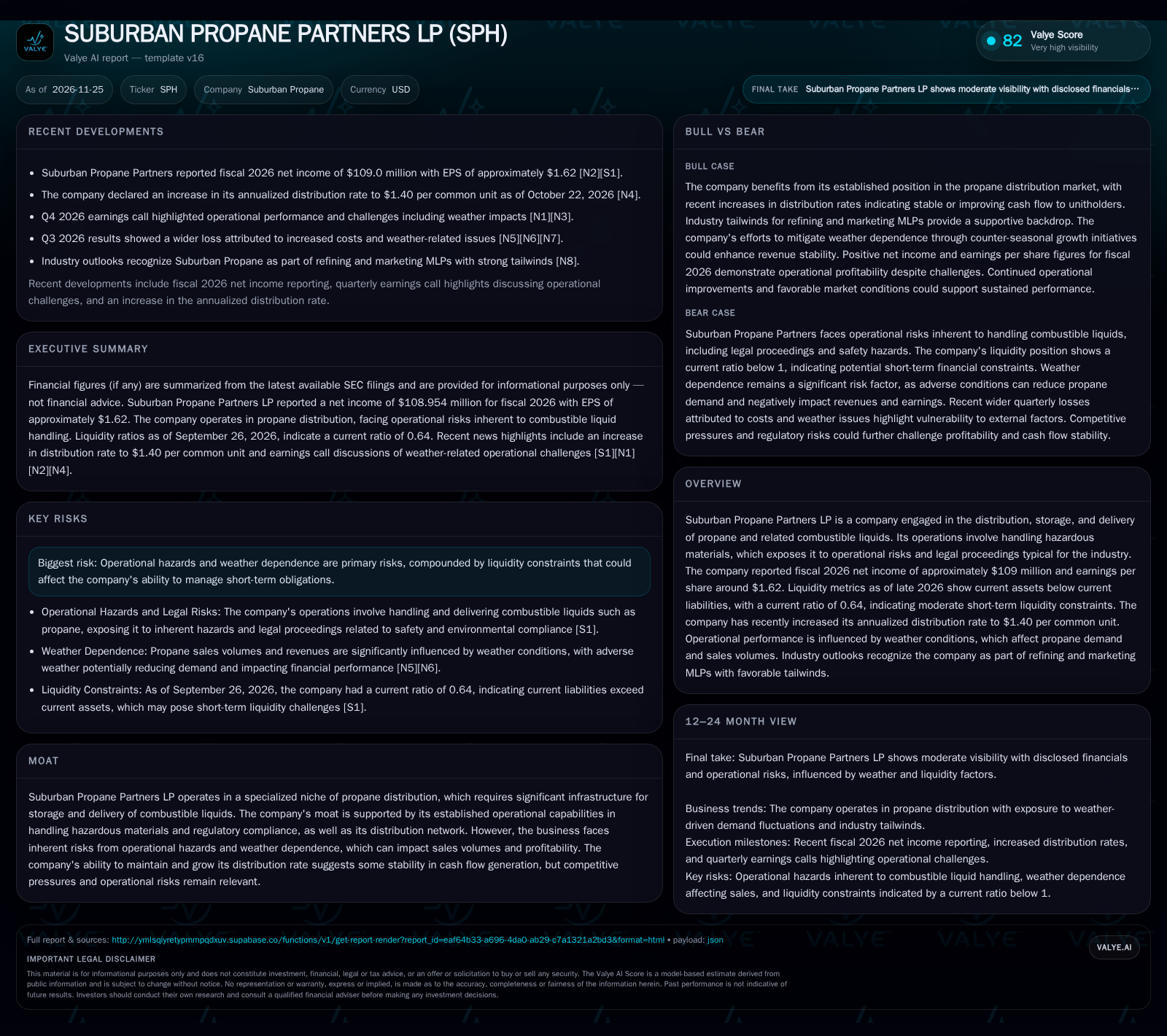
Suburban Propane Partners LP reported $109 million in net income for fiscal 2026 and recently raised its annualized distribution to $1.40/unit.
Suburban Propane Partners LP reported $109 million in net income for fiscal 2026 and recently raised its annualized distribution to $1.40/unit. The company’s efforts to reduce weather dependence and industry tailwinds for refining and marketing MLPs offer potential upside, but execution risks remain high. [S1] [N4] [N5] [N6] [N8]
Suburban Propane Partners LP stands at a crossroads between stable core earnings and mounting operational headwinds. Fiscal 2026 finished with over $108 million in net income and a notable increase in distributions to unitholders, signaling management’s focus on returning capital. As Suburban Propane attempts to diversify away from its traditional weather-driven business model and capitalize on industry tailwinds, the question is whether its operational discipline and distribution strategy can offset the persistent uncertainties inherent in its market.
Recent Profitability Trends and Distribution Adjustments Under Liquidity Constraints
Suburban Propane reported net income of $108.954 million and diluted EPS of $1.62 for fiscal 2026, demonstrating that the core propane distribution business remains profitable despite ongoing operational challenges [S1]. The company raised its annualized distribution rate to $1.40 per common unit as of October 22, 2026, indicating a continued commitment to capital returns for unitholders [N4]. The company reported cash and liquidity metrics for the period; these figures do not by themselves establish operating runway, investment capacity, financial flexibility, or financing capacity. [S1] The business continues to face pronounced weather-driven demand swings, with recent quarterly losses attributed to warmer-than-normal temperatures and increased costs, reinforcing the volatility inherent in its operating model [N1] [N5] [N6].
Weather Patterns, Pricing Dynamics, and Capital Decisions Influencing Earnings
Suburban Propane’s revenue and earnings are driven primarily by the volume of propane sold, which is highly sensitive to weather patterns—colder winters and cooler springs drive higher demand for residential and commercial heating, while warmer periods suppress volumes sold. Pricing is influenced by both wholesale propane market dynamics (e.g., Mont Belvieu benchmarks) and the company’s ability to pass cost changes to end customers. Fixed costs for infrastructure, logistics, and regulatory compliance are substantial, creating significant operating leverage: small changes in sales volume or gross margin can have outsized impacts on net income.
Variable costs include propane procurement, transportation, and seasonal labor. The company’s MLP structure means a significant portion of net income is distributed to unitholders, limiting balance sheet flexibility and making the business reliant on steady cash flow for both operations and distributions. Capital needs focus on maintaining and upgrading storage, delivery fleets, and safety systems, while growth initiatives (such as renewable fuels or counter-seasonal offerings) require incremental investment. [S1]
A Specialized Market Position Facing Substitute Risks and Regulatory Changes
Suburban Propane’s competitive position is rooted in its established distribution network, regulatory expertise, and experience managing hazardous materials. These factors create meaningful barriers to entry for new direct competitors in propane distribution. However, the company faces competition from other regional and national propane distributors, as well as from alternative heating fuels (natural gas, electricity, heating oil) and, increasingly, from electrification and energy efficiency trends that can erode propane’s share of the residential and commercial heating market.
Switching costs for end customers are moderate, as propane infrastructure is often already in place, but regulatory mandates (e.g., electrification requirements or emissions restrictions) could accelerate substitution. The company’s MLP structure—common among peers—means that yield-focused investors compare distribution rates and financial stability across the sector. Suburban Propane’s pursuit of counter-seasonal and renewable fuel offerings may help offset some of these pressures, but the scale and impact of these initiatives remain to be proven [N5] [N6] [N8].
Potential Growth from Counter-Seasonal Demand and Favorable Industry Trends
The most favorable scenario for Suburban Propane is one in which counter-seasonal growth initiatives (such as summer grilling, agricultural, or industrial propane sales) meaningfully reduce the company’s dependence on winter heating demand, stabilizing volumes and smoothing cash flows. If industry-wide tailwinds for refining and marketing MLPs persist—such as robust wholesale propane pricing, stable regulatory environments, and favorable tax treatment—the company could maintain or even increase distribution rates while funding incremental growth projects [N8].
Confirmation of this scenario would require evidence of sustained revenue growth outside peak heating seasons, visible margin expansion from new business lines, and improved liquidity ratios or free cash flow. A reduction in weather-related quarterly earnings volatility, as well as positive commentary from management regarding the success of diversification efforts, would further validate the upside case. Conversely, failure to see such diversification reflected in segment results or persistent reliance on cold-weather demand would undermine this thesis.
Managing Cyclical Fluctuations Through Targeted Operational Adjustments
The most plausible outcome is that Suburban Propane continues to operate as a weather-sensitive, distribution-focused MLP, generating solid profits in average years and experiencing periodic setbacks from unseasonable weather or cost inflation. The company is likely to incrementally expand counter-seasonal offerings and explore renewable fuels, but these initiatives may only partially offset the core business’s exposure to demand swings.
Industry tailwinds may provide some support, but competitive and regulatory pressures remain constant. This scenario would be confirmed by stable annual net income, continued weather-driven quarterly volatility, and steady but unspectacular growth in non-heating propane volumes. Signs of persistent liquidity stress, such as delayed capital spending or distribution cuts, would challenge this base case.
Distribution Reductions Resulting from Liquidity Challenges and Adverse Weather
In a negative scenario, a combination of unusually warm winters, sharp cost inflation, or adverse regulatory changes could significantly reduce propane sales volumes and compress gross margins.Given the company’s reported current ratio and negligible reported cash balance, a sustained downturn would quickly erode available liquidity, potentially forcing Suburban Propane to reduce or suspend distributions to preserve cash for operations and debt service.
This scenario could be triggered by back-to-back mild heating seasons, spikes in propane procurement costs not fully passed on to customers, or unexpected regulatory mandates accelerating electrification. Confirmation would come from negative free cash flow, rising short-term borrowing, distribution cuts, or asset sales to raise cash. Persistent legal or operational setbacks (such as safety incidents or environmental fines) could further exacerbate downside risks given the hazardous nature of the business [S1] [N6].
Critical Developments Defining Suburban Propane’s Operational Strength
Quarterly and annual trends in retail propane volumes sold, especially during non-winter months, would help assess the effectiveness of counter-seasonal growth initiatives.
Gross margin per gallon and overall margin trends—if disclosed—would signal the company’s ability to manage procurement costs and pricing power.
Distribution coverage ratio (distributable cash flow divided by distributions paid)—if disclosed—would test the sustainability of current payout levels.
Quarterly segment reporting on revenues and margins from new business lines (renewables, non-heating propane applications) would indicate progress on diversification.
Updates on legal or regulatory proceedings, or any disclosed environmental/safety incidents, would help gauge operational risk and potential financial impact.
Management commentary on customer retention, competitive pricing dynamics, or regulatory headwinds/tailwinds would contextualize medium-term threats and opportunities.
Evidence of changes in customer mix (e.g., more commercial/industrial versus residential) could signal successful repositioning or increased vulnerability to substitution.
Disclaimer: This is research-only, informational analysis and not investment advice. It may include AI-generated interpretation and general industry context. Always verify important details using primary sources.

Comments