
Capitol Federal Financial: Commercial Lending Shift, Asset Quality, and the Mechanics of Regional Bank Resilience
Capitol Federal Financial is navigating a strategic pivot toward commercial lending while maintaining robust asset quality and disciplined capital management. The bank’s performance in 2026 reflects both the rewards and risks of this transition, with low delinquency ratios and a strong deposit base but also sensitivity to rate cycles and credit concentration in commercial real estate.
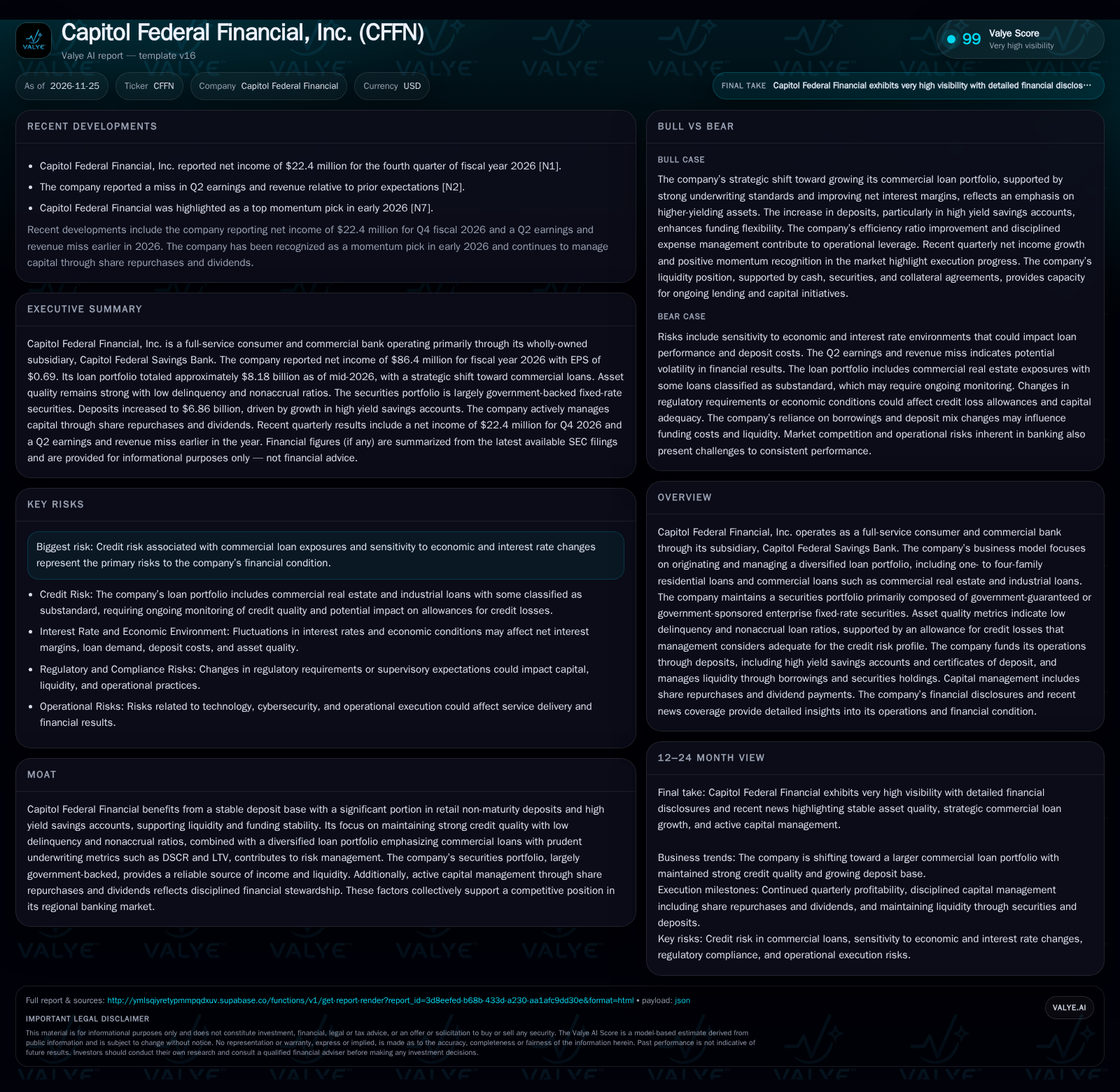
Capitol Federal Financial reported $86.4 million in net income for fiscal 2026, with continued growth in its commercial loan portfolio and low delinquency metrics. The bank’s funding is anchored by a large base of retail deposits, particularly high yield savings, and its securities portfolio remains primarily government-backed. While asset quality is strong, the shift toward commercial lending and Q2 earnings volatility highlight both opportunity and risk in the current environment. Active share repurchases and dividends shape capital management, but future performance will hinge on credit quality, deposit trends, and interest rate dynamics. [S1] [S2] [N1] [N2]
Capitol Federal Financial’s 2026 results paint a picture of a regional bank in transition: the institution is aggressively expanding its commercial loan book, leveraging a stable deposit base, and maintaining high asset quality standards, even as it faces the realities of margin pressures, competitive deposit costs, and the cyclical nature of credit. The company’s robust metrics—low nonaccrual and delinquency rates, a conservative securities portfolio, and disciplined capital returns—suggest operational strength, but recent earnings volatility and the risk profile of commercial real estate lending introduce new uncertainties. The key question is whether Capitol Federal can sustain profitable growth and asset quality as it leans further into commercial banking amid shifting economic and rate environments.
2026 Performance: Strategic Shifts and Asset Quality Standouts
Capitol Federal Financial reported net income of $86.4 million for fiscal 2026, with EPS of $0.69 and Q4 net income of $22.4 million. The loan portfolio stood at $8.18 billion as of June 30, 2026, reflecting a strategic emphasis on commercial lending—particularly commercial real estate, commercial and industrial, and construction loans—while one- to four-family residential loans declined. Asset quality metrics remain robust: as of September 30, 2026, nonaccrual loans totaled $50.9 million (0.62% of total loans), loans 30-89 days delinquent were 0.19%, and loans 90+ days delinquent or in foreclosure were 0.12%. The allowance for credit losses was $26.0 million, or 0.32% of loans receivable, net. Deposit balances reached $6.86 billion, with growth in high yield savings accounts offsetting declines in certificates of deposit. The company also continued share repurchases, with $25.2 million remaining authorized as of mid-2026. [S1] [S2] [N1]
How Capitol Federal Makes Money: Lending, Spread Management, and Capital Returns
Capitol Federal’s revenue model centers on net interest income earned from its loan and securities portfolios, funded primarily through retail and commercial deposits. The ongoing shift toward commercial loans may improve yields compared to traditional residential lending, but it also increases exposure to credit cycles and sector-specific risks. The bank’s net interest margin (NIM) is influenced by the mix of loans, the cost of deposits—especially as high yield savings become a larger share—and the yield on its government-guaranteed securities portfolio (average yield 5.36%).
Operating leverage is possible if loan growth and spread expansion outpace increases in funding and operating costs, but this is constrained by regulatory capital requirements and the need to maintain strong asset quality. The company’s capital management includes share repurchases and dividends, which return capital to shareholders but can limit retained earnings growth if not carefully balanced with future loan loss provisions or regulatory capital needs. Funding is largely stable due to a sizable deposit base, but a shift in deposit mix toward higher-cost or less-sticky products could pressure margins or require alternate funding sources.
Regional Bank Dynamics: Deposit Franchise, Credit Discipline, and Peer Pressures
Capitol Federal’s competitive position is rooted in its stable deposit franchise—largely retail and high yield savings accounts—which provides low-cost funding and supports loan growth. Its focus on credit quality, with low delinquency and nonaccrual rates and conservative portfolio metrics (weighted average DSCR 1.77x, LTV 63%), suggests prudent risk management, which is particularly important as the mix shifts toward commercial and construction lending.
However, the bank faces competition from other regional and community banks, as well as nonbank lenders, especially for commercial clients and deposit relationships. Competitive pressures can drive up deposit costs and compress lending margins. The securities portfolio, being primarily government-backed, offers safety and liquidity but may lag peers in yield during periods of rising rates or aggressive loan growth elsewhere. The question is whether Capitol Federal can continue to differentiate on credit quality and customer service while scaling commercial operations.
If Commercial Lending Growth Drives Profitable Expansion
The most favorable outcome is that Capitol Federal’s commercial loan growth accelerates, with strong underwriting keeping credit losses low and net interest margin expanding as higher-yielding assets replace lower-yielding residential loans and securities. Deposit growth—especially in high yield savings—continues to provide stable, low-cost funding, and the bank leverages its disciplined expense management to improve the efficiency ratio.
Evidence that would confirm this scenario includes sustained increases in net interest income, further improvements in operating leverage, continued low levels of nonaccrual and delinquent loans, and a stable or improving NIM. Additional confirmation would come from successful share repurchases and dividend continuity without eroding regulatory capital ratios. If commercial loan growth is achieved without a spike in credit losses or funding costs, the bank could deliver above-peer returns and justify a premium valuation.
Commercial Shift Brings Opportunity—and Measured Risk
The most plausible trajectory is that Capitol Federal continues to grow its commercial loan book, but faces periodic margin and earnings volatility tied to credit cycles, deposit pricing, and economic conditions. Asset quality remains solid due to conservative underwriting, but the mix of loans gradually increases credit risk relative to the historical residential focus. Funding costs rise modestly as high yield deposits become a larger share, and regulatory capital requirements constrain the pace of capital returns.
Confirmation of this scenario would be a stable or slightly improving efficiency ratio, moderate earnings growth, and manageable credit costs—possibly with occasional quarters of higher provision expense or earnings misses. Falsification would occur if commercial credit losses rise sharply, net interest margin contracts significantly, or deposit outflows accelerate, undermining loan growth and profitability.
Credit Deterioration or Funding Strain Disrupts Stability
The adverse scenario would be triggered if the commercial loan book—particularly commercial real estate or construction exposures—experiences rising delinquencies or charge-offs, forcing higher credit loss provisions and eroding net income. Simultaneously, if competition for deposits intensifies or economic conditions drive deposit outflows, the bank may need to rely more heavily on higher-cost borrowings or sell securities, compressing margins and reducing flexibility.
Evidence of this scenario would include a material increase in nonaccrual and substandard loans, rising delinquency ratios, a spike in provision expense, and a decline in net interest margin. If these pressures persist, dividend or buyback programs could be curtailed, and the company’s valuation would likely compress relative to peers.
What Will Determine Capitol Federal’s Success in Commercial Banking?
Trends in nonaccrual and substandard commercial loans, especially within the commercial real estate and construction segments, as reported in quarterly filings.
Net interest margin movement, with particular focus on the spread between loan yields and deposit/funding costs.
Deposit growth or attrition by product type (high yield savings vs. certificates of deposit), and any signs of competitive pressure in funding.
Quarterly provision expense and allowance for credit losses as a percentage of loans receivable.
Efficiency ratio trends, as a measure of operating leverage and expense control.
Share repurchases and dividend payments—pace, scale, and any changes to authorization or payout ratios.
Regulatory capital ratios and any commentary on capital adequacy or prudential review, if disclosed.
Commercial loan portfolio growth rates and underwriting metrics (DSCR, LTV), as disclosed, to assess risk discipline and growth sustainability.
Disclaimer: This is research-only, informational analysis and not investment advice. It may include AI-generated interpretation and general industry context. Always verify important details using primary sources.

Comments