
Central Garden & Pet’s Margin Expansion Stands Out Amid Soft Sales and Strategic Uncertainty
While Central Garden & Pet Co. delivered notable margin gains and a reported balance sheet position in fiscal 2026, revenue softness and limited competitive disclosure complicate the business outlook. The company’s operational flexibility and product breadth offer resilience, but sustained growth may hinge on consumer demand, category trends, and clarity on differentiation.
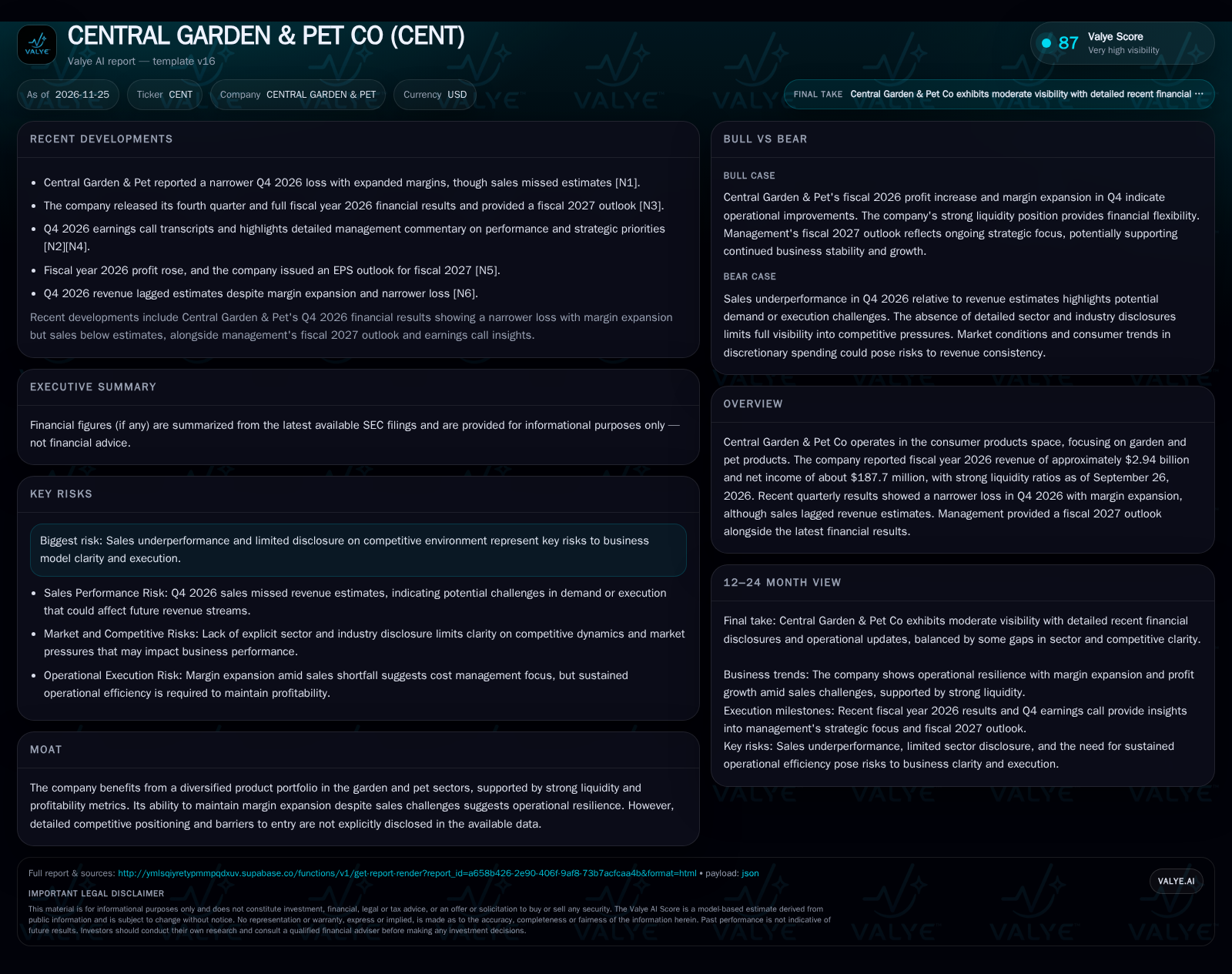
Central Garden & Pet Co. ended fiscal 2026 with $2.94 billion in revenue and $187.7 million in net income, supported by reported liquidity position and expanded margins. However, Q4 sales lagged estimates, raising questions about demand and competitive positioning. The company’s strong financial footing may enable strategic investment or weathering downturns, but further visibility into market dynamics and category leadership is needed to gauge sustainable upside.[S1] [N1]
Central Garden & Pet Co. enters fiscal 2027 with a paradox: on one hand, the company demonstrates robust margin improvement and a fortress-like balance sheet, with $1.09 billion in cash and solid profitability; on the other, recent quarters have exposed softness in top-line performance, with Q4 2026 sales trailing expectations. This duality—strong operational execution amid tepid demand—places the spotlight on Central’s ability to drive sustainable growth in a competitive, discretionary-driven market. The challenge ahead is not just to preserve margins, but to reignite revenue momentum and articulate a more distinct competitive edge.
Margin Gains and Liquidity Define the 2026 Finish Line
Central Garden & Pet Co. reported fiscal 2026 revenue of approximately $2.94 billion and net income of $187.7 million, with basic and diluted EPS at $3.05 and $3.03, respectively [S1]. This result was achieved despite a Q4 sales shortfall versus estimates, as management delivered a narrower-than-expected loss and expanded margins [N1] [N6]. On the balance sheet, the company held $1.09 billion in cash and cash equivalents, with a current ratio of 4.18 and a cash ratio of 2.17 as of September 26, 2026 [S1]. The interplay between improved profitability and demand softness is now central to the investment thesis.
Where Profits Emerge: The Mechanics of Margin Expansion
Central Garden & Pet generates revenue through the sale of branded and private-label garden and pet products to retailers, distributors, and e-commerce channels. Gross margin improvement in fiscal 2026, despite underwhelming sales, suggests effective cost containment, SKU mix optimization, or procurement gains. The ability to expand margins in a challenging demand environment indicates variable cost discipline and potentially favorable input cost trends, though the report does not specify whether this came from pricing actions, product mix, or operational efficiencies.
Fixed costs in manufacturing, distribution, and logistics mean that top-line pressure could threaten operating leverage if sales softness persists. The absence of explicit segment detail leaves open whether certain categories (e.g., pet consumables vs. garden hardgoods) are driving margin gains or masking volatility in others. If Central can maintain or further improve margins while reigniting volume growth, the business could unlock significant incremental profit due to its scale and cost base.
Further analysis of margin expansion mechanisms suggests that Central Garden & Pet’s ability to leverage economies of scale could be a critical factor. If the company can increase production volumes or streamline its supply chain, fixed costs per unit would decline, enhancing operating leverage. However, this benefit is conditional on stabilizing or growing demand; persistent volume declines would dilute these gains. Additionally, the role of pricing strategy merits deeper consideration. Selective price increases on differentiated products might have contributed to margin improvement, but such actions risk dampening volume if consumer price sensitivity is high in discretionary categories. Thus, the sustainability of margin gains likely depends on a delicate balance between cost control, pricing power, and volume recovery.
Competitive Positioning: Product Breadth Without Clear Moat
Central Garden & Pet’s diversified portfolio across garden and pet categories provides some insulation from seasonal and category-specific volatility. In theory, this breadth enables cross-selling, supply chain efficiencies, and resilience to shifts in consumer spending patterns. However, the company’s filings and recent disclosures do not establish a clear, defensible moat—such as proprietary brands, category leadership, or exclusive distribution relationships—relative to large specialty retailers, mass merchants, and private-label competitors.
Competitive dynamics in these sectors are shaped by consumer preference shifts (e.g., premium pet foods, organic lawn care), retailer consolidation, and the rise of e-commerce. Central’s ability to differentiate its brands, innovate in response to trends, and maintain retailer shelf space will be crucial. The lack of explicit disclosure on renewal rates, customer concentration, or contract terms means it is unclear how sticky Central’s revenue base is or whether it enjoys cost or scale advantages that are sustainable. A key competitive question is whether Central can transition from being a broad supplier to a category captain with pricing power and brand loyalty.
The absence of a clearly defined moat invites scrutiny of Central’s strategic positioning within the competitive landscape. If the company can cultivate stronger brand equity or exclusive product offerings, it might transition from a commoditized supplier to a preferred partner for retailers and consumers. This shift would enable better pricing power and reduce vulnerability to private-label encroachment. Conversely, failure to establish distinctive value propositions could exacerbate margin pressure as competitors leverage scale or innovation. Moreover, channel dynamics—such as the growing prominence of e-commerce and direct-to-consumer models—pose both risks and opportunities. Central’s ability to adapt its distribution strategy and enhance customer engagement through digital platforms could be a differentiator, but this requires investment and organizational agility.
How Central Could Turn Margin Gains into Sustainable Growth
The most favorable scenario for Central Garden & Pet is one where recent margin expansion proves durable, and the company reignites sales growth through a combination of product innovation, strategic acquisitions, and targeted marketing. If consumer demand in pet and garden categories rebounds, and Central leverages its liquidity to invest in growth initiatives (e.g., digital channels, premium segments, or international expansion), operating leverage could drive outsized earnings gains.
Evidence that would support this scenario includes: a return to above-market sales growth, consistent margin retention even as revenue grows, and new product launches or partnerships that capture incremental share. Confirmation could also come from management guidance revisions upward, positive commentary on category trends in earnings calls, or disclosure of successful integration of acquisitions. Falsification would be signaled by persistent sales underperformance, margin erosion as costs re-accelerate, or evidence that competitors are outpacing Central in core categories.
Stability with Pockets of Volatility in a Mature Consumer Market
The most plausible trajectory is for Central Garden & Pet to maintain profitability and balance sheet strength, but with modest sales growth and periodic margin fluctuations. The company’s operational discipline and product breadth may allow it to offset category-specific headwinds, but absent a step-change in consumer demand or competitive differentiation, top-line acceleration will likely be limited.
In this scenario, Central delivers steady—if unspectacular—results, with margins oscillating in response to input costs and promotional intensity. Confirmation would come from continued margin management, stable or slightly rising EPS, and incremental revenue growth. Falsification of this scenario would occur if sales decline accelerates, if there is a material margin squeeze, or if liquidity erodes due to unforeseen shocks or aggressive capital deployment.
Demand Weakness or Competitive Disruption Could Erode Gains
A credible risk is that persistent softness in consumer demand—driven by macroeconomic uncertainty or shifts away from discretionary categories—leads to ongoing sales underperformance. If margin gains prove unsustainable as the company is forced to promote or discount to defend share, profitability could deteriorate quickly given the fixed cost base.
Competitive disruption, such as retailer private-label expansion, direct-to-consumer entrants, or consolidation among major customers, could also pressure both sales and margins. Downside evidence would include further revenue misses, declining gross or operating margins, negative cash flow trends, or management guidance resets. If Central is unable to articulate a clear growth strategy or defend its core categories, investor confidence may wane, and valuation could compress.
What Will Separate Resilience from Stagnation for Central Garden & Pet?
Quarterly revenue growth versus category benchmarks—if disclosed—would help determine whether Central is gaining or losing share.
Gross and operating margin trends, especially if the company can sustain recent gains in the face of cost fluctuations.
Cash flow from operations and capital deployment decisions, to assess whether liquidity is being invested for growth or simply shoring up the balance sheet.
Any announced product launches, acquisitions, or major partnerships that signal a proactive growth strategy.
Management commentary on consumer demand, retail channel trends, and competitive responses in earnings calls and outlook statements.
Segment-level performance data (if disclosed), which would clarify which product categories are driving results or masking weakness.
Guidance changes or mid-year outlook updates, which may reflect evolving confidence in the sales pipeline and market conditions.
Evidence of strategic repositioning—such as divestitures, digital transformation, or brand-building investments—that could reshape the company’s market standing.
Disclaimer: This is research-only, informational analysis and not investment advice. It may include AI-generated interpretation and general industry context. Always verify important details using primary sources.

Comments