
3 E Network Technology: AI Data Center Expansion, Capital Structure Complexity, and the Challenge of Scaling Profitability
3 E Network Technology Group Ltd has positioned itself in the high-demand AI data center space, pursuing infrastructure growth in Europe and raising capital through varied mechanisms. The company’s mix of early-stage revenue, persistent net losses, and insider-centric governance creates both potential for transformative scale and substantial execution risk.
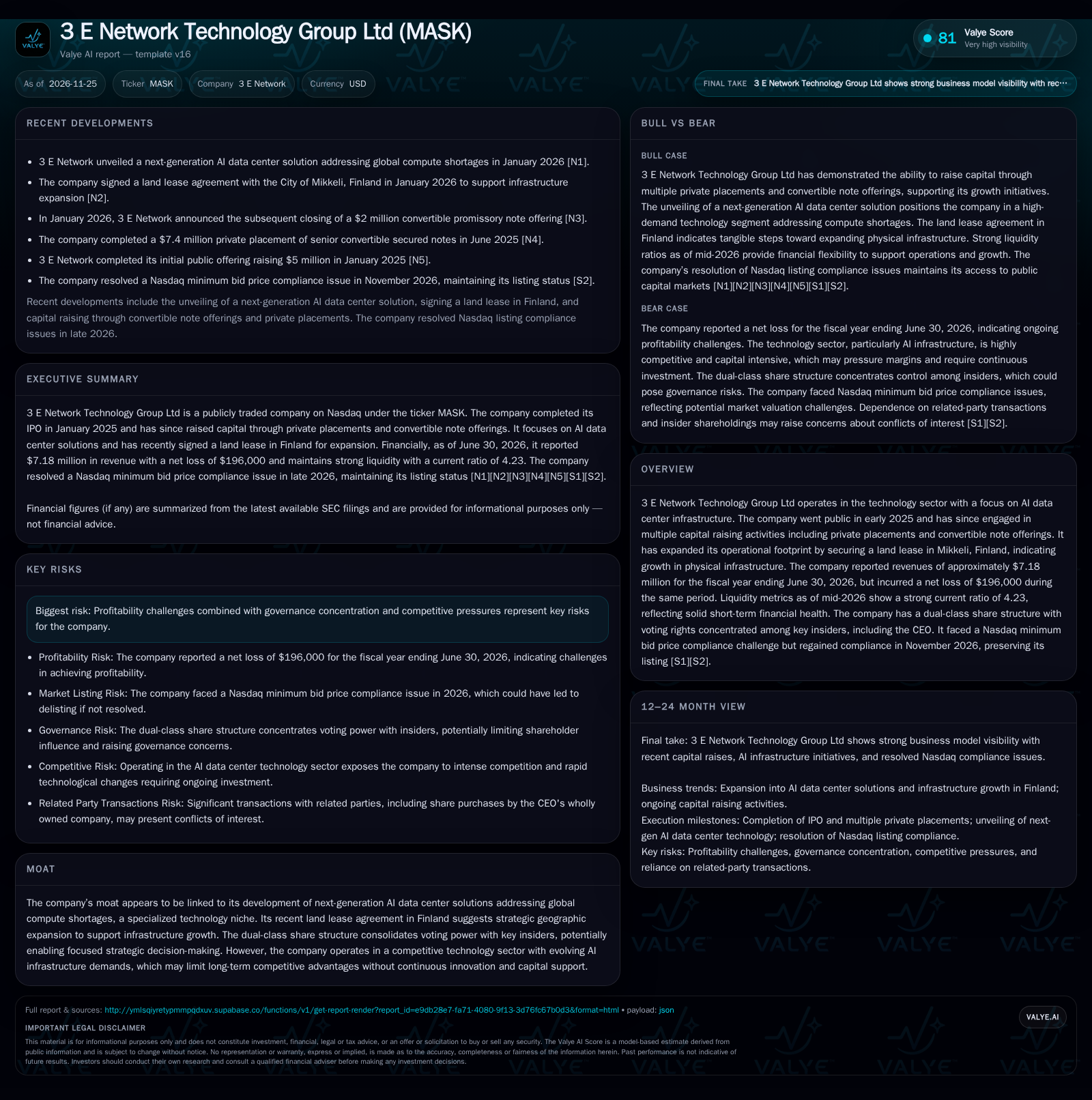
3 E Network Technology Group Ltd (Nasdaq: MASK) is expanding its AI data center infrastructure, notably in Finland, and has unveiled new solutions targeting global compute shortages. Despite raising capital through IPO and convertible notes, the company reported a net loss for FY26 and operates with a dual-class share structure concentrating control among insiders. Its future will likely depend on capital-efficient execution, market adoption of its AI solutions, and its ability to move from early revenue to sustained profitability. [S1] [N1] [N2] [N3] [N4] [N5]
3 E Network Technology Group Ltd is at a strategic inflection point, leveraging capital raised from both its Nasdaq IPO and subsequent convertible offerings to fund growth in the AI data center segment. The company’s expansion in Finland, coupled with the launch of a next-generation AI compute solution, suggests an ambition to capture a slice of the rapidly growing demand for advanced data infrastructure. However, persistent net losses, a complex capital structure, and concentrated insider control raise questions about the company’s ability to translate technical progress and infrastructure investments into durable shareholder value.
Recent Capital Raises and European Expansion Shape Strategic Trajectory
Since its January 2025 IPO, 3 E Network Technology Group Ltd has raised over $14 million through a mix of public and private capital—including a $7.4 million private placement of convertible notes and a $2 million convertible promissory note offering in early 2026. These funds have supported operational growth and the company’s expansion into Europe, as evidenced by a land lease agreement with the City of Mikkeli, Finland in January 2026. Notably, the company unveiled a next-generation AI data center solution in January 2026, positioning itself as a player in addressing global compute shortages. As of June 30, 2026, the company reported $7.18 million in revenue and a net loss of about $196,000, with a current ratio of 4.23 and cash ratio of 0.75. The company also resolved a Nasdaq minimum bid price compliance issue in November 2026, maintaining its listing. [S1] [S2] [N1] [N2] [N3] [N4] [N5]
How the AI Data Center Model Could Drive Value Creation—or Burn Cash
The economics of AI data center infrastructure are shaped by a mix of high upfront capital requirements, ongoing operating costs (energy, maintenance, staffing), and the potential for recurring revenue if customers sign long-term compute or storage contracts. At present, 3 E Network’s business model appears to be in the early stages of monetization: $7.18 million in annual revenue is modest relative to sector benchmarks, and the company remains unprofitable. If its next-generation AI data center solution can secure enterprise or cloud-provider customers, revenue could shift toward higher-margin, multi-year contracts. However, capital intensity is likely to increase as the company builds out its European footprint, particularly in Finland. The company’s use of convertible debt and equity raises suggests that internally generated cash flow is not yet sufficient to fund growth, increasing dilution risk and financial leverage. If the company succeeds in scaling occupancy and utilization rates in its facilities, operating leverage could improve, but this is far from assured.
Competing in a Crowded, Capital-Intensive AI Infrastructure Arena
3 E Network operates in a highly competitive arena populated by established hyperscalers, regional data center operators, and a growing cohort of AI-specialized infrastructure firms. The unveiling of a next-generation AI data center solution could differentiate the company technologically, particularly if it addresses unique power, cooling, or compute-density needs. However, incumbents benefit from scale, established customer relationships, and access to cheaper capital. Geographic expansion into Finland may offer advantages—such as lower energy costs and proximity to emerging European AI hubs—but also exposes the company to logistical, regulatory, and operational execution risks. Without clear evidence of proprietary technology, long-term customer contracts, or ecosystem lock-in, the company’s competitive position is likely to remain tenuous unless it can rapidly demonstrate commercial traction and technological differentiation.
Rapid Customer Adoption and Infrastructure Scale Unlock Operating Leverage
The most favorable scenario for 3 E Network is one in which its next-generation AI data center solution gains rapid adoption among enterprise, cloud, or AI-native customers—possibly attracted by unique performance, energy efficiency, or cost advantages. This would drive higher utilization rates at new facilities, especially in Finland, supporting both top-line growth and margin expansion through operating leverage. Successful execution could position the company as a niche leader in high-performance AI compute infrastructure, attracting further strategic partnerships or acquisition interest. Evidence that would confirm this scenario includes multi-year customer contracts, disclosed occupancy/utilization rates above industry norms, and margin expansion in financial disclosures. Conversely, slow customer uptake, inability to fill new capacity, or sustained margin pressure would falsify the upside thesis.
Incremental Revenue Growth Amid Persistent Profitability and Governance Hurdles
A plausible base case is that 3 E Network achieves modest revenue growth as its European expansion comes online and its AI data center solution is piloted by a handful of customers. However, capital expenditures and operating costs likely outpace revenue gains, resulting in continued net losses over the medium term. The company may need to return to capital markets for further funding, with dilution risk for existing shareholders. Governance remains tightly controlled by insiders due to the dual-class structure, potentially limiting the appeal to some institutional investors. Confirmation of the base scenario would include slow but steady revenue increases, persistent negative net income, and recurring capital raises. Evidence that would contradict this outcome could be a sudden shift to profitability, major customer wins, or governance reforms that broaden shareholder influence.
Execution Missteps, Capital Constraints, and Market Weakness Threaten Viability
The downside scenario centers on execution risk: delays or overruns in building out the Finnish data center, lack of customer uptake for the new AI solution, or intensifying competition eroding any initial technological edge. Given the company’s reliance on external capital and lack of sustained profitability, a tightening funding environment could force cutbacks or asset sales. The concentrated insider control and related-party transactions could further erode market confidence, especially if governance controversies arise. Evidence for the downside scenario would include a sharp increase in net losses, missed project milestones, further Nasdaq compliance issues, or difficulty raising new capital on favorable terms. Conversely, evidence that would contradict this scenario would be rapid revenue growth, timely project delivery, and improved profitability metrics.
Milestones That Will Determine Whether 3 E Network Delivers on Its AI Ambitions
Disclosure of occupancy and utilization rates at new and existing data center facilities—if disclosed—would provide insight into demand for the company’s infrastructure.
Details on customer contracts for the next-generation AI data center solution, including contract length, value, and renewal rates, would help test the commercial traction thesis.
Updates on capex for the Finnish expansion, as well as timelines for facility buildout and commissioning, are critical to assessing execution risk.
Gross margin trends and segment-level profitability would indicate whether operating leverage is being achieved as revenue scales.
Any further capital raises, especially if on dilutive terms or involving related parties, would signal ongoing dependence on external funding.
Changes to the dual-class share structure or insider ownership concentration would impact governance risk and market perception.
Resolution or recurrence of Nasdaq listing compliance issues could affect the company’s access to public capital markets.
Disclosures of strategic partnerships, ecosystem integrations, or technology licensing arrangements would help assess competitive positioning.
Disclaimer: This is research-only, informational analysis and not investment advice. It may include AI-generated interpretation and general industry context. Always verify important details using primary sources.

Comments