
SafeSpace Global: Early-Stage AI Safety Platform Eyes Vertical Expansion Amid Product and Liquidity Hurdles
SafeSpace Global Corporation is positioning its multimodal AI platform and exclusive molecular detection partnership to penetrate high-need verticals such as senior living, education, and corrections.
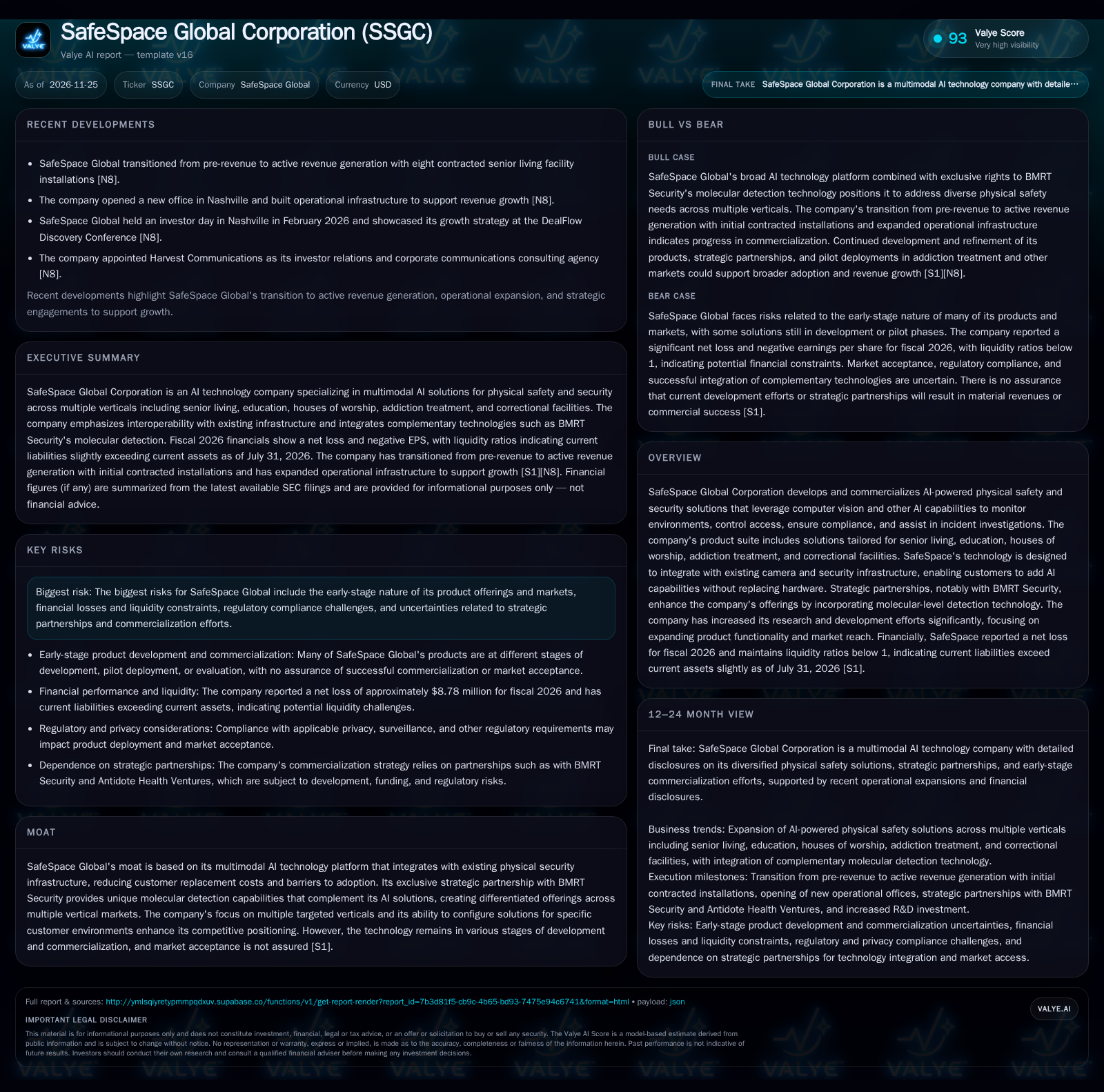
SafeSpace Global integrates AI-driven computer vision and exclusive molecular detection to offer physical security and compliance solutions across multiple high-risk verticals. With a net loss of $8.78 million and liquidity ratios below 1 as of July 2026, the company faces a critical period where successful commercialization and broader adoption are pivotal for sustainability. Its platform’s interoperability and strategic partnerships differentiate its offering, but early-stage product maturity and financial constraints remain key risks [S1].
SafeSpace Global Corporation is advancing an ambitious strategy to redefine physical safety and compliance in sensitive environments using a multimodal AI platform that integrates with legacy security systems. Its exclusive rights to molecular detection technology add a novel layer of threat identification, differentiating its offering in markets where rapid response and regulatory compliance are paramount. However, as of July 2026, the company’s financial results reflect the challenges typical of early-stage technology commercialization: a substantial net loss, current liabilities exceeding assets, and most products still in pilot or development stages.
Recent Financials and Strategic Moves Shape the Near-Term Outlook
SafeSpace Global reported a net loss of approximately $8.78 million for the fiscal year ending July 31, 2026, with basic and diluted EPS at -$0.05 [S1]. As of the same date, the company held $277,671 in cash and equivalents, current assets of $580,414, and current liabilities of $646,727, yielding a current ratio of 0.9 and a cash ratio of 0.43 [S1]. These metrics indicate that current liabilities modestly exceed current assets, raising near-term liquidity considerations.
The company’s April 2025 rebranding to SafeSpace Global and its expanded mission beyond senior living to additional verticals—including schools, houses of worship, addiction treatment, and corrections—signal a strategic pivot toward broader addressable markets [S1].
A key differentiator is the exclusive partnership with BMRT Security for molecular detection technology, which is integrated into SafeSpace’s AI platform and specifically targets high-urgency environments such as K-12 schools and correctional facilities [S1].
How SafeSpace Could Monetize Interoperable AI Safety Solutions
SafeSpace Global’s economic model centers on delivering AI-driven safety, security, and compliance solutions that integrate with customers’ pre-existing camera and security infrastructure, minimizing up-front replacement costs. This interoperability could lower customer friction and capital expenditure hurdles, supporting faster adoption if the value proposition is clear.
Revenue may derive from a mix of software licensing, platform subscriptions, and potentially hardware integration or managed services, although the specific commercial mechanics are not disclosed. A plausible model for this sector involves recurring subscription fees for AI analytics and monitoring, with one-time installation or integration charges, especially for feature-rich modules such as SafeFace™ Access Control or SafeSchool™.
Operating leverage could materialize as more customers are onboarded and as monitoring/analytics workloads scale across cloud infrastructure, but this is contingent on achieving a critical mass of deployments. R&D remains a significant cost center, reflecting the early-stage nature of product development and the need for ongoing platform enhancement [S1].
Capital needs are acute: with cash and equivalents well below $1 million as of July 2026 and negative net income, SafeSpace may require additional funding to support continued product development, sales expansion, and working capital.
Differentiation Versus Incumbents and the Role of Molecular Detection
The physical security and compliance technology market is crowded with incumbents offering camera-based analytics, access control, and incident management—ranging from established security integrators to specialized AI startups. SafeSpace Global attempts to carve out a differentiated position through its multimodal AI platform, which emphasizes interoperability with legacy infrastructure and layered detection capabilities.
The exclusive partnership with BMRT Security for molecular detection is a potential moat, as it enables threat identification (e.g., firearms, narcotics) at a molecular level, which traditional camera analytics cannot match. If this technology proves reliable and cost-effective, it could become a compelling selling point in high-liability settings such as schools and corrections.
However, the market is rife with counterforces: regulatory scrutiny, data privacy mandates, and procurement inertia in institutional environments can slow adoption. Additionally, larger security players may respond with their own integrated AI platforms or partner with alternative sensor providers, eroding SafeSpace’s early-mover advantage.
Switching costs may be moderate if SafeSpace’s integration is seamless, but retention and pricing power will ultimately depend on the demonstrable reduction in incidents and compliance costs for customers.
From Pilots to Platform: What Could Drive SafeSpace’s Breakout
The most favorable scenario is one where SafeSpace successfully converts pilot projects—such as those with Antidote Health Ventures for addiction-treatment applications—into multi-site, recurring deployments. This would validate the product’s efficacy and create reference customers across key verticals [S1].
Broader adoption in education and corrections, catalyzed by the exclusive BMRT integration, could unlock larger contracts, especially if SafeSpace demonstrates a measurable reduction in false positives and incident response times compared to incumbent solutions.
Commercial momentum would be confirmed by sequential revenue growth, expanding backlog or contracted pipeline (if disclosed), and positive customer testimonials or case studies. Evidence of successful navigation of regulatory and privacy hurdles—such as certifications or regulatory approvals—would further support the upside case.
A reduction in net losses or improvement in operating cash flow would indicate successful scaling and improved business fundamentals.
Early Commercialization with Persistent Execution and Funding Pressures
The most plausible near-term outcome is a period of incremental revenue growth as SafeSpace continues to pilot and gradually deploy its AI solutions in a handful of verticals, with ongoing product refinement and customer education required to drive adoption.
Revenue may remain modest relative to R&D and SG&A costs, resulting in continued operating losses and the need for additional funding rounds or credit lines to support operations.
Progress would be reflected in an expanding roster of pilot sites, early customer renewals, and evidence that SafeSpace’s interoperability and molecular detection features are valued by a subset of institutional buyers. However, delays in procurement cycles, regulatory reviews, or integration challenges could limit the pace of scale-up.
Confirmation of this scenario would come from stable or slightly improving liquidity metrics, steady (if modest) revenue growth, and ongoing investment in R&D and sales infrastructure.
Liquidity Constraints and Market Friction Stall Commercialization
In the adverse case, SafeSpace’s liquidity position deteriorates before it can achieve meaningful commercial traction, forcing the company to curtail R&D or delay deployments. The sub-1.0 current and cash ratios as of July 2026 highlight the risk of near-term funding shortfalls if new capital is not secured [S1].
Product pilots may fail to translate into paid contracts if integration challenges, regulatory pushback, or insufficient differentiation from established solutions emerge. The reliance on key partnerships—such as BMRT Security and Antidote Health Ventures—exposes SafeSpace to counterparty risks, where delays or technology setbacks could undermine the product roadmap.
This scenario would be confirmed by stagnant or declining revenue (if disclosed), widening net losses, negative working capital trends, or reports of delayed product rollouts and customer attrition.
Under these circumstances, SafeSpace could face strategic options including asset sales, restructuring, or seeking a merger with a better-capitalized player.
Concrete Milestones That Will Shape SafeSpace Global’s Commercial Trajectory
Sequential revenue growth and backlog expansion, if disclosed, would provide tangible evidence of market traction and the ability to convert pilots into recurring business.
Updates on the number and scale of contracted deployments—especially multi-site or multi-year agreements—would clarify the pace of commercialization.
Gross margin trends, if disclosed, would illuminate the underlying economics of AI platform deployments versus hardware or service components.
Progress on regulatory approvals, privacy certifications, or compliance milestones would help assess the company’s ability to navigate market-entry hurdles.
Disclosure of customer retention rates or contract renewal percentages would test the stickiness and perceived value of the platform.
Evidence of new or expanded strategic partnerships—especially those that enhance distribution or add new technology layers—would indicate the company’s ability to build on its platform.
A useful metric would be the number of successful incident preventions or reductions in response time attributable to SafeSpace deployments, as validated by customer case studies or third-party verification.
Disclaimer: This is research-only, informational analysis and not investment advice. It may include AI-generated interpretation and general industry context. Always verify important details using primary sources.

Comments