
Athena Technology Acquisition Corp. II: Liquidity Pressures and the Countdown on SPAC Value Creation
Athena Technology Acquisition Corp.
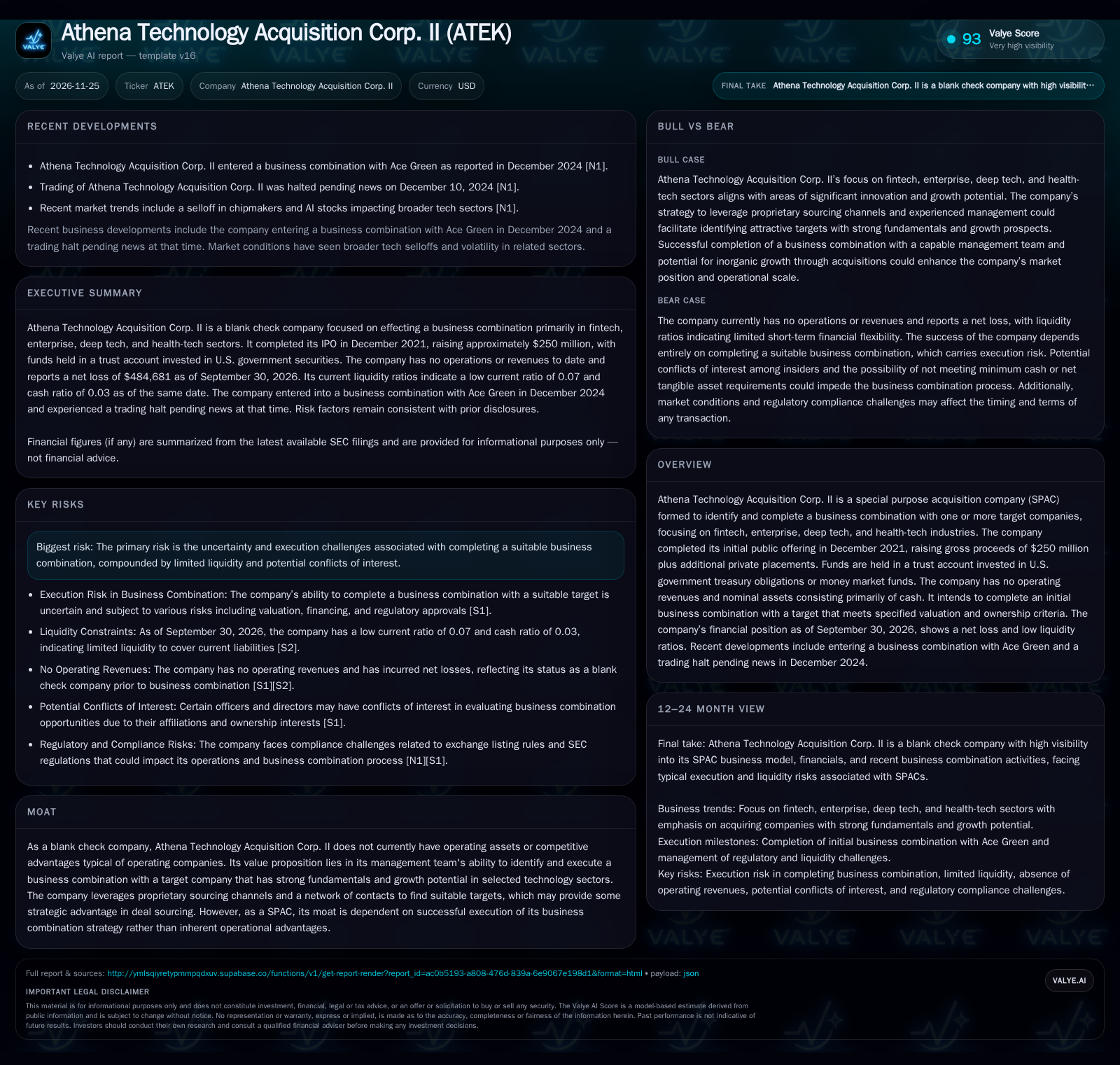
Athena Technology Acquisition Corp. II (ATEK) is a blank check company still seeking its initial business combination as of late 2026, with no operations or revenues and a net loss reported. The company’s sector focus—fintech, enterprise, deep tech, and health-tech—offers potential upside if a suitable target is found, but execution risk is now acute. [S1] [S2]
Athena Technology Acquisition Corp. II (ATEK) exemplifies the late-stage SPAC dilemma: flush with investor capital at inception, but now facing a sharply diminished cash position, a net loss, and an urgent need to consummate a business combination. The sectors targeted—fintech, enterprise, deep tech, and health-tech—remain promising, but the window for realization is narrowing.
Current Liquidity Status and Pending Transaction Overview
As of September 30, 2026, Athena Technology Acquisition Corp. II had not consummated its initial business combination, meaning it remains a pre-revenue, non-operating SPAC [S2]. Its most recent financials show a net loss of $484,681 for the period, a cash balance of $348,472 (as of December 31, 2025), and a trust account with $297,614 [S1] [S2]. [S2] Shareholder redemption rights remain intact, and the business combination process—while approved by stockholders—had not closed as of the last report [S2]. These facts signal a company at a crossroads, with limited time and flexibility to execute the transaction that will define its future.
Beyond the raw liquidity figures, a more nuanced analysis considers the burn rate relative to the remaining cash and trust assets. If the company’s monthly administrative and legal expenses continue at current levels, the runway for maintaining operational readiness without a completed business combination is severely constrained. This pressure intensifies given that redemption rights allow shareholders to withdraw their capital, potentially accelerating depletion of available funds. Moreover, the interplay between shareholder redemption behavior and the trust account balance creates a feedback loop: higher redemptions reduce capital available for deal-making, which in turn may deter potential targets wary of reduced transaction certainty.
SPAC Business Model: Deal Completion as the Value Catalyst
Athena’s entire economic model is predicated on successfully merging with or acquiring a high-potential operating business. Until that transaction closes, the company generates no operating revenues and incurs ongoing administrative and legal costs, resulting in predictable net losses [S1] [S2]. The trust account—once the main reservoir of IPO capital—has dwindled, with most funds typically earmarked for redemptions or the closing of a business combination. The fixed cost structure (listing, legal, sponsor, and administrative fees) is only partially offset by interest income on trust assets, which is now minimal given the reduced balance.
If Athena completes a business combination, its economics will pivot entirely to those of the acquired business—meaning future value depends on the acquired company’s revenue model, margin structure, and growth prospects. In the absence of a deal, the remaining capital is likely insufficient to cover ongoing obligations for long, raising the risk of forced liquidation. The company’s ability to extract value for shareholders is thus acutely sensitive to both the timing and quality of its initial acquisition.
The SPAC model’s reliance on deal completion as the primary value inflection point inherently concentrates risk around timing and execution quality. If the transaction occurs late in the SPAC’s lifecycle, the sponsor’s ability to negotiate favorable terms diminishes, as target companies may demand concessions reflecting the sponsor’s constrained bargaining power. Additionally, the fixed cost base creates a structural drag on value preservation, as these expenses continue irrespective of transaction progress. The limited interest income generated by the trust account further underscores the importance of deal velocity, as prolonged delays erode the capital base and reduce the sponsor’s incentive alignment, especially if dilution or recapitalization becomes necessary to sustain operations.
Challenges in Deal Sourcing Amid a Saturated SPAC Landscape
Athena’s primary competitive lever is its proprietary sourcing network and sponsor expertise, which theoretically could position it ahead of other SPACs in accessing attractive targets [S1]. However, the broader market is saturated: hundreds of SPACs compete for a limited pool of high-quality private companies, many of whom are wary of public market volatility or skeptical about the value-add of a SPAC merger.
Unlike operating companies, Athena has no product, customer base, or recurring revenue to differentiate itself. Its ability to win deals depends on offering terms that are more attractive or flexible than those of rival SPACs, private equity, or direct listings. The company’s sector focus—fintech, enterprise, deep tech, and health-tech—aligns with areas of innovation, but these are also sectors where valuations can be high and due diligence complex. The late-stage nature of Athena’s SPAC life cycle means that its bargaining power may be diminished, especially if targets sense time pressure or limited potential financial flexibility.
The competitive environment for SPAC acquisitions not only pressures valuation and deal terms but also complicates due diligence and integration planning. Targets in fintech, enterprise, deep tech, and health-tech often require specialized technical and regulatory expertise to assess growth sustainability and compliance risks. Athena’s ability to leverage sponsor domain knowledge and network connections is critical in differentiating its value proposition, yet the late stage of the SPAC lifecycle may limit the time available for thorough evaluation. Furthermore, the presence of multiple competing SPACs and alternative financing routes increases the likelihood that targets will negotiate from a position of strength, potentially resulting in higher transaction costs or less favorable governance structures post-merger.
Unlocking Shareholder Gains Through Swift High-Quality Acquisitions
A favorable outcome would see Athena quickly executing a business combination with a target that not only meets its sector focus but also brings strong fundamentals—recurring revenues, robust growth, and a compelling competitive moat. In this scenario, the acquired company’s operating profile would supersede Athena’s current financials, and the value proposition for shareholders would shift to the prospects of the new entity.
Evidence that would confirm this scenario includes the announcement and closing of a merger with a well-regarded private company, clear disclosure of the target’s historical revenue and margin performance, and post-deal trading that signals market confidence in the combined entity’s prospects. Strong target-company management retention and minimal redemptions would further validate the upside.
Extended Search Narrows Margins and Limits Deal Potential
The most plausible path is that Athena continues to pursue a business combination but faces delays and must make concessions—either in valuation or deal structure—to get a transaction across the finish line. In this scenario, the eventual target may be a less mature or lower-profile company than originally envisioned, and the deal may be structured to address high redemption rates or to attract additional PIPE (private investment in public equity) funding.
Confirmation would come from a deal announcement with less favorable terms for Athena stockholders, such as a smaller transaction value or significant dilution. High redemption rates at closing and the need for additional capital would also support this scenario. If the deal closes but the market reacts with skepticism or volatility, this would further indicate that the outcome is functional rather than value-creating.
Risks of Deal Collapse or Liquidation with Dwindling Cash
The adverse scenario materializes if Athena is unable to close a business combination before its financial resources are exhausted or regulatory deadlines kick in. In this case, the company may be forced to liquidate, returning remaining trust assets to public shareholders—likely at a discount to initial capital given administrative costs and redemptions.
Confirmation would include further deterioration of liquidity metrics, regulatory extensions expiring, or public disclosures that a transaction cannot be completed. High or total shareholder redemptions and the announcement of a liquidation and trust distribution would mark the realization of downside risk.
Factors Influencing Athena’s SPAC Performance Trajectory
Announcement of a definitive business combination agreement, including details on target sector, size, and historical financials.
Redemption rates at the time of business combination closing—if disclosed—will reveal shareholder confidence and capital retention.
Any revisions to the regulatory or charter-imposed deadline for completing a business combination.
Changes in the trust account balance or additional withdrawals for non-deal purposes, especially if not in accordance with the trust agreement.
Disclosure of PIPE investments or alternative financing arrangements to support a business combination.
Material changes in the company’s current ratio or cash ratio in subsequent filings.
Updates on regulatory or exchange compliance, especially related to listing status and SEC reviews.
Management turnover or changes in sponsor commitment, which may signal shifting confidence or deal prospects.
Disclaimer: This is research-only, informational analysis and not investment advice. It may include AI-generated interpretation and general industry context. Always verify important details using primary sources.

Comments