
Membership Momentum and Margin Pressure: BJ’s Wholesale Club at a Crossroads
The company’s strategy now hinges on sustaining high member engagement and navigating industry cost pressures while managing a thin liquidity cushion.
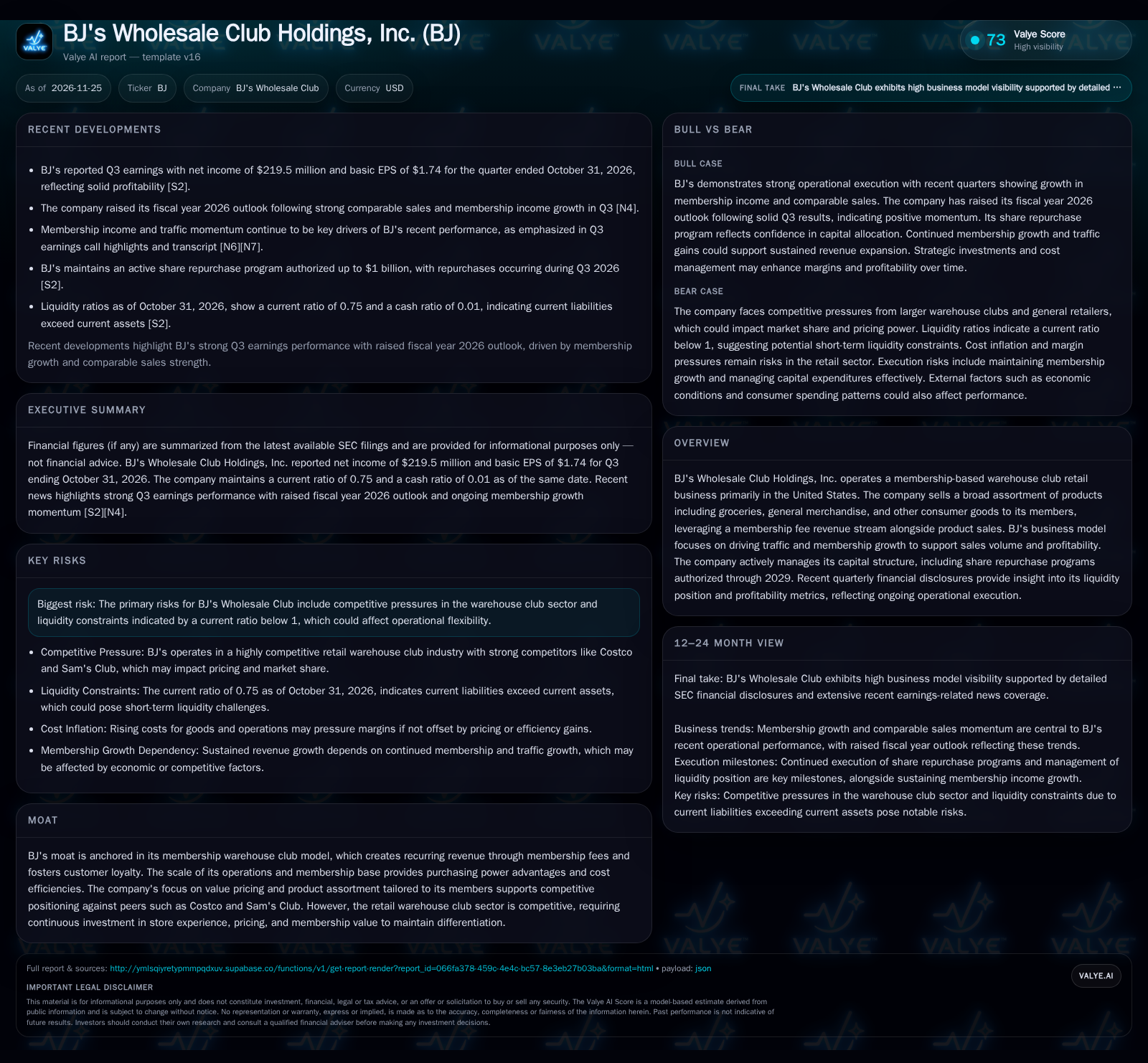
BJ’s Wholesale Club reported strong Q3 profitability, with $219.5 million in net income and raised its fiscal 2026 outlook on the back of membership and sales momentum. However, a current ratio of 0.75 and a cash ratio of 0.01 highlight a tight liquidity position. The company’s active $1 billion share repurchase program shows capital allocation discipline but also underscores the need for careful cash management amid competitive and margin pressures. Ongoing membership growth and execution on cost structure will be critical to BJ’s ability to maintain its trajectory in a crowded warehouse club market. [S2] [N4] [N6] [N7]
BJ’s Wholesale Club stands at a pivotal point: its recent financial performance demonstrates the power of a membership-driven warehouse model, with robust net income and upgraded guidance reflecting strong member engagement and sales momentum. Yet, this momentum is shadowed by a notably thin liquidity position and intensifying competition from larger warehouse retailers, raising questions about the sustainability of its growth and capital allocation strategies. The next phase for BJ’s will test its ability to convert membership gains into durable margin expansion while mitigating risks from cost inflation, capital needs, and ongoing competitive threats.
Recent Results Reveal Strengths—and Expose Constraints
BJ’s Wholesale Club reported net income of $219.5 million for the quarter ended October 31, 2026, with basic earnings per share at $1.74 and diluted EPS at $1.73 [S2]. This performance reflects effective execution in driving sales and capturing value from its membership base, supporting the company’s decision to raise its fiscal 2026 outlook following strong comparable sales and membership income growth [N4]. The company reported cash and liquidity metrics for the period; these figures do not by themselves establish operating runway, investment capacity, financial flexibility, or financing capacity. [S2] An active $1 billion share repurchase program, with buybacks executed in Q3, underscores management’s commitment to capital returns but also puts added focus on cash management in a low-liquidity environment [S2].
How BJ’s Makes Money: Membership Leverage and Margin Dynamics
BJ’s core business model is built around the membership warehouse club format: customers pay annual membership fees for access to a limited-assortment, value-focused retail offering. This creates two primary revenue streams—recurring membership income and merchandise sales—with the former providing high-margin, relatively predictable cash flow that helps smooth retail cyclicality. Merchandise sales, especially in grocery and consumables, typically operate on thin gross margins, making scale and inventory efficiency critical for profitability.
The economics of the model mean that incremental traffic and membership renewals can drive outsized earnings leverage, as fixed costs (store operations, distribution, core SG&A) are spread over higher sales volumes. However, these fixed costs also create downside risk in periods of weak traffic or elevated expense pressure.
The membership model’s reliance on recurring fees provides a buffer against retail volatility, but it also creates a dependency on member retention and acquisition. If external factors such as economic downturns or shifts in consumer preferences reduce membership renewals or new sign-ups, the revenue base could contract sharply, given the thin margins on merchandise sales. Additionally, the model’s fixed cost structure means that any decline in traffic disproportionately impacts profitability, making operational efficiency and cost control critical. Investments in technology or supply chain optimization could improve margins but require careful capital allocation given liquidity constraints.
Warehouse Club Rivalry: Competitive Advantages and Pressures
BJ's faces intense competition from larger warehouse club peers such as Costco and Sam’s Club, as well as from traditional mass retailers like Walmart and Target. The primary differentiator lies in the membership model, which can foster loyalty and predictable revenue, but the sector’s low price points and overlapping product mixes make it difficult to build durable pricing power.
Scale is a double-edged sword: while BJ’s has significant purchasing power, it is smaller than Costco, which can negotiate better supplier terms and invest more heavily in technology and store experience. BJ’s seeks to differentiate through regional focus, curated assortments, and targeted value propositions, but these efforts may be offset by national competitors’ broader reach and deeper capital resources.
Switching friction for consumers is moderate—membership fees are relatively low, and warehouse club shoppers often hold multiple memberships. This underscores the importance of continuous investment in member value, experience, and assortment to avoid churn, particularly as economic conditions or promotional intensity shift.
BJ’s competitive position must be evaluated in light of the trade-offs inherent in scale and differentiation. While larger rivals benefit from economies of scale and supplier leverage, BJ’s regional focus and curated assortments may allow for tailored value propositions that resonate more strongly with specific customer segments. However, this approach requires precise inventory management and marketing effectiveness to avoid dilution of the value proposition or inventory obsolescence. Furthermore, the moderate switching costs imply that any lapse in perceived value or service quality could accelerate member churn, emphasizing the importance of continuous innovation and member engagement initiatives to sustain loyalty.
If Membership and Traffic Momentum Unlocks Sustained Margin Expansion
The most favorable scenario for BJ’s is one in which current trends in membership growth and traffic persist, driving higher renewal rates and incremental sales per member.
Confirmation would come from continued above-peer comparable sales growth, rising membership income, and evidence that margin gains are outpacing any cost inflation. A further positive sign would be a sequential improvement in liquidity ratios—suggesting that growth is translating into improved cash generation rather than being offset by rising payables or working capital drain.
Falsification would occur if membership or traffic momentum stalls, or if incremental gains fail to translate into margin expansion—suggesting that cost pressures or competitive pricing are eroding the benefits of top-line growth.
Solid Performance Tempered by Margin and Liquidity Constraints
The most plausible near-term path is that BJ’s maintains positive membership and sales momentum, but margin expansion is limited by ongoing cost inflation and competitive pricing.
This scenario would be confirmed by continued, but not accelerating, membership and traffic growth, stable or slightly improving gross and operating margins, and a steady or marginally reported liquidity-ratio trends. Any material negative shift in these indicators—such as a deterioration in liquidity or a reversal in traffic trends—would falsify this middle-ground outcome.
When Liquidity Tightens and Competition Erodes Membership Gains
The adverse scenario unfolds if heightened competition or softening consumer demand leads to stagnation or decline in membership and traffic, while cost inflation outpaces the company’s ability to pass through pricing or offset with efficiencies. In this environment, BJ’s fixed cost structure would magnify profit declines, and a low liquidity buffer could force reductions in investment, promotional intensity, or even trigger asset sales or external financing needs.
Confirmation would include a drop in comparable sales, flat or declining membership income, and further deterioration of the current and cash ratios. Early warning signs would be a suspension of share repurchases, missed earnings guidance, or management commentary highlighting cash conservation or capital spending cuts.
Signals That Will Shape BJ’s Membership-Driven Growth Thesis
Quarterly net membership income growth rate, as this remains central to both top-line and margin expansion.
Comparable club sales (comps) trends, especially relative to warehouse club peers, to gauge traffic and wallet share momentum.
Gross and operating margin progression, which will signal whether scale and membership leverage are offsetting cost inflation.
Sequential changes in the current ratio and cash ratio, as improved liquidity would help validate sustainable growth and capital allocation.
Pace and scale of share repurchases, as a reduction or suspension could signal internal cash constraints or shifting capital priorities.
New club openings or regional expansion announcements, which would reflect management’s confidence in growth and capital allocation capacity.
If disclosed, member renewal rates and churn, which would provide insight into the stickiness of the membership base and competitive positioning.
Management commentary on supplier terms, inventory strategy, and cost management initiatives, as these will affect the company’s ability to navigate margin pressures.
Disclaimer: This is research-only, informational analysis and not investment advice. It may include AI-generated interpretation and general industry context. Always verify important details using primary sources.

Comments