CNX Resources Corp: Strategic Resilience and Leadership in Appalachian Natural Gas
CNX Resources leverages its vast Appalachian foothold and integrated operations to navigate volatile markets and energy transition trends.
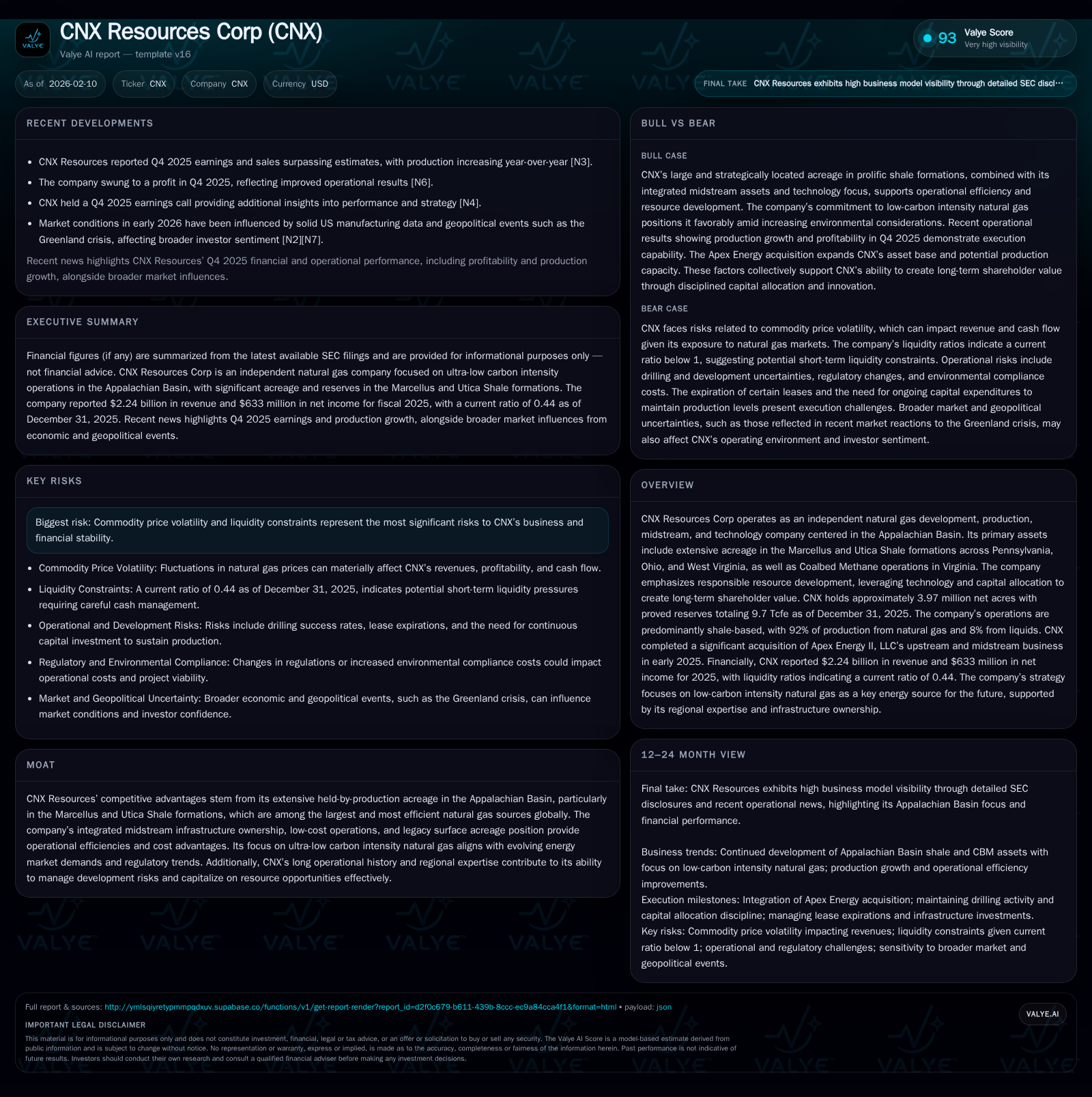
CNX Resources Corp stands as a central player in the Appalachian Basin’s natural gas sector, harnessing nearly 4 million net acres with a focus on ultra-low carbon intensity shale and coalbed methane production. The company’s robust 2025 earnings, featuring $2.24 billion revenue and $633 million net income, illustrate operational excellence amid industry headwinds that have challenged peers. CNX’s strategic acquisition of Apex Energy II’s upstream and midstream assets further consolidates its integrated infrastructure footprint, underpinning cost efficiency and long-term value creation in an evolving energy landscape. Market risks including commodity price swings and inflation remain tangible, yet CNX’s disciplined capital deployment and sustainability initiatives afford it a resilient outlook for 2026 and beyond.
Appalachian Powerhouse: CNX’s Operational Heartland
CNX Resources’ operational strength is deeply rooted in its expansive footprint within the Appalachian Basin—the heartland of America’s most prolific shale gas formations. Holding approximately 3.97 million net acres spread across Pennsylvania, Ohio, West Virginia, and Virginia (for Coalbed Methane or CBM operations), CNX commands a resource base few competitors can rival [S1]. This land position is not merely large; it is strategically held-by-production acreage—a term meaning these lands are retained because they yield hydrocarbons, conferring ongoing development opportunities without the risk of lease expiration.
Core to this footprint are the Marcellus and Utica Shale formations, which jointly account for a majority of CNX's reserves and production volumes. The geological characteristics here—thick organic-rich layers coupled with favorable pressure regimes—render this basin one of the most cost-efficient natural gas sources globally [Valye_report_excerpt]. Furthermore, the integration of coalbed methane operations in Virginia adds a legacy but valuable dimension to CNX's asset mix.
As of December 31, 2025, CNX reported proved reserves totaling approximately 9.7 trillion cubic feet equivalent (Tcfe), heavily skewed toward natural gas (89.5%), with 72.2% classified as proved developed reserves—all critical metrics signaling that most reserves are readily recoverable with existing infrastructure [S1][F1]. Complementing this is a production mix where shale accounts for roughly 94%, underscoring CNX's strategic focus on high-margin unconventional resources.
This intricate geospatial and technical tapestry grants CNX significant competitive moats: economies of scale in drilling; operational knowledge cultivated over decades; ownership of surface acreage lowering access costs; and robust data-driven reservoir management enhancing recovery efficiency.
Financial Fortitude: Breaking Down CNX’s Latest Earnings Performance
The full-year 2025 results delivered by CNX illuminate an entity not only managing but thriving amid a challenging natural gas market environment. Generating $2.24 billion in revenue paired with $633 million in net income, the company registered notable earnings beats against consensus expectations amidst a backdrop where many peers saw profit compression or outright losses [N2][N4][N9][S1][F1].
A key driver behind this resilience is CNX’s operational execution which allowed it to increase total sales volumes to approximately 629 Billion cubic feet equivalent (Bcfe) during the year—an impressive near doubling over ten years illustrating both growth discipline and sustained reservoir productivity [S1][F1]. The ability to sustain such volume growth while navigating volatile commodity prices speaks to a nimble cost structure.
Detailed segment data reveals that shale operations accounted for revenues exceeding $1.76 billion, dwarfing the coalbed methane contribution near $148 million [S1]. These figures reflect not just scale but optimized capital deployment across high-return wells. Moreover, midstream activity contributed an additional $69 million of segment revenue supported by environmental attribute sales totaling nearly $78 million — evidence that diversified revenue streams underpin CNX's financial health.
In contrast to some midstream-centric firms struggling through margin squeezes noted in contemporaneous sector reporting [N1], CNX's integrated model combining upstream supply control with midstream logistics confers both operational flexibility and enhanced margin capture.
Decoding Reserves and Production Mix: Shale Meets Coalbed Methane
A nuanced understanding of CNX's resource base reveals a sophisticated blend dominated by shale reservoirs complemented by legacy coalbed methane holdings. The company's daily average production stood around 1.72 million Mcfe during 2025—92% derived from natural gas with liquids accounting for the balance [S1][F1]. This composition reflects targeted drilling strategies favoring dry gas-rich plays aligned with market demand realities.
Shale operations contribute roughly 94% to production volumes while CBM assets provide diversity across commodity cycles given their differing geomechanical extraction profiles and localized pricing dynamics [S1]. Crucially, about 99% of proved reserves are operated directly by CNX which provides greater control over development timing, cost optimization, and environmental compliance processes.
Over the past decade, the company has successfully grown total sales volumes roughly 91%, reaching nearly 629 Bcfe—a testament to consistent reservoir performance enhancement combined with technological advances in horizontal drilling and hydraulic fracturing tailored specifically to Appalachian geology [Valye_report_excerpt]. This volume growth trend also bolsters fixed cost absorption rates thereby enhancing per-unit profitability.
Capital Allocation and Strategic Acquisitions: Apex Energy Integration Impact
In January 2025, CNX completed a pivotal acquisition from Apex Energy II LLC encompassing both upstream natural gas production and associated midstream assets for approximately industry-standard valuation measures [S1]. This transaction extends CNX's asset base materially while broadening its infrastructure ownership footprint—particularly pipeline gathering systems vital for efficient condensate liquid handling alongside dry gas transport.
The strategic rationale centers on vertical integration gains: owning midstream reduces third-party tolling fees improves scheduling control amid congested takeaway capacity challenges experienced region-wide—and enhances overall capital efficiency. Such synergies contribute directly to operating cost depressions and margin uplifts apart from preserving long-term flexibility for future growth opportunities or joint ventures.
Additionally, integrating Apex's assets enriches commodity diversification while coupling with CNX's existing technology platforms improves data analytics precision across drilling targets—ultimately aiming to sharpen well economics incrementally over time without substantive capital intensity increases.
Sustainability at the Core: Ultra-Low Carbon Intensity Initiatives
Uniquely within its peer group, CNX prominently emphasizes ultra-low carbon intensity (CI) natural gas production—a proactive positioning anticipating tightening regulatory landscapes as well as growing buyer preference for cleaner fuels [Valye_report_excerpt][S1]. By deploying advanced emission monitoring technologies combined with rigorous venting minimization protocols across its operations—including during hydraulic fracturing stages—the company underscores its commitment to environmental stewardship.
This orientation aligns naturally given Appalachia's structural advantages such as proximity to end users limiting transport emissions plus generally lower greenhouse gas footprint relative to other basins reliant on deepwater or long-haul logistics solutions. Furthermore, environmental attribute sales approaching $78 million annually denote tangible monetization of sustainability efforts beyond compliance into new revenue streams supporting ongoing reinvestment in cutting-edge processes.
CNX’s corporate culture strongly anchors on values encapsulated as Responsibility, Ownership, and Excellence — traits that permeate safety standards, community engagement endeavors, and innovation fosters making sustainability a central business pillar rather than mere afterthought.
Navigating Market Risks: Commodity Prices and Inflation Pressures
Despite impressive results, fundamental risks persist inherent to upstream energy operations. Commodity price volatility remains paramount; fluctuations in natural gas prices influenced by global macro dynamics or regional supply-demand imbalances can materially swing earnings trajectories [S1][S2]. To mitigate this exposure, CNX actively employs derivative instruments including physical supply contracts paired with financial hedges designed to stabilize cash flows without forfeiting upside potential.
Inflationary pressures constitute another tangible headwind—rising costs for steel pipe inputs essential for well completion programs; diesel fuel expenses influencing drilling rig mobilization; alongside wage inflation impacting labor-intensive field operations all present margin compression risks if unchecked over prolonged durations [S1]. Nevertheless, management continues targeted efforts on operational efficiencies via lean practices plus technology-enabled remote monitoring reducing onsite manpower needs complementing those strategies.
Further risk mitigation is evident through conservative balance sheet management maintaining adequate liquidity buffers despite sizeable purchase obligations totaling roughly $1.48 billion spread over several years reflecting ongoing capital commitments [S1]. This financial discipline supports resilience against episodic market shocks while preserving optionality for future capital deployment decisions.
Midstream Integration: Enhancing Operational Efficiency
CNX distinguishes itself through integrated ownership spanning exploration through midstream gathering infrastructure—an approach strengthening cost negotiation leverage as well as end-to-end production cycle alignment [S1][Valye_report_excerpt]. Midstream revenues reported at about $69 million in fiscal 2025 comprise fee-based income from processing raw output alongside compression services vital for maintaining pipeline pressure stability particularly critical for Appalachian shale heterogeneity.
Moreover, the sale of environmental attributes contributes nearly $78 million enhancing profitability via monetizing emissions reductions—a growing monetizable category within renewable energy credit markets intersecting traditional fossil fuel sectors. Such diversification tempers upstream commodity price dependency fostering steadier cash flow profiles particular beneficial in cyclical downturns.
Owning much of one's transportation assets contrasts favorably against counterparts reliant on third-party pipeline capacity subject to bottlenecks or tariff volatility often problematic during seasonal demand spikes or winter heating seasons particularly prominent within Appalachia’s domestic customer base.
Governance, Values, and Long-term Shareholder Value Creation
Embedding governance principles tightly interwoven with corporate values ensures that leadership accountability aligns closely with shareholder interests without sacrificing community responsibilities [Valye_report_excerpt][S1]. Responsibility manifests as stringent safety compliance standards together with transparent stakeholder communications fostering trust within operating regions deeply impacted by industrial activities.
Ownership demands calculated risk-taking balanced against prudent capital allocation strategies manifested through share repurchases ($528 million spent buying back approximately 16.9 million shares at an average price of $31) indicative of beliefs regarding intrinsic stock value relative to market levels signaling confidence beyond short-term headwinds [S1].
Excellence reflects continuous performance improvement aspirations measured via segment-adjusted income benchmarks supporting disciplined investment prioritization among competing projects ensuring capital efficiency remains paramount throughout fluctuating cycles. Such cultural pillars forge sustainable competitive differentiators creating durable shareholder value foundations amidst dynamic markets.
The Road Ahead: Outlook and Strategic Priorities in 2026
Looking forward into calendar year 2026 presents a complex picture balancing emerging economic optimism bolstered by encouraging US manufacturing data alongside persistent geopolitical tensions capable of unsettling commodity markets unpredictably [N8][S1].
Management signals emphasize efficiency improvement initiatives leveraging technological innovation aimed at lowering per-unit costs offsetting inflationary pressures whilst prudently managing capital expenditures near disciplined target bands preserving liquidity flexibility necessary amid uncertain macroeconomic backdrops.
The recently completed Apex acquisition integration remains a focal point driving operational synergies anticipated to manifest increasingly into bottom-line accretion gradually rather than abruptly minimizing disruption risks. Sustainability considerations will retain prominence given evolving regulatory regimes alongside expanding ESG requirements from capital providers increasingly directing funding towards environmentally responsible operators like CNX.
Overall strategy retains clear priorities: responsibly develop Appalachia’s unparalleled resource base; grow ultra-low carbon intensity natural gas volumes profitably; expand allied midstream capabilities where synergistic; uphold robust risk management frameworks addressing price volatility; continuously engage stakeholders transparently reinforcing social license to operate—all coalescing towards long-term per share value accretion respecting cyclical nuances inherent in upstream energy sectors.
This analysis synthesizes publicly available regulatory filings and market reports up to February 2026 without offering investment recommendations or price targets. Readers should consider inherent uncertainties including commodity market cyclicality when interpreting forward-looking statements herein.
Disclaimer: This is research-only, informational analysis and not investment advice. It may include AI-generated interpretation and general industry context. Always verify important details using primary sources.

Comments