
Cocrystal Pharma Q2 2026: Government Contract Revenue Supports R&D Amid Continued Net Loss
Cocrystal Pharma’s Q2 2026 results highlight modest government contract revenue supporting antiviral drug development, alongside ongoing net losses and stable liquidity.
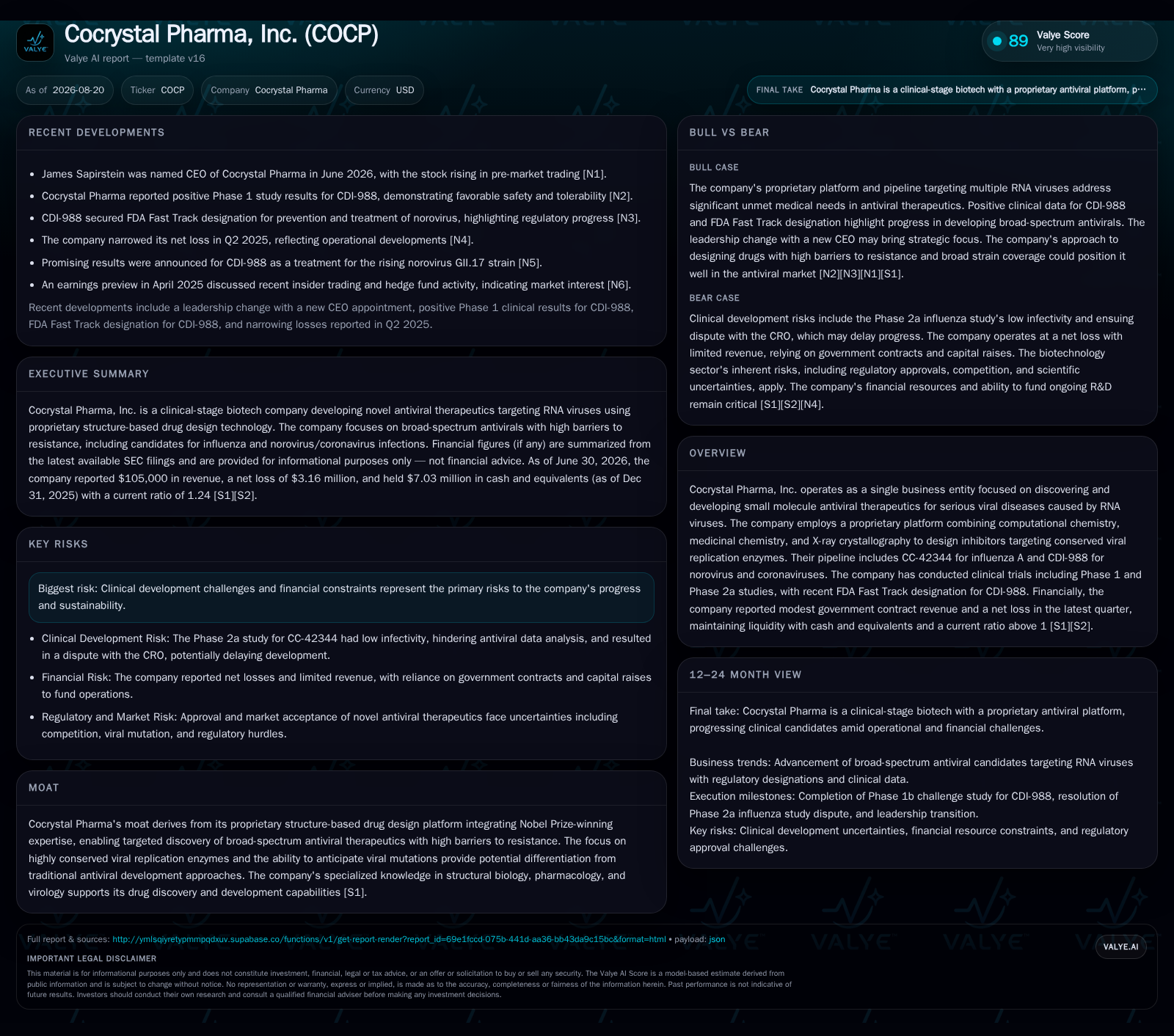
In Q2 2026, Cocrystal Pharma recognized $105,000 in government contract revenue from a Small Business Innovation Research (SBIR) Phase I contract with NIAID, contributing to its research and development efforts targeting RNA viruses. The company reported a current ratio of 1.24 as of June 30, 2026, indicating a modest but positive liquidity position. Despite these revenues, Cocrystal continues to operate at a net loss consistent with its clinical-stage biotech status, underscoring reliance on external financing or cash reserves to sustain operations.
Q2 2026 Operating and Financial Results
Cocrystal Pharma, Inc. reported modest government contract revenue of $105,000 for Q2 2026 and $330,000 for the first half of 2026 under a Small Business Innovation Research (SBIR) Phase I contract with the National Institute of Allergy and Infectious Diseases (NIAID), supporting its antiviral drug development efforts [S2]. This revenue is recognized over time based on research and development services performed under the fixed-price contract.
As of June 30, 2026, the company reported current assets of $3.236 million and current liabilities of $2.616 million, resulting in a current ratio of 1.24, indicating modest but positive near-term liquidity [F1]. While this supports operational continuity, the limited liquidity buffer requires prudent cash management given ongoing cash burn from research and development.
Cocrystal’s proprietary structure-based drug design platform integrates computational chemistry, medicinal chemistry, and X-ray crystallography, guided by Nobel Prize-winning expertise [S1]. This platform targets highly conserved regions of viral replication enzymes in RNA viruses such as influenza, norovirus, coronaviruses (including SARS-CoV-2 and MERS-CoV), respiratory viruses, and hepatitis C virus (HCV). The approach aims to develop small molecule therapeutics effective against both wild-type viruses and potential mutants, addressing viral resistance challenges.
Revenue at this stage derives primarily from government contracts like the SBIR Phase I, reflecting the pre-commercial nature of operations where research and development expenses dominate and net losses continue [S2]
Business Model and Pipeline Overview
Cocrystal Pharma is a clinical-stage biotechnology company focused on discovering and developing novel antiviral therapeutics targeting serious and chronic viral diseases [S1]. Its business model relies on government agencies such as NIAID funding research services under fixed-price contracts, which provide critical financing for early-stage drug discovery and preclinical development [S2]. Revenue recognition aligns with the delivery of research services over time.
Margins remain negative due to high research and development costs and absence of commercial product sales [S2][F1]. Cash consumption is driven by clinical trial and drug discovery expenses, with capital allocation focused on advancing the antiviral pipeline supported by government contract revenue and cash reserves
The company’s competitive advantage lies in its proprietary drug design platform that uses high-resolution structural data to design inhibitors targeting conserved viral enzymes, aiming to reduce off-target effects and overcome viral mutations [S1]. Reliance on government contracts and external financing underscores the importance of securing continued funding to sustain pipeline advancement.
Analytical Conclusions and Scenarios
The current ratio of 1.24 as of June 30, 2026 indicates a positive working capital position supporting near-term operations but suggests a limited liquidity buffer given the company’s cash burn profile [F1]. Absence of commercial revenue and ongoing R&D expenses imply that cash reserves and contract funding must be managed prudently.
The base case scenario envisions advancing the antiviral pipeline using government contract funding and cash reserves while seeking additional financing to support clinical development [S2][F1]. Confirmation would come from stable or increasing government contract revenues, successful capital raises or partnerships, and uninterrupted clinical trial progress. Conversely, a bear case involves funding challenges and clinical setbacks leading to liquidity constraints and operational disruptions.
Investors should monitor future quarterly government contract revenue, cash and liquidity metrics, clinical trial progress, and capital raising or partnership activities. These factors are critical to assessing the company’s ability to sustain operations and advance antiviral candidates toward commercialization.
Cocrystal’s proprietary drug design platform offers potential competitive advantages in antiviral drug discovery, but significant clinical and financial risks remain. Maintaining liquidity and securing additional funding are essential to support ongoing research and development and pipeline progression.
Disclaimer: This is research-only, informational analysis and not investment advice. It may include AI-generated interpretation and general industry context. Always verify important details using primary sources.

Comments