
CPKC’s Strategic Trajectory After Latest Regulatory and Operating Updates
Canadian Pacific Kansas City’s latest filings highlight operational resilience, currency impact management, and financial stability underpinning its integrated North American rail franchise.
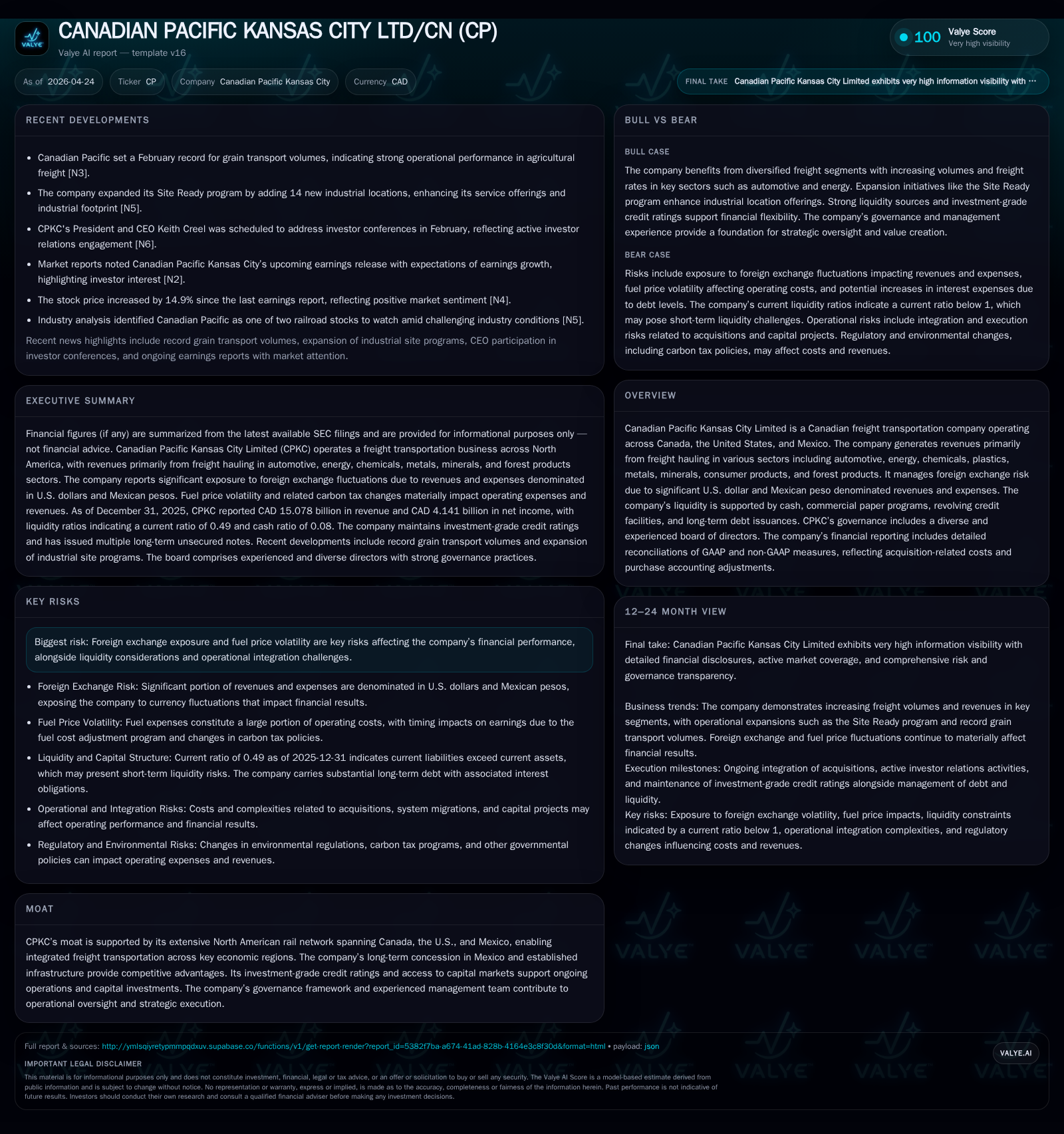
In its most recent quarterly (Q3 2025) and event filings, Canadian Pacific Kansas City Limited (CPKC) reported solid volume growth supported by a 6% increase in gross ton-miles and stable fuel efficiency despite foreign exchange headwinds stemming from CAD/USD and CAD/MXN fluctuations. The company’s core business model leverages a unique tri-national rail network connecting Canada, the United States, and Mexico, with a significant advantage from its long-term Mexican concession and cross-border integration. Its competitive moat is reinforced by scale, regulatory approvals, and strong credit ratings, enabling capital investments to optimize operational productivity. Key growth drivers include intermodal expansion and site-ready industrial locations, although FX volatility, fuel price swings, and capacity limitations remain notable risks. Financially, CPKC maintains an investment-grade profile with BBB+/Baa1 ratings, sustained free cash flow generation, and active capital return programs.
Latest Operational Update: Volume Growth and Currency Dynamics
Canadian Pacific Kansas City Limited (CPKC) displayed encouraging operational momentum in Q3 2025 according to its 10-Q filed October 30, 2025 [S2]. Gross ton-miles (GTMs) rose by 6% year-over-year to approximately 100.3 billion driven largely by higher volumes of Intermodal freight alongside commodity shipments such as grain, potash, coal, automotive products, energy-related chemicals, and plastics. Train miles increased only 3%, evidencing improved train productivity facilitated by longer and heavier trains—particularly with grain and potash loads—resulting in enhanced efficiency per unit distance traveled.
Fuel consumption per thousand GTMs remained stable at ~1.02 gallons versus ~1.016 gallons last year, indicating consistency in locomotive fuel efficiency despite rising volumes. The average number of employees edged down slightly due to resource optimization efforts without sacrificing service levels.
Foreign exchange played a material role this quarter: the U.S. dollar strengthened modestly against the Canadian dollar to an average of $1.38 CAD/USD (up from $1.36), while the Mexican peso also appreciated relative to the Canadian dollar. This currency shift contributed approximately $24 million additional revenue but simultaneously increased operating expenses by $18 million and net interest expense by $1 million compared to Q3 last year [S2]. The firm proactively manages FX risk via hedging programmes employing U.S. dollar and Mexican peso forwards.
Looking over the first nine months of 2025 overall revenue grew alongside FX effects compounded by productivity gains. These results reflect operational execution behind CPKC’s integrated continental freight platform.
Business Model Overview: Integrated North American Freight Network
Canadian Pacific Kansas City generates revenues predominantly through transporting freight across diverse sectors—including automotive manufacturing supply chains, energy products (excluding crude oil for certain periods), chemicals/plastics, metals/minerals like potash and coal, consumer goods, forest products, and grain [S1], [F1]. Its footprint uniquely spans Canada, the United States, and Mexico through an expansive rail network supported by substantial physical assets valued at nearly CAD13.7 billion in properties as of September end [S15].
A core strategic asset is CPKC’s exclusive fifty-year concession covering its Mexican railway operations until 2047 (renewable under conditions), which imposes an annual concession duty equal to 1.25% of gross revenues [S12]. This confers a durable competitive edge allowing seamless cross-border integration unmatched by competitors limited mostly to bilateral country operations.
The company must adeptly manage foreign currency translation effects given considerable revenues and costs denominated in USD and MXN offsetting or amplifying GAAP results reported in CAD [S18]. Governance involves seasoned board members skilled in finance, transportation industry dynamics, regulatory affairs across jurisdictions—a vital aspect considering varying public policies impacting rates, labor relations, environment regulations—and climate expertise aligned with sustainability mandates [S1].
Investment-grade credit ratings (BBB+, Baa1) provide access to debt markets financing capital expenditures focused on maintenance plus growth initiatives including technology upgrade investments that enhance reliability [S2]. All these elements weave together into a resilient business model underpinning continental freight logistics leadership.
Competitive Positioning and Industry Structure in Rail Transportation
CPKC operates within highly capital-intensive Class I freight rail sector characterized by strong barriers to entry stemming from network scale requirements, regulatory approval complexity across multiple countries (Canada/US/Mexico), land rights/concessions (notably Mexico), significant infrastructure investment thresholds plus entrenched customer relationships.
The tri-national network creates switching costs for customers due to logistical complexity in rerouting shipment flows elsewhere alongside integration efficiencies delivered through unified cross-border operations unavailable to peers lacking comparable presence in Mexico [S1], [F1]. Pricing power is sustained moderately due to scarcity of alternative modes that can economically cover distances such as those served for automotive or agricultural exports within North America.
Regulation is multilayered involving surface transportation acts in each country alongside trade agreements affecting tariffs/permitting [S18]. Recent upgrades via long-term credit facilities underline financial strength supporting capital projects intended to relieve potential bottlenecks amid capacity constraints.
This provides a lengthy runway for capacity build-out relative to demand forecasts aligned with North American industrial growth patterns accentuated by cross-border manufacturing clusters.
Growth Drivers: Network Optimization and Industrial Expansion Initiatives
Volume growth prospects tie directly to NAFTA-region trade dynamics expanding industrial throughput plus strategic programs such as CPKC’s "Site Ready" initiative that identifies & develops industrial real estate poised for shippers requiring rail connectivity [N5]. Recently announced additions of fourteen new industrial sites signal proactive positioning capturing next-generation supply-chain localization trends incentivizing rail freight adoption.
Operational efficiency continues improving as longer/heavier trains—evidenced by GTMs outpacing train miles—raise productivity metrics lowering incremental costs per ton-mile while preserving fuel consumption ratios [S2]. This benefit supports margin retention amid inflationary or external pressures such as labor or equipment cost increases.
Intermodal segments buoyed further participation leveraging hubs throughout Canada-US-Mexico corridors where distribution economies are optimized relative to trucking alternatives suffering scale disadvantages under capacity constraints post-pandemic disruptions.
Ongoing investments captured through annual capex exceeding CA$3 billion annually [F1] underscores commitment to infrastructure renewal & scalability aligned closely with expected cargo mix shifts.
Constraints and Risks: FX Exposure, Fuel Volatility, and Capacity Limits
Material risk factors include significant foreign exchange exposure given variable USD/CAD/MXN movements affecting consolidated earnings—FX translation benefits observed when CAD weakens versus USD but suffering asymmetric cost effect rises especially in interest expense [S2], [S18]. Hedge programs mitigate but cannot eliminate these impacts fully.
Fuel price volatility persists as an uncontrollable expense component affecting operating costs albeit partially offset through improved fuel efficiency measures including train weight management strategies established since pre-acquisition periods.
Capacity bottlenecks may emerge regionally where demand outpaces infrastructure capabilities; regulatory delays or labor disruptions represent potentially material operational hazards complicating schedule adherence or capacity expansions particularly post-KCS integration phase completing recently which still requires harmonization efforts internally.
Additional uncertainties stem from geopolitical tensions affecting trade flows or potential governmental decisions impacting concession longevity in Mexico [S23]. Environmental compliance demands add incremental capital requirements potentially squeezing returns if metal tightening policy frameworks emerge globally.
Key Milestones and Monitoring Points Ahead
Investors should track near-term quarterly releases for continued operating ratio trends reflecting mix shifts or inflation pass-through efficacy after Q3’s reported core adjusted operating ratio improvement toward ~60.7% from prior levels [S2], [N2].
Progress reports on Site Ready program utilization provide clues around future volume ramp-ups linked directly to multinationals relocating/distributing manufacturing footprints nearer continental sources enhancing modal reliance on rail transport [N5].
Earnings call disclosures concerning FX impact hedging effectiveness amid recent CAD retracements will reveal sensitivity dynamics shaping fiscal year-end guidance adjustments where available [S3].
Governance reports including proxy statements deliver insight into management accountability standards during sizable stock repurchase campaigns executed simultaneously with debt issuance activities maintaining balance sheet flexibility.
Financial Health Snapshot: Liquidity, Leverage, and Capital Investment
Historical performance (annual)
| FY | Rev ($bn) | Net ($bn) | CFO ($bn) | OpInc ($bn) | Rev YoY | Net YoY |
|---|---|---|---|---|---|---|
| 2025 | 15.1 | 4.1 | 5.3 | 5.6 | +3.7% | +11.4% |
| 2024 | 14.5 | 3.7 | 5.3 | 5.2 | +15.9% | -5.3% |
| 2023 | 12.6 | 3.9 | 4.1 | 4.4 | +42.4% | +11.7% |
| 2022 | 8.8 | 3.5 | 4.1 | 3.3 |
Source: SEC companyfacts cache [F1].
Capital returns and efficiency (annual)
| FY | Div ($mm) | Buybacks ($bn) | FCF ($bn) |
|---|---|---|---|
| 2025 | 796 | 3.9 | 2.2 |
| 2024 | 709 | 2.4 | |
| 2023 | 707 | 1.7 | |
| 2022 | 707 | 0.0 | 2.6 |
Source: SEC companyfacts cache [F1].
As at September 30, 2025 (10-Q) CPKC held cash & equivalents totaling approximately CA$411 million compared with CA$739 million at prior year-end with total commercial paper borrowings outstanding near US$1.14 billion backed fully by revolving credit facilities that remain undrawn—evidencing liquidity cushion adequacy [S2], [F1].
Investment-grade credit ratings remain stable with Standard & Poor's BBB+ and Moody's Baa1 ratings affirmed as of September 30, 2025, supporting access to capital markets [S2].
Operating cash flows generated year-to-date climbed modestly compared to prior period (+0.8%), sustaining free cash flow around CA$2.2 billion after capital expenditures increased nearly +10% YoY invested mainly in capacity enhancement projects marking disciplined financial stewardship supporting dividends (CA$796 million paid in FY2025) alongside hefty share repurchases exceeding CA$3.9 billion recently completed representing confidence in intrinsic value accretion [F1], [S2].
Stock-based compensation expenses exhibit moderate sensitivity linked directly to share price fluctuations implying potential modest impact on reported margins though well understood within planning frameworks [S2].
Overall balance sheet strength combined with measured leverage enables CPKC to execute growth strategies prudently while buffering against operating environment variability inherent across multinational railroad operators.
This analysis synthesizes information available as of April 24, 2026 from Canadian Pacific Kansas City Limited's most recent SEC filings including Form 10-Q dated October 30, 2025 ([S2]), Form 8-K dated March 25, 2026 ([S3]), Form 10-K/A dated April 23, 2026 ([S1]), supplemented by public news sources ([N2], [N5]) and Companyfacts XBRL data ([F1]). It does not constitute investment advice.
Disclaimer: This is research-only, informational analysis and not investment advice. It may include AI-generated interpretation and general industry context. Always verify important details using primary sources.

Comments