
Capri Holdings Drives Efficiency and Growth After Global Optimization Completion
Following its Global Optimization Plan completion, Capri Holdings focuses on operational efficiency and capital return to capitalize on luxury market recovery.
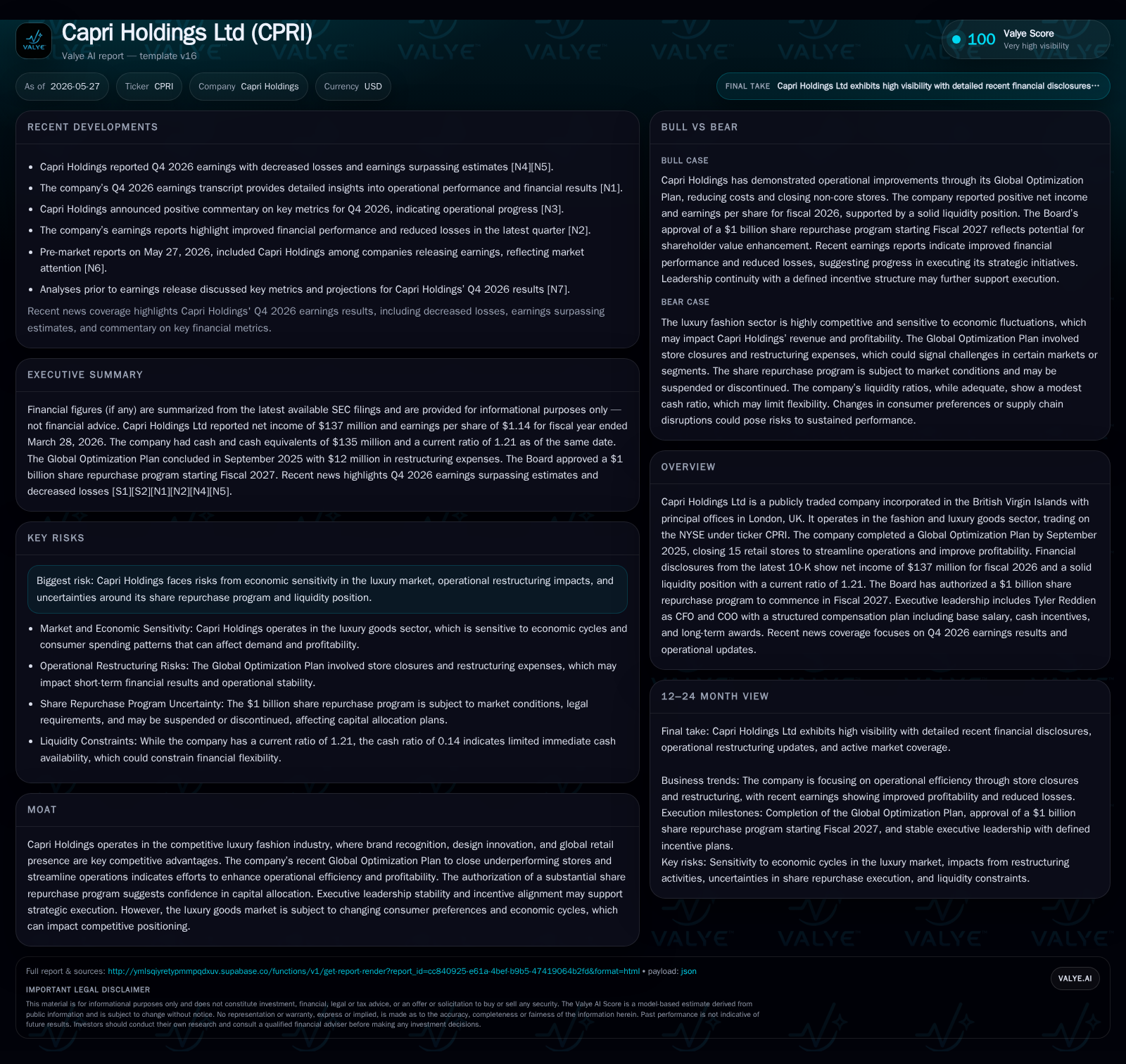
Capri Holdings concluded its Global Optimization Plan by September 2025, closing 15 underperforming stores and recording $12 million in related restructuring expenses in Q3 2026. This initiative has sharpened the company’s cost structure while setting the stage for improved profitability. As a holding company for Michael Kors and Jimmy Choo, Capri leverages strong brand equity and accessories expertise to pursue growth through product innovation and channel expansion, particularly in e-commerce. The recently authorized $1 billion share repurchase program signals management’s confidence in cash flow generation amid a recovering luxury fashion market. Risks remain from macroeconomic sensitivities and execution challenges post-restructuring, but the company’s stable liquidity profile supports ongoing strategic investments.
Current Quarter Operating Update: Streamlining and Profitability Focus
In its latest quarterly filing dated February 3, 2026 [S2], Capri Holdings confirmed the successful completion of its Global Optimization Plan as of September 27, 2025. This strategic initiative involved closing 15 retail stores to rationalize the company’s global footprint with the goal of enhancing operational efficiency. The restructuring charge directly attributable to this plan totaled $12 million during the quarter ended December 27, 2025, reflecting primarily final lease termination costs. These closures mark a pivotal step in sharpening Capri’s cost base and underpinning future profitability improvements following a period of operational reevaluation.
The finalized Global Optimization Plan aligns with management’s approach to optimize store productivity while rebalancing channel mix towards growing e-commerce sales. Such a footprint reshaping is critical amidst evolving consumer shopping behaviors favoring digital interactions over physical retail visits. Although the $12 million restructuring expense impacts near-term margins, it represents an investment into a leaner platform better suited to market demands.
Overview of Capri Holdings’ Business Model and Brand Portfolio
Capri Holdings operates as a holding company for two major luxury brands: Michael Kors and Jimmy Choo [S1]. Michael Kors contributes about 83% of total revenues in fiscal 2026 through an integrated distribution strategy comprising owned retail stores (673 locations including concessions), e-commerce platforms, wholesale partnerships, and licensing arrangements across geographies.
Jimmy Choo represents the remaining ~17% of revenue with sales generated from approximately 211 stores worldwide complemented by online channels and wholesale agreements. Both brands benefit from group-wide expertise in the accessories category—particularly noteworthy given that accessories represent high-margin segments within luxury portfolios—enabling product category leadership through merchandising best practices and scale advantages.
Revenue generation hinges on multiple consumers paying premium prices for distinct fashion products including handbags, footwear, watches, jewelry, and related accessories. Volume growth depends on geographic penetration alongside channel expansion (notably digital), while price realizations reflect brand positioning within accessible luxury tiers for Michael Kors versus more aspirational categories for Jimmy Choo.
Competitive Environment in the Global Luxury Market
The global luxury goods industry is intensely competitive, dominated by well-established players that continuously innovate product design while cultivating brand prestige to sustain pricing power [S1],. Capri’s strategy post-optimization aims to reinforce relevance by focusing resources on core profitable markets and investing in product innovation.
Channel mix dynamics continue shifting with accelerated adoption of e-commerce platforms imposing cost structure adjustments across traditional wholesale and brick-and-mortar channels. Store capacity rationalization not only addresses underperforming outlets but also repositions Capri’s retail presence toward high-traffic locations capable of delivering immersive customer experiences essential for luxury retailing.
Maintaining brand equity involves consistent marketing investment alongside careful control over distribution to avoid channel conflict or dilution. Competitors ranging from legacy French maisons to newer aspirational brands exert pressure through collaboration with global celebrities or leveraging sustainability themes—areas where Capri will need continuous agility to compete effectively.
Capital Allocation and Share Repurchase Strategy
Capital allocation has become a focal point following the operational reorganization. As disclosed in the February quarter report [S14], Capri’s Board authorized a three-year share repurchase program totaling up to $1 billion commencing fiscal year 2027. This program is designed to deploy excess capital efficiently while signaling confidence in free cash flow generation capability post-optimization.
Prior buyback activities included withholding shares from award vesting for employee tax obligations but no open market purchases under this new authorization have yet been executed as of late December 2025 [S2]. The significant size of this program reflects management’s view that current valuations present attractive capital return opportunities without compromising reinvestment for growth.
Growth Drivers: Product Innovation, Channel Expansion, and Brand Equity
Capri Holdings’ path to growth centers on several measurable levers:
- Product Innovation: Continued development within Michael Kors’ accessories lines leverages brand recognition while expanding Jimmy Choo’s accessory offering benefits from group merchandising expertise [S1].
- Channel Expansion: Increasing penetration in digital commerce is paramount as e-commerce gains share in total sales globally. Enhancements to online shopper experience and omni-channel integration are key initiatives.
- Geographic Penetration: Expanding presence selectively within emerging luxury markets offers upside potential while solidifying footholds in established regions.
- Margin Enhancement: Operational efficiencies from store footprint rationalization are expected gradually to translate into improved operating margins.
Successful execution will be visible through KPIs such as ecommerce sales growth rate outpacing brick-and-mortar segments, positive same-store sales results excluding closed locations, margin expansion trends driven by lower occupancy costs adjusted for inflationary pressures, plus new product rollouts capturing consumer interest.
Risks and Operational Challenges Ahead
Despite positive developments, Capri faces notable risks:
- Cyclical Demand Sensitivity: Luxury consumption patterns fluctuate with macroeconomic cycles including discretionary spending shifts linked to geopolitical or inflation volatility impacting shopper sentiment.
- Execution Risks: Integrating the outcomes of restructuring without disrupting brand momentum requires continued operational discipline.[S2]
- Residual Impact From Optimization Costs: Although restructuring charges have been booked largely in prior quarters, unexpected costs or slower-than-anticipated benefits could pressure near-term results.
- Share Repurchase Dependence: The large buyback program assumes stable free cash flow generation; any material disruption could impact capital return plans.
- Brand Relevance Maintenance: Fashion volatility demands consistent innovation; failure can erode customer loyalty leading to revenue declines.
Continuous monitoring is essential given these variables could constrain margin recovery or growth acceleration in competitive settings.
Key Milestones and What Investors Should Monitor Next
Upcoming catalysts include:
- FY27 Earnings Guidance Updates: Management commentary will reveal expectations for top-line trends post-global optimization as well as margin outlooks indicated after restructuring efforts mature.[N2], [N3]
- Repurchase Program Initiation: Execution tempo on share buybacks starting FY27 will be an important gauge of capital deployment discipline.[S14]
- Q1 FY27 Results: Early quarter sales data signals underlying demand environment elasticity influenced by macro factors.[N1]
- New Product Launches/Marketing Campaigns: Announcements or performance metrics around new offerings from Michael Kors or Jimmy Choo inform brand vitality.
Tracking these elements provides insight into operating leverage realization following structural changes alongside sustained brand momentum fueling growth.
Financial Position Snapshot and Capital Structure
Capri maintains a reasonably solid balance sheet position reflecting its recent optimization progress. As of March 28, 2026 end period reporting shows cash & equivalents totaling approximately $135 million with total debt around $357 million yielding net debt near $222 million [F1]. Current assets stood at roughly $1.15 billion against current liabilities slightly under $954 million producing a current ratio estimate of about 1.21 signaling adequate near-term liquidity coverage [F1].
Disclaimer: This analysis is based solely on publicly available filings from Capri Holdings Ltd as of May 27, 2026. It does not constitute investment advice or research views but aims to provide an informed institutional perspective on company operations and industry context.
Disclaimer: This is research-only, informational analysis and not investment advice. It may include AI-generated interpretation and general industry context. Always verify important details using primary sources.

Comments