
U-Haul Faces Fleet Financing and Regulatory Challenges While Leveraging Extensive Dealer Network
Recent quarterly results reveal U-Haul’s steady operational footing amid growing pressures from fleet sourcing, regulatory shifts, and competitive dynamics.
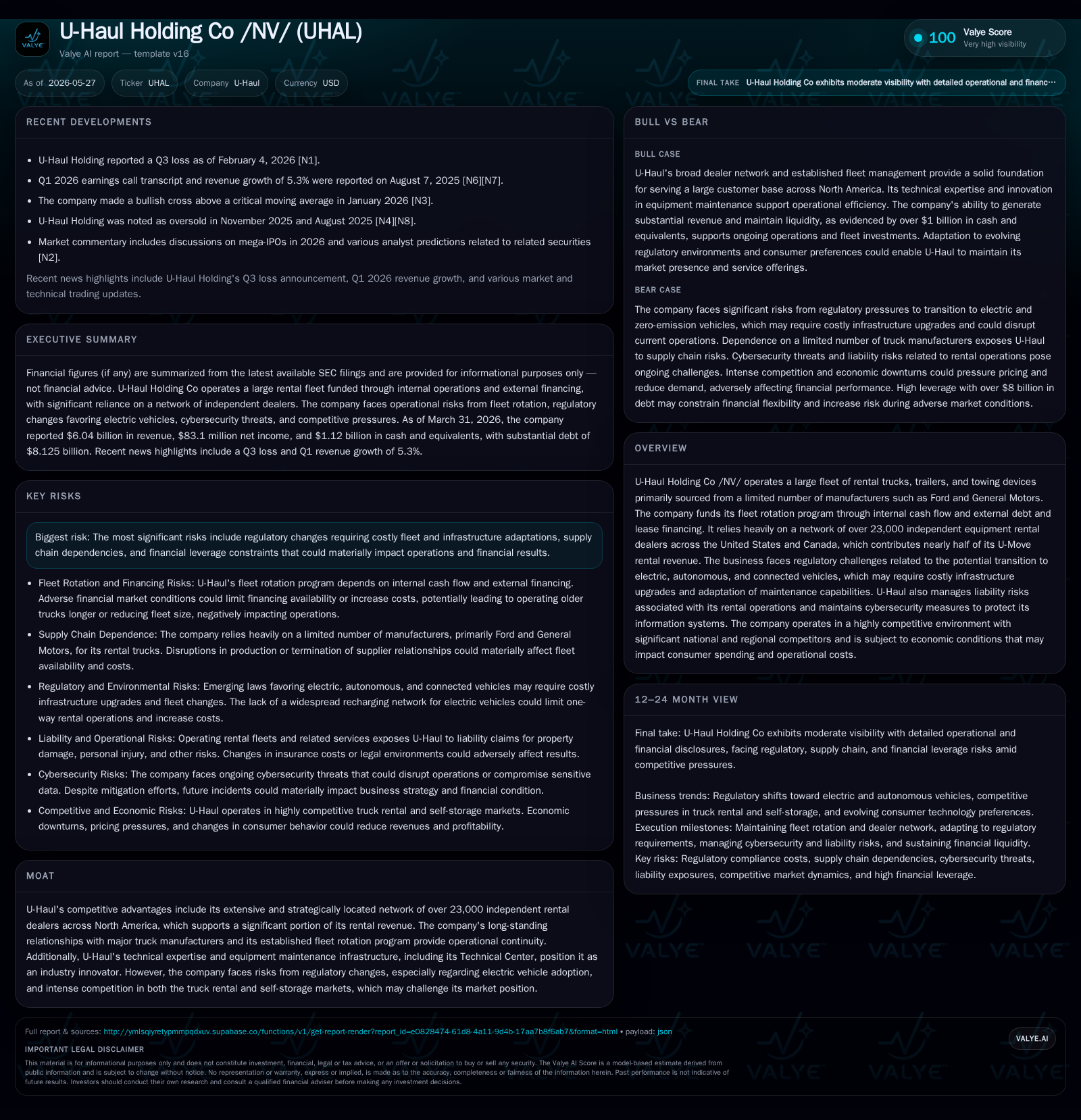
U-Haul Holding Co’s latest quarter ending March 31, 2026, confirmed ongoing operational stability supported by its vast network of independent rental dealers. However, the company confronts notable headwinds including elevated fleet acquisition costs, potential regulatory mandates toward electric and zero-emission vehicles, and increased financial leverage. Its business model remains anchored by a one-way rental service relying on internal cash flow and external debt to finance a large fleet predominantly sourced from major automakers. Competitive and regulatory environments will test U-Haul’s ability to maintain pricing power and operational flexibility as it adapts to technological and sustainability demands.
Recent Operating Update
U-Haul Holding Co released its financial results for the quarter ending March 31, 2026 [S3]. The company reported revenue of approximately $6.04 billion with operating income of about $433 million and net income around $83 million [F1]. While the figures illustrate continued profitability and robust top-line scale, these results arrived amid rising operational costs tied primarily to fleet acquisition and maintenance expenses. No material changes were disclosed to previously identified risk factors in the February 2026 quarterly report [S2], highlighting steady near-term operating conditions but underlying structural challenges.
The May 2026 event filing confirms that U-Haul continues capitalizing on its established model while increasingly facing pressures from evolving regulatory landscapes—particularly potential mandates for electric or zero-emission vehicles (ZEVs)—and supply constraints in new truck procurement from its core OEM partners Ford Motor Company and General Motors Corporation [S14][S26]
Business Model: Revenue Mechanics and Strategic Positioning
U-Haul operates a large fleet comprising box trucks, cargo vans, pickups, trailers, towing devices, and portable storage units (U-Box). Revenue stems primarily from equipment rentals covering do-it-yourself moving services across the U.S. and Canada. Nearly half of these rental revenues originate via an expansive independent dealer network exceeding 23,000 locations [S14], anchoring the company's unparalleled geographic reach.
The fundamental revenue mechanics revolve around transaction-based payments made by end consumers who rent vehicles or storage units for local or one-way moves. Rental revenue is driven by volume of rentals, rental duration, pricing per transaction (which can vary by location demand), and fleet availability—dependent on turnover timing in the fleet rotation program.
Fleet rotation is critical since vehicles are depreciating assets incurring high capital expenditure. Funding for new equipment primarily derives from internal free cash flow supplemented by external debt financing given the sizable capital requirements [S1][S16]. Revenues are supported by steady asset utilization enabled by proprietary online reservations systems and dealer relationships facilitating efficient vehicle distribution.
Margins are sensitive to fleet costs (purchase price of trucks), resale prices of used trucks upon their retirement from rental service cycles, fuel prices impacting customer demand elasticity, and repair/maintenance cost controls through U-Haul’s Technical Center expertise [S14]. The ability to maintain favorable resale values influences depreciation schedules affecting reported profits.
Customer loyalty benefits from package deals integrating towing devices, moving supplies sales at locations, self-storage services with distinctive orange branding products (subject to ongoing legal protection efforts) [S22], and ease of access via widespread dealer footprint. Contracts generally do not feature long-term lock-ins; repeat customers stem from brand recognition and convenience.
Industry Structure and Competitive Position
U-Haul operates in a highly fragmented but competitive truck rental industry alongside national commercial giants and regional/local players substantially larger than U-Haul itself in some cases [S11]. The principal competitive factors are location convenience; availability of quality equipment; price; breadth of offered moving-related services; and brand familiarity.
Unlike fully owned retail fleets seen in traditional car rental sectors, U-Haul’s hybrid dealer-based distribution model blends broad coverage with localized market knowledge but introduces dependency risks if dealer networks contract or change economics unfavorably [S14]. This structure inherently limits direct centralized control over all endpoints yet allows rapid geographic saturation.
Self-storage also represents a complementary segment with significant competition based on location density, security features, cleanliness standards, pricing pressures due to overbuilding cycles in some regions, and evolving consolidation trends favoring scale operators [S11][S20]
Key peers remain aggressive with pricing strategies that can induce margin compression or volume retention challenges [S14][S26]. U-Haul’s entrenched dealer system coupled with long-term OEM vendor relations supplies some competitive differentiation through reliable fleet replenishment but remains vulnerable to OEM production cuts or parts shortages—a historically recurrent risk exacerbated by supply chain volatility post-2020 pandemic disruptions
Innovation-wise, U-Haul has actively invested in technology-enabled tools for digital booking but faces challenges adapting fast enough against rivals capitalizing on AI-driven customer engagement solutions or autonomous vehicle integration possibilities highlighted within broader market evolution discussions [S20].
Growth Drivers
Network Scale and Dealer Expansion
U-Haul’s expansive dealer network offers strategic reach into underserved markets where competitors maintain minimal presence. Growth opportunities hinge on selectively expanding this network while maintaining strong operational economics for dealer partners.
Technology Adoption for Customer Convenience
While the industry sees increasing demand for app-based reservations and AI-powered support interactions, U-Haul aims to deepen usage of these technologies to better target consumer segments that favor digital-first moving solutions.
Incremental Product Mix Enhancement
Growth prospects exist by cross-selling related products such as moving supplies, towing accessories installations, propane refills at locations alongside rentals—capturing ancillary revenue opportunities within each transaction.
Self-Storage Segment Development
Expanding self-storage footprint selectively offers stable recurring revenue streams counterbalancing cyclical fluctuations in truck rental demand tied to consumer mobility patterns.
Fleet Optimization Amid Regulatory Shift Potential
Proactive modernization of fleet composition—including exploratory electric vehicle pilots—and enhancement of maintenance infrastructure could position U-Haul favorably when regulations tighten yet pose upfront capital intensity risks.
Risks / Watchpoints / Constraints
Financial Leverage Limits Operational Flexibility
As of March 31, 2026, U-Haul held cash and equivalents of approximately $1.12 billion against total debt near $7.36 billion, resulting in net debt around $6.24 billion [F1]. This capital structure reflects the capital-intensive nature of its equipment-heavy business model.
OEM Concentration Risk Impacts Fleet Acquisition Cost & Timing
Dependency on Ford and GM exposes U-Haul fundamentally to swings driven by those automakers’ production capacity decisions influenced by supply chain issues or economic cycles [S14][S26]. Alternative sourcing partnerships are uncertain in feasibility or timeline should existing deals falter unexpectedly
Regulatory Environment for Electric/ZEV Fleets Creates Uncertainty & Cost Pressure
California’s Advanced Clean Fleets regulation exemplifies forthcoming mandates which could force accelerated phase-out of combustion vehicles requiring significant capital investment for charging infrastructure upgrades at proprietary locations and independent dealers—likely reducing fleet utilization efficiency due to charging time requirements versus fueling rapidity [S14][S21]. Consumer skepticism towards full electrification for moving needs may limit demand elasticity if price premiums arise.
Liability & Litigation Exposure Related To Rental Operations & Intellectual Property Disputes
Operating extensive rental equipment fleets exposes U-Haul continuously to claims arising from accidents or improper use despite risk management protocols. Cybersecurity breaches remain an omnipresent threat given reliance on IT systems storing sensitive data [S13,S15]. Legal disputes over trademark protections involving orange color branding might impact marketing initiatives if unfavorable outcomes ensue [S22].
Competitive Pricing Pressure May Challenge Margin Sustainability
Aggressive discounting or promotional campaigns by larger rivals can erode U-Haul's rate structures leading potentially to decreased profitability absent offsetting cost efficiencies or volume gains.
What To Watch Next
- Quarterly booking trends through upcoming earnings reports will reveal whether pricing power sustains amid competitive dynamics.
- OEM production updates regarding vehicle allocations could signal near-term capacity constraints impacting fleet additions.
- Regulatory developments on federal/state emission requirements including any firmer electric vehicle mandates would materially shift capex outlooks.
- Progress in electrification pilot programs or technical center innovations may indicate preparedness for future fleet transitions.
- Dealer network growth metrics as an indicator of geographical expansion effectiveness.
- Resolution or progress toward intellectual property litigation outcomes affecting brand usage rights.
- Capital markets updates tied to refinancing activities given high leverage level that dictates liquidity flexibility.
Financial Profile Snapshot
As of March 31, 2026, U-Haul maintained cash and equivalents of approximately $1.12 billion against total debt near $7.36 billion resulting in net debt around $6.24 billion—reflective of the capital-intensive nature of its equipment-heavy business model [F1]
This analysis is based solely on information available through SEC filings as of May 27, 2026, supplemented with general industry context where appropriate. It does not constitute investment advice but rather a structured assessment intended for buy-side strategic review purposes.
Disclaimer: This is research-only, informational analysis and not investment advice. It may include AI-generated interpretation and general industry context. Always verify important details using primary sources.

Comments