
Dorian LPG’s Latest Quarter Signals Resilience Amid Volatile LPG Shipping Markets
The February 2026 quarter revealed operational steadiness for Dorian LPG despite geopolitical tensions and volatile charter rates.
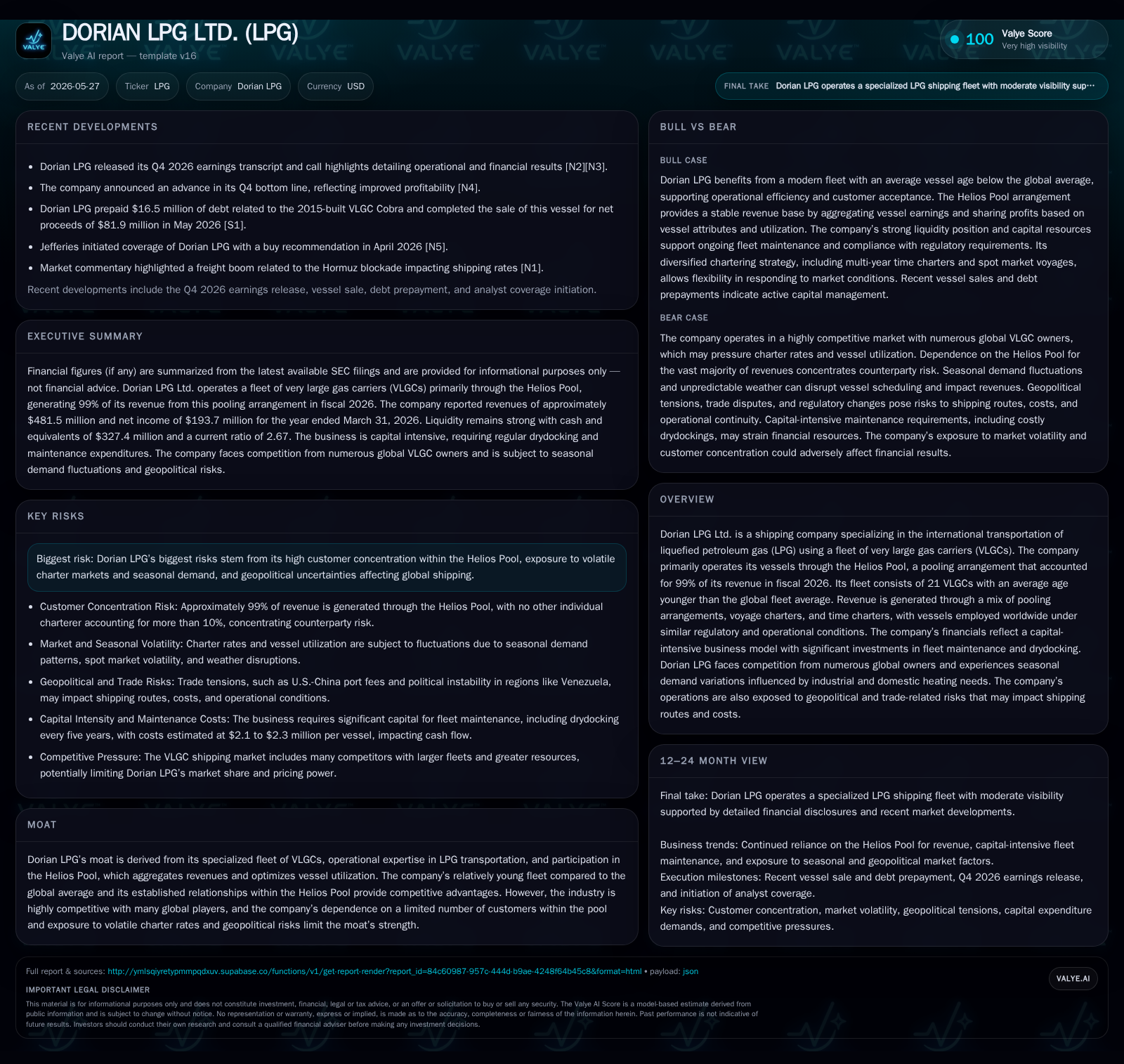
Dorian LPG Ltd. maintains a robust operating profile anchored by its participation in the Helios Pool, which accounted for 99% of revenue in fiscal 2026. The company’s fleet of 21 VLGCs, younger than the global average, supports steady vessel utilization amid disruptions from evolving U.S.-China trade negotiations affecting port fees. While the capital-intensive business shows sound liquidity with over $327 million cash and manageable net debt, risks from customer concentration and volatile charter markets persist. Growth prospects rely on the expanding industrial demand for LPG, fleet renewal, and balanced charter strategies mixing fixed and spot exposures.
Latest Quarterly Operating Update and Its Implications
The company’s latest quarterly filing dated February 5, 2026 ([S2]) highlights that Dorian LPG’s operations continue to hinge critically on the Helios Pool arrangement, which accounted for approximately 99% of revenue during the fiscal year. This pooling approach aggregates revenues from participating vessels and allocates net earnings based on vessel attributes—including capacity and fuel efficiency—and utilization days within the pool.
However, a notable operational headwind is presented by escalating geopolitical trade tensions between the U.S. and China. New port fee regimes targeting vessels owned or operated by entities linked to these countries came into effect in late 2025. A subsequent temporary one-year suspension agreed upon in November 2025 has delayed the financial impact but injects uncertainty going forward. These tariffs could indirectly increase shipping costs and disrupt logistics chains in key trading hubs, potentially elevating transit times or creating congestion at both U.S. and Chinese ports.
Management commentary within the filing notes that despite such uncertainties, the suspension of fee implementation has mitigated immediate cost pressures on vessel operations. Nonetheless, market volatility remains pronounced—spot charter rates fluctuated throughout the quarter reflecting macroeconomic factors and shipping supply-demand imbalances.
Business Model and Revenue Generation Through VLGC Fleet
Dorian LPG operates exclusively within the very large gas carrier (VLGC) sector transporting liquefied petroleum gas internationally ([S1],[F1]). Its core business model leverages a specialized fleet of 21 vessels — all VLGCs — averaging an age of approximately 10.5 years compared to the global average fleet age of roughly 11.7 years.
This relatively youthful fleet provides advantages in operational efficiencies including fuel consumption and compliance with tightening environmental regulations such as IMO’s GHG emissions targets. The company invests heavily in scheduled drydocking approximately every five years lasting about one month per vessel to maintain vessel classification status and ensure compliance with evolving ballast water treatment requirements and scrubber installations ([S1],[S16]).
Revenue streams come mainly from three charter types:
- Pool Arrangements (Helios Pool): Dominant revenue source where earnings are shared among participants based on pool points (which consider vessel size and fuel efficiency) and days on-hire.
- Voyage Charters: Spot market contracts priced by tonnage carried; these carry higher gross revenues but also greater expense volatility as voyage costs like bunkering are borne by Dorian.
- Time Charters: Contracts fix daily or monthly hire rates while Dorian retains responsibility for crewing and maintenance but not voyage expenses.
The company aims to balance its deployment across these modalities to optimize utilization while smoothing revenue fluctuations inherent to cycle-dependent spot rates.
Competitive Dynamics and Industry Positioning in LPG Shipping
The global VLGC fleet comprises around 427 vessels with a combined carrying capacity near 35.8 million cubic meters as of May 2026 ([S1]). There are approximately 129 owners globally; notably, the top ten owners hold about 41% of the fleet by vessel count.
Dorian sits as a significant player with its focused VLGC-only portfolio offering scale advantages in accessing global cargoes alongside participation in the Helios Pool—a key differentiator providing enhanced revenue stability through optimized utilization and profit sharing across pooled vessels.
Competition hinges strongly on fleet attributes such as vessel condition/age, size (cargo capacity), geographic positioning flexibility, and acceptability to charterers—often large petrochemical companies requiring reliable transport solutions. Vessels must comply with increasing regulatory requirements internationally; those lagging risk losing charters or facing costly retrofits.
Newbuild orderbooks remain substantial with over 120 units planned through 2029 including ammonia carriers related to LPG fleets — representing nearly a quarter increase in capacity if fully delivered ([S1]). This looming supply growth poses potential overcapacity risks that could depress charter rates unless matched by commensurate demand expansion.
Barriers to entry remain moderate due to capital intensity of VLGC acquisition (~$70–90M per newbuild) plus technical expertise needed for crew management and regulatory compliance; switching costs tied to vessel acceptability also limit churn among leading operators.
Key Growth Drivers Shaping Demand and Fleet Optimization
Industrial shifts underpinning stronger LPG demand extend beyond traditional heating uses to include expanding petrochemical feedstock applications which have less severe seasonal variability ([S1]). This evolution flattens previous winter-driven seasonal rate spikes thus supporting steadier year-round utilization.
Fleet renewal programs focused on acquiring newer dual-fuel ECO-design VLGCs widen opportunities for longer-term time charters at premium rates given enhanced fuel efficiency and emissions profiles aligned with increasingly stringent IMO regulations. Such investments also reduce drydocking costs compared to older tonnage.
Additional growth avenues include expanding contract coverage outside Helios Pool potentially capturing diversified customer bases or COA agreements offering volume visibility albeit often at lower margin since counters seasonal volatility.
Dorian’s mixed chartering strategy blending multi-year fixed charters (some featuring profit-sharing components) alongside spot market exposure aims to balance revenue stability against upside potential during freight rate surges ([S1]).
Risks From Geopolitics, Customer Concentration, and Market Volatility
Dependence on Helios Pool revenue concentration (99%) introduces counterparty credit risks should any major pool participants default or significantly reduce engagements ([S1]). Furthermore, geopolitical frictions—illustrated by U.S.-China port fee disputes—and other unexpected trade measures could elevate operating expenses or disrupt cargo flows across critical shipping lanes impacting voyage scheduling.
Voyage charter rates retain inherent cyclicality tied closely to weather-driven heating demand patterns plus industrial production cycles leading to volatility despite softening seasonality through petrochemical uptake ([S1],[S2]). Rising bunker fuel prices and crew wage inflation exert upward pressure on operating costs affecting margins if not offset by higher charter revenues.[S1]
Significant leverage also heightens sensitivity; although Dorian demonstrates solid covenant compliance presently, adverse rate environments could strain cash flows complicating debt servicing obligations ([F1]).
Monitoring Indicators: What Investors Should Watch Next
Key near-term milestones include:
- Updates on any vessels deployed outside Helios Pool under fixed charters or COAs impacting portfolio diversification [S3]
- Changes to profit-sharing distribution methodologies or adjustments within Helios Pool mechanics affecting net earnings allocation [N1]
- Seasonal patterns post-winter heating period validating demand strength or weakness influencing Q2/Q3 earnings guidance [N2]
- Progress on geopolitical trade relations particularly U.S.-China negotiations affecting port fees or sanctions regimes that could reshape cost structures [N1][N2]
- Regulatory developments around IMO GHG emissions standards mandating capital expenditures like scrubbers or ballast water equipment potentially increasing drydocking costs across fleet [S1]
- Earnings call commentary addressing operational efficiencies or expenses related to technical management given higher crew employment cost pressures [N2]
Timely disclosures will be essential to parse potential commodity shipping volatility from structural growth trends underpinning longer-term demand for clean energy carriers like LPG shipped via VLGCs.
Financial Overview Supporting Operating Performance
As of March 31, 2026 ([F1]), Dorian LPG held cash & equivalents totaling approximately $327 million against total debt near $566 million resulting in net debt around $238 million—an indicator of manageable leverage supported by steady cash generation from pool arrangements.
This analysis integrates disclosures from Dorian LPG Ltd.’s most recent quarterly filings and annual statements consistent with observed industry operating conditions without extrapolations beyond verified data points. It avoids investment opinions focusing strictly on factual observations relevant for industry peers monitoring VLGC sector dynamics.
Disclaimer: This is research-only, informational analysis and not investment advice. It may include AI-generated interpretation and general industry context. Always verify important details using primary sources.

Comments