
CRH’s Expansion Strategy: Acquisitions, Integration Risks, and the Economics of Scale in Construction Materials
CRH’s $8.5B Arcosa acquisition and Nordic expansion signal an aggressive growth play in global construction materials.
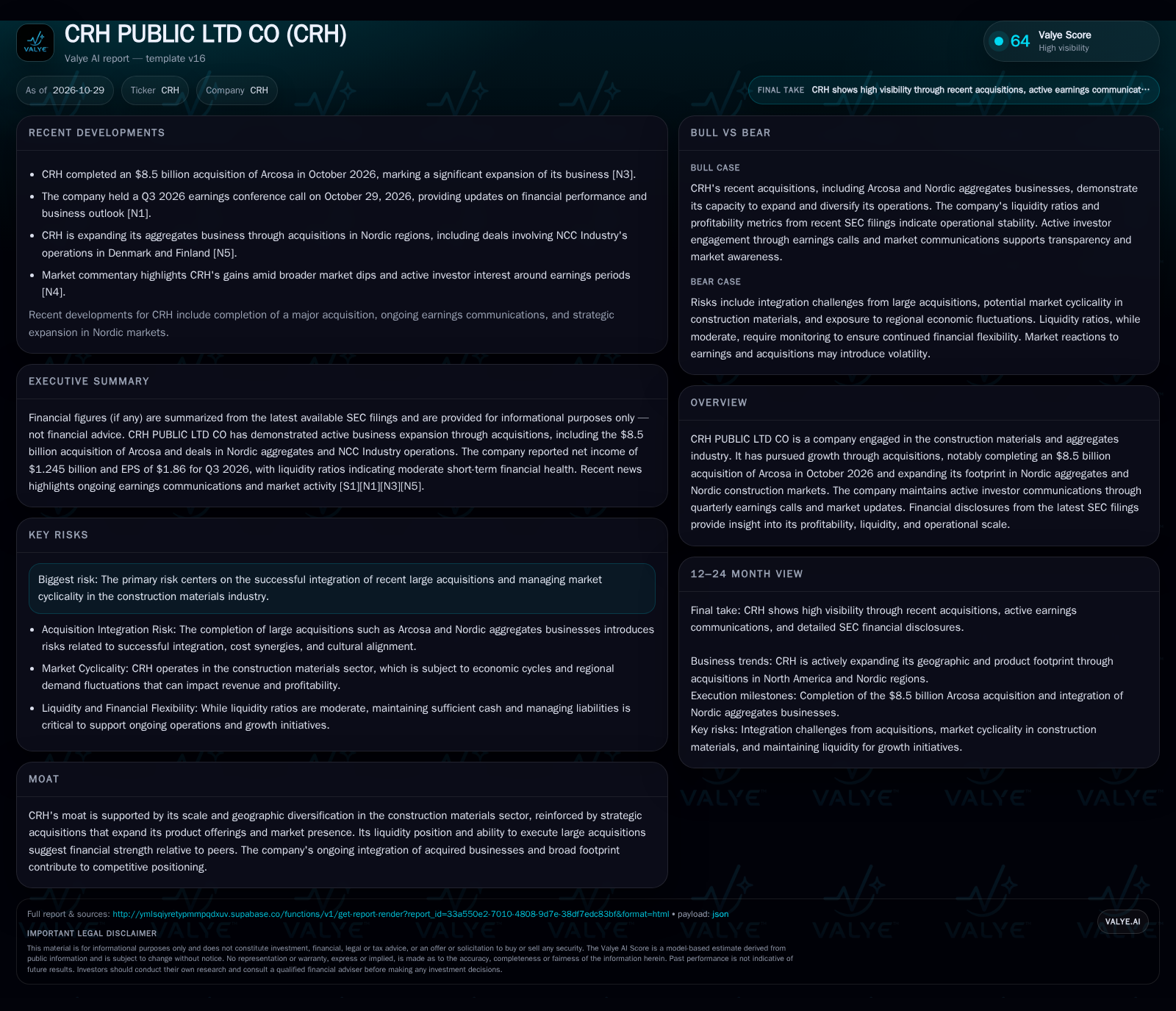
CRH has executed a transformative $8.5B acquisition of Arcosa and additional Nordic deals, aiming to scale its aggregates and construction materials platform. Near-term, the focus pivots to integration and realizing operational synergies. The path forward depends on integration execution, margin retention, and demand resilience.
With the $8.5 billion acquisition of Arcosa and new Nordic deals, CRH PUBLIC LTD CO is doubling down on scale and geographic reach in the construction materials sector. These moves position CRH to capture a broader share of infrastructure and commercial build cycles, but introduce substantial integration complexity and exposure to regional market swings. As the company enters a critical period of post-acquisition execution, its ability to maintain profitability, manage working capital, and realize expected synergies will determine whether this expansion drive translates into durable value creation or exposes the business to heightened risk as industry cycles turn.
Recent Acquisitions Redefine CRH’s Strategic Landscape
The $8.5 billion acquisition of Arcosa, finalized in October 2026, stands as CRH’s most significant inorganic expansion to date, substantially enhancing its North American aggregates and construction materials platform [N3]. Alongside this, CRH has completed deals for Nordic Aggregates and acquired NCC Industry’s operations in Denmark and Finland, reinforcing its commitment to geographic diversification and product breadth [N5].
The company reported cash and liquidity metrics for the period; these figures do not by themselves establish operating runway, investment capacity, financial flexibility, or financing capacity. [S1]
These moves mark a strategic pivot: CRH is leveraging its balance sheet to drive scale, but now faces the operational task of integrating disparate businesses and realizing the anticipated cost and revenue synergies.
How Scale Could Reshape CRH’s Margin and Capital Structure
CRH generates revenue through the production and supply of aggregates, cement, ready-mix concrete, asphalt, and related construction services—a business characterized by high fixed costs, significant capital intensity, and typically low-to-mid single-digit net margins in competitive markets. The economics hinge on volume throughput, local market share, and the ability to command price premiums or realize procurement and logistics efficiencies through scale.
Acquisitions like Arcosa and Nordic Aggregates potentially offer operating leverage by increasing asset utilization and spreading fixed costs over a larger revenue base. However, the benefits are contingent on successful integration—cost synergies, procurement rationalization, and elimination of duplicative overhead are not automatic. Moreover, large capital outlays and added debt or working capital requirements could pressure free cash flow, especially if integration costs or market headwinds outpace initial synergy gains.
Key economic levers for CRH post-acquisition will include asset rationalization, optimization of logistics networks, and disciplined capital allocation to avoid value dilution from overextension or margin erosion.
Scale, Diversification, and the Threat of Localized Disruption
CRH’s expanding footprint positions it among the largest global players in construction materials, with peer groups including multinational aggregates producers, vertically integrated cement and concrete suppliers, and regional building materials conglomerates. The company’s moat is rooted in its scale, geographic reach, and product diversity—attributes that can confer advantages in procurement, pricing negotiations, and project bidding.
However, construction materials remain a fundamentally local business. Transport costs, regulatory environments, and local demand cycles mean that national or multinational scale does not guarantee local dominance. Entrenched regional competitors, nimble niche players, and alternative materials or construction techniques (such as modular building or increased recycling) could erode CRH’s share or compress margins in specific markets.
Successful integration and the ability to harness group-wide efficiencies without disrupting local relationships and operational agility will dictate whether scale translates into sustainable competitive advantage.
If Integration Delivers: Unlocking Synergies and Margin Expansion
The most favorable scenario for CRH is one in which it rapidly and smoothly integrates Arcosa and the Nordic acquisitions, realizing cost and procurement synergies ahead of schedule. This would manifest in improved gross and operating margins, higher asset utilization, and the ability to deploy capital into additional bolt-on opportunities or shareholder returns.
Confirmation would come from sequential improvement in segment margins, reduction in SG&A as a percentage of sales, and management commentary or disclosures quantifying realized synergies. Further, sustained free cash flow generation and stable or improved net leverage would suggest that integration is not consuming excessive capital or creating hidden liabilities.
A successful integration could also improve CRH’s ability to bid for large infrastructure projects and cross-sell across its expanded product and geographic portfolio, compounding the benefits of scale.
Operational Complexity and Cyclical Demand Create a Mixed Outlook
The most plausible path forward sees CRH gradually integrating its new businesses, with some synergy capture but also temporary margin dilution and elevated SG&A as integration costs are absorbed. Market demand in core geographies (especially North America and Northern Europe) remains stable but not robust, with construction cycles providing both growth opportunities and intermittent volume/margin headwinds.
In this scenario, CRH’s scale provides modest protection against regional slowdowns, but the company is not immune to commodity cost inflation, local competition, or project delays. Free cash flow remains positive but is partially offset by working capital needs and integration outlays.
Integration Stumbles or Market Downturn Could Pressure CRH’s Balance Sheet
In a less favorable scenario, integration of Arcosa and the Nordic businesses proves more difficult or costly than anticipated—realized synergies lag, cultural or operational friction leads to project delays, and overhead savings are slow to materialize. Simultaneously, a downturn in construction activity in one or more key markets (due to macroeconomic slowdown, interest rate spikes, or public-sector budget cuts) compresses volumes and margins.
This double hit could erode profitability, strain working capital, and force CRH to prioritize balance sheet repair over growth investment. Signs of this outcome would include rising SG&A as a percentage of sales, declining or negative free cash flow, management guidance revisions, or the need to access additional credit or equity markets to shore up liquidity.
Sustained deterioration in liquidity ratios, missed synergy targets, or adverse earnings surprises would be early warning signs of this downside scenario.
Milestones That Will Determine Whether CRH’s Expansion Pays Off
Quarterly updates on integration progress, with quantified synergy capture from the Arcosa and Nordic deals, would help test whether operational benefits are being realized.
Gross and operating margin trends, especially in newly acquired segments, would indicate the success of cost management and pricing discipline.
Disclosure of free cash flow generation post-acquisition, particularly in the context of working capital swings and integration costs, would clarify capital flexibility.
Management commentary on demand trends in North America and Northern Europe will be critical, as these regions now represent a larger share of CRH’s revenue base.
If disclosed, net leverage and interest coverage ratios should be monitored for signs of balance sheet stress or improved financial resilience.
Updates on competitive dynamics—such as changes in local market share, new project wins, or loss of key contracts—would help gauge the effectiveness of CRH’s expanded footprint.
Any indication of supply chain disruptions, cost inflation, or regulatory changes in core markets would be important external factors affecting CRH’s outlook.
A useful metric would be the rate of customer retention or cross-selling success in regions where operations have been combined post-acquisition.
Disclaimer: This is research-only, informational analysis and not investment advice. It may include AI-generated interpretation and general industry context. Always verify important details using primary sources.

Comments