
Altria’s Profit Formula: Navigating Tobacco Decline, Smoke-Free Ambitions, and Liquidity Tradeoffs
Altria’s latest earnings confirm robust profitability, but a sub-1.0 current ratio and persistent cigarette volume declines highlight the urgency of its shift toward smoke-free products. The company’s ability to sustain dividends and defend its market position will depend on execution in non-combustible segments, evolving regulatory headwinds, and prudent management of near-term financial obligations.
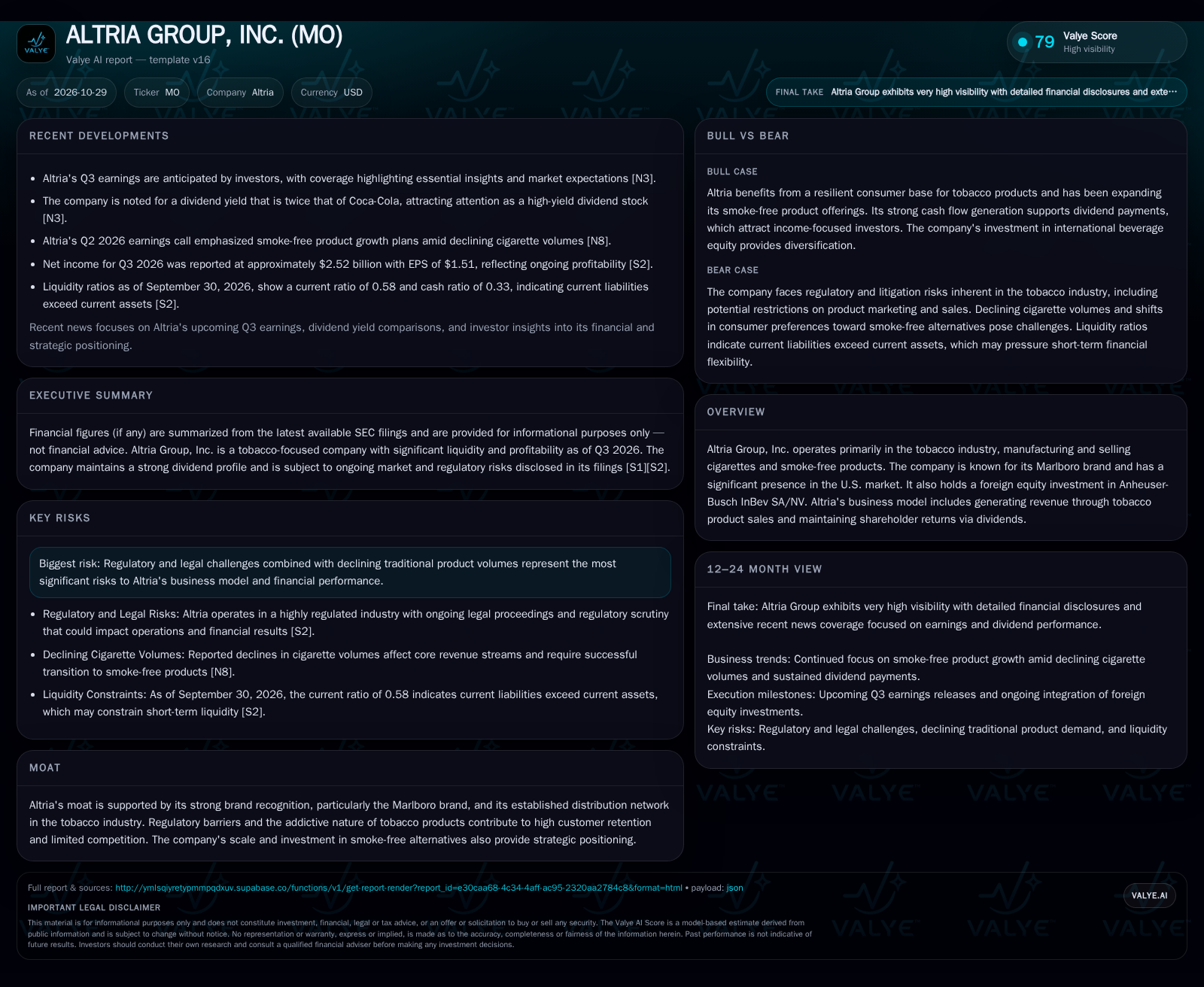
Altria remains highly profitable, with $2.52 billion in Q3 2026 net income and $1.51 EPS, but faces liquidity pressures (current ratio 0.58) and declining cigarette volumes. The strategic pivot toward smoke-free products is central to future growth, while regulatory and legal risks remain significant. Monitoring the pace of non-combustible adoption, cash flow dynamics, and regulatory developments is critical to the investment case. [S2] [N8]
Altria Group’s Q3 2026 results reaffirm its status as a cash-generating giant in the tobacco sector, reporting $2.52 billion in net income and $1.51 EPS. Yet, the company’s liquidity ratios—current ratio of 0.58 and cash ratio of 0.33—underscore a capital structure where short-term obligations outweigh liquid assets. With cigarette volumes declining and regulatory scrutiny unrelenting, Altria’s strategic push into smoke-free products takes on heightened urgency. The next phase for Altria will hinge on its ability to translate brand power and distribution heft into share gains in emerging nicotine categories, while managing both legal exposures and potential financial flexibility. [S2] [N8]
Profitability Holds Steady, But Liquidity and Volume Trends Demand Attention
Altria posted net income of approximately $2.52 billion and earnings per share of $1.51 for Q3 2026, underscoring the enduring profitability of its tobacco-focused business model. However, the company’s liquidity profile reflects a more complex picture: with current assets of $4.8 billion against current liabilities of $8.29 billion, the current ratio stands at just 0.58, and the cash ratio at 0.33. This means near-term obligations exceed immediately available resources, a pattern that could stress potential financial flexibility if not offset by strong ongoing cash flows or refinancing. In parallel, the company continues to face declining cigarette volumes, making its smoke-free product strategy increasingly central to long-term performance. [S2] [N8]
How Altria Makes Money: Cash Flows, Pricing Power, and the Search for New Volume
Altria’s economics are anchored in high-margin tobacco product sales, especially from its flagship Marlboro brand. Historically, the company has offset declining cigarette volumes through price increases, leveraging strong brand loyalty and the addictive nature of nicotine. However, as cigarette consumption contracts, the company’s ability to continue raising prices without accelerating declines becomes a key constraint.
The push into smoke-free products—such as heated tobacco and oral nicotine pouches—represents both a growth opportunity and a margin management challenge. These segments often require upfront investment in product development, regulatory approval, and marketing. While they may eventually offer similar or even superior margins to cigarettes if scale is achieved, the transition period can dilute overall profitability. The cited source reports dividend-related activity; that disclosure alone does not establish dividend-policy continuity, management confidence, or a material constraint on capital flexibility.
Altria's pricing power, historically a cornerstone of its revenue resilience, faces inherent limits as consumer sensitivity to price increases grows amid shrinking cigarette consumption. The elasticity of demand in tobacco products suggests that aggressive pricing strategies could hasten volume declines rather than offset them, introducing a delicate tradeoff between margin preservation and unit sales. Concurrently, the investment-intensive nature of smoke-free product development demands capital outlays that may compress near-term margins. The success of these initiatives depends on achieving economies of scale and operational efficiencies that can replicate or exceed legacy product profitability, a transition contingent on consumer acceptance and regulatory approval timelines.
Brand Strength, Regulatory Barriers, and the Shifting Landscape of Nicotine Delivery
Altria’s competitive edge derives from its dominant market share in U.S. cigarettes—primarily through Marlboro—and a deeply entrenched distribution network. Regulatory barriers, including advertising restrictions and product approval hurdles, serve as both a moat and a challenge: they limit new entrants but also constrain product innovation and marketing. The addictive nature of nicotine supports customer retention, but public health campaigns and regulatory shifts are steadily eroding the cigarette user base.
In smoke-free products, Altria faces a more dynamic and fragmented competitor set, including independent vape brands, multinational tobacco peers, and emerging consumer wellness companies. The company’s scale and regulatory expertise offer some advantages, but success in these new categories may depend more on speed of innovation and consumer adoption than on traditional tobacco strengths. The company’s equity stake in Anheuser-Busch InBev provides diversification, but does not fundamentally alter its exposure to U.S. nicotine trends.
Regulatory frameworks simultaneously constrain and protect Altria's market position by limiting new entrants while imposing compliance costs that can hinder rapid innovation. The company's entrenched distribution channels and brand recognition provide a competitive moat, yet these advantages may be less transferable in the more fragmented and innovation-driven smoke-free segment. Success in this arena likely requires agility in product development and marketing within stringent regulatory confines, as well as the ability to anticipate and adapt to shifting consumer preferences toward harm-reduction alternatives. The diversification benefits from non-tobacco investments, while valuable, remain peripheral to core nicotine-related risks and opportunities.
A Successful Transition: Smoke-Free Traction Outpaces Cigarette Decline
If Altria can accelerate adoption of its smoke-free offerings—whether through superior product performance, effective marketing within regulatory boundaries, or favorable shifts in consumer preferences—it could offset or even surpass the revenue and profit lost to declining cigarette volumes. In this scenario, smoke-free categories would deliver high margins at scale, leveraging existing distribution and brand equity.
Confirmation would come from disclosed rapid volume growth in non-combustible segments, stabilization or growth of total nicotine market share, and evidence of margin preservation or expansion. A further positive sign would be the company’s ability to maintain or grow its dividend despite category transition costs. Falsification would result if smoke-free volume growth stalls or if margins erode significantly during the transition, undermining overall profitability.
Balancing Decline and Renewal: Core Tobacco Shrinks as Smoke-Free Grows Incrementally
A more probable outcome is that Altria’s cigarette volumes continue to decline at a manageable rate, partially but not fully offset by incremental growth in smoke-free product sales. Price increases in cigarettes may soften the revenue impact, but elasticity limits loom. The company manages liquidity through ongoing cash generation, refinancing, and disciplined capital allocation, avoiding acute stress but operating with reported liquidity metrics that do not by themselves establish potential financial flexibility.
It would be challenged if liquidity metrics deteriorate further, if regulatory actions accelerate volume declines, or if smoke-free adoption lags internal targets.
Regulatory Shocks or Funding Pinch: When Legacy and New Segments Both Falter
The greatest risk to Altria’s model is a scenario in which regulatory or legal actions sharply restrict tobacco or smoke-free product sales, or impose onerous financial penalties. This could coincide with continued declines in cigarette volumes and a failure to achieve meaningful scale in smoke-free alternatives.
Evidence for this scenario would include major adverse regulatory developments, abrupt declines in both combustible and non-combustible sales, or a cut to the dividend. Worsening liquidity ratios, inability to refinance debt, or disclosure of significant legal liabilities would further support the downside case.
What Will Define Altria’s Evolution: Metrics and Events to Test the Strategic Thesis
Quarterly disclosure of cigarette and smoke-free product volumes—direction and rate of change in each segment would validate or challenge the transition narrative.
Gross margin trends, especially as the product mix shifts toward smoke-free categories—if disclosed, this would clarify profitability dynamics.
Updates on regulatory or legal proceedings—material new developments could dramatically reshape the business outlook.
Progress reports on smoke-free product launches, distribution expansion, and market share—company disclosures or third-party data would be informative.
Any refinancing, debt issuance, or asset sales designed to shore up liquidity—these actions would confirm management’s approach to near-term obligations.
If disclosed, retention or conversion rates of cigarette users to Altria’s own smoke-free products—this would be a key indicator of transition effectiveness.
Disclaimer: This is research-only, informational analysis and not investment advice. It may include AI-generated interpretation and general industry context. Always verify important details using primary sources.

Comments