
Portland General Electric: Weather Volatility Meets Strategic Infrastructure Investment
Portland General Electric’s Q3 2026 results reflect both the resilience and the vulnerability of a regulated utility confronting intensifying weather disruptions. The company’s infrastructure upgrades are a strategic response, but the durability of earnings amid climate volatility and rising system costs remains the central question for long-term value.
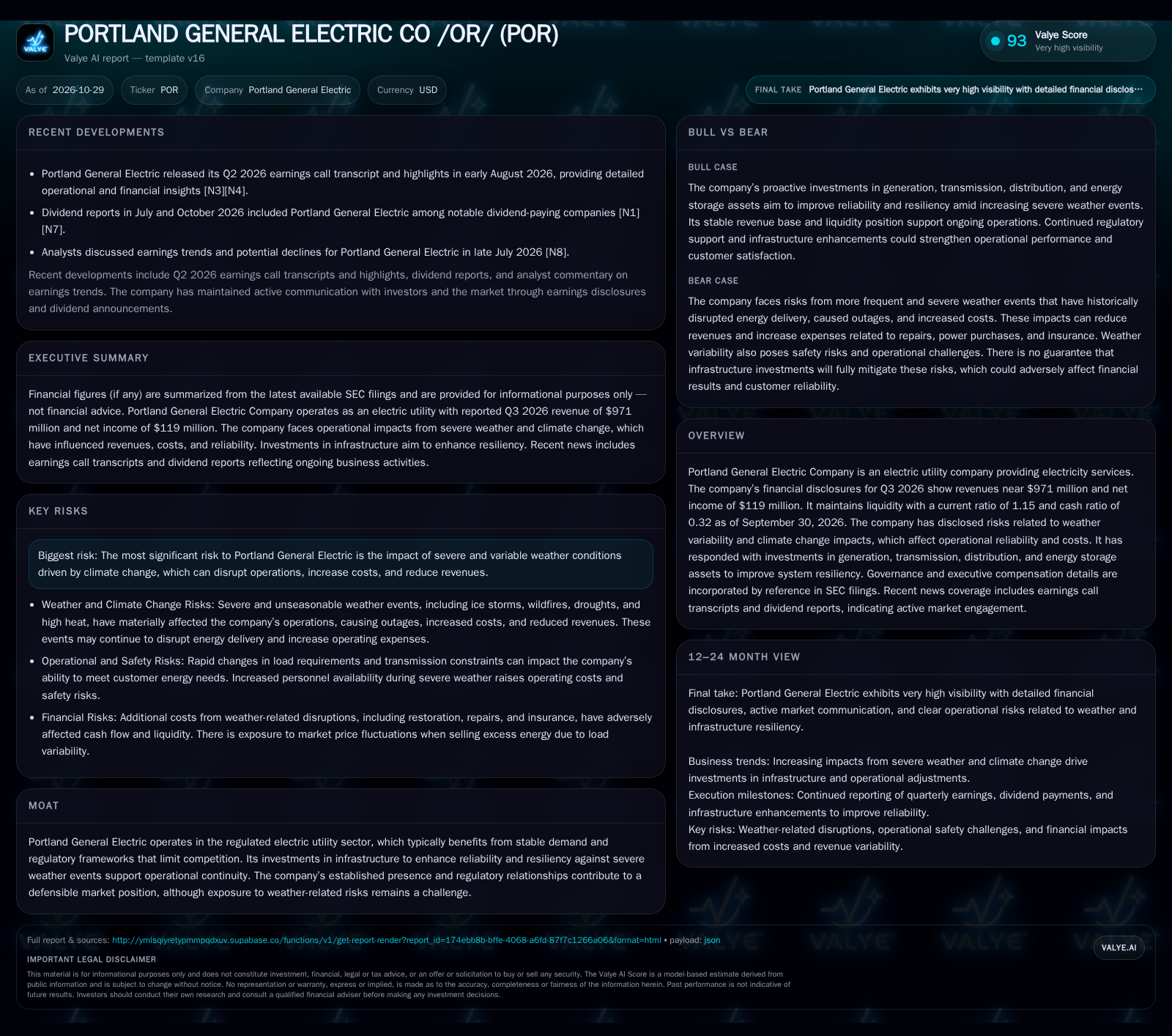
Portland General Electric reported Q3 2026 revenue of $971 million and net income of $119 million, maintaining a current ratio of 1.15 and a cash ratio of 0.32 as of September 30, 2026. The company continues to invest in generation, transmission, and storage to counteract operational impacts from severe weather and climate change. While these upgrades aim to enhance system reliability, persistent weather-related risks continue to pressure costs and revenue stability. The effectiveness of these investments—and the regulatory environment’s support for cost recovery—will shape the company’s future earnings power and risk profile. [S2]
Portland General Electric (PGE) sits at the fault line of two powerful forces: the enduring stability of a regulated utility business and the mounting unpredictability wrought by climate-driven weather events. Its Q3 2026 results—$971 million in revenue and $119 million in net income—demonstrate the operational heft of a utility with a large customer base. But these headline numbers mask a deeper challenge: how to sustain reliable service and earnings as extreme weather increasingly disrupts both the grid and the company’s cost structure. PGE’s answer has been stepped-up investment in generation, transmission, and storage, aiming to harden infrastructure and reduce outage risk. The critical question for investors is whether these capital outlays, together with regulatory cost recovery, can outpace the accelerating threat of climate volatility and system stress. [S2]
Recent Results Reflect Both Stability and Weather-Related Fluctuations
Portland General Electric reported $971 million in revenue and $119 million in net income for Q3 2026, with basic EPS at $1.01. As of September 30, 2026, the company disclosed $294 million in cash and a current ratio of 1.15. These figures reflect a business that remains operationally robust but not overcapitalized, especially when considering a cash ratio of just 0.32. The company has disclosed that severe weather and climate change have materially affected its operations, revenues, and costs. This context is crucial: while PGE continues to generate substantial earnings, the external threat from weather volatility is not hypothetical but has already translated into higher expenses and operational challenges. Investments in generation, transmission, distribution, and energy storage are underway to strengthen system resiliency, but the magnitude and pace of weather-related disruption remain open variables for future performance. [S2]
Climate Volatility Reshapes the Economics of Utilities
As a regulated utility, Portland General Electric’s core economics are built around cost recovery and allowed returns on invested capital, with rates set through regulatory processes. Revenue stability is underpinned by relatively inelastic residential and commercial demand, but weather-driven load variability and event-driven outages introduce revenue and cost unpredictability. Extreme weather increases both the frequency and scale of restoration, repair, and emergency response costs, which may not be immediately recoverable through rates. At the same time, significant ongoing capital expenditures for system hardening (generation, transmission, storage) are shifting the cost base upward. If regulatory lag or disallowances occur, the company could face margin compression.
The fixed-cost nature of utility operations means that increased variable costs—such as fuel procurement during shortages, overtime labor, and emergency equipment—can rapidly erode margins during severe events. On the other hand, successful cost recovery and prudent capital allocation could reinforce operating leverage as new assets are placed into rate base.
The interplay between capital intensity and regulatory frameworks is pivotal in shaping Portland General Electric’s economic resilience. Utilities traditionally rely on stable, long-lived assets to generate steady cash flows, but climate volatility introduces a dynamic where asset utilization and operational efficiency can be intermittently compromised. If weather events lead to disproportionate asset damage or accelerated depreciation, the timing and scale of capital recovery through rate base adjustments become critical. Moreover, the company’s ability to forecast and incorporate climate risk into its capital planning and depreciation schedules will influence both its financial metrics and regulatory credibility. This dynamic underscores the importance of integrated risk management and adaptive investment strategies within the utility sector.
Another dimension influencing utility economics under climate stress is the potential shift in load profiles and demand elasticity. While residential and commercial demand is generally inelastic, prolonged or frequent weather disruptions can alter consumption patterns temporarily or permanently, affecting volumetric sales and revenue forecasts. For instance, increased adoption of backup generation or energy efficiency measures in response to outages may dampen demand growth. Consequently, utilities must balance infrastructure investments with evolving customer behavior and technological adoption, which may necessitate more sophisticated rate designs or alternative revenue mechanisms to maintain financial stability amidst changing consumption dynamics.
Regulatory Protection and Local Monopoly Counterbalance Cost and Substitution Threats
Portland General Electric operates within a classic regulated utility framework, enjoying potentially leading local monopoly status and rate-setting based on prudent cost recovery. This creates high barriers to entry for direct competitors and typically ensures a predictable customer base. However, the company’s competitive position is less about traditional rivals and more about external forces—namely, the pace of climate-driven grid stress and the regulatory environment’s willingness to allow timely cost recovery.
Distributed energy resources (such as rooftop solar, battery storage, and microgrids) represent a slow but growing form of substitution, potentially eroding long-term load growth or shifting revenue from volumetric sales to grid services. In addition, persistent cost inflation from emergency repairs and infrastructure upgrades could test the limits of regulatory and customer tolerance for higher rates. The company’s ability to maintain a constructive relationship with regulators, communicate the necessity of investments, and demonstrate improved reliability will be central to preserving its economic moat as the sector transforms.
Margin Recovery Depends on Infrastructure Upgrades Outrunning Weather Challenges
A favorable scenario would see Portland General Electric’s recent and ongoing investments in grid resilience (generation, transmission, storage) meaningfully reducing outage frequency and severity, thereby stabilizing operating costs and supporting higher customer satisfaction. If the company can demonstrate measurable reliability improvements, regulators may be more willing to approve timely and full cost recovery in rates, enabling return on invested capital and margin expansion.
Evidence for this scenario would include a declining trend in weather-related outage duration and frequency, successful rate case outcomes allowing recovery of recent capital expenditures, and stable or rising operating margins despite continued climate volatility. Additional confirmation could come from positive customer satisfaction metrics and a lack of significant regulatory pushback on rate increases. Conversely, if major storm- or wildfire-driven outages persist at prior levels or regulatory lag increases, the upside would be limited.
In scenarios where infrastructure investments effectively mitigate weather-related disruptions, there may also be ancillary benefits that enhance the company’s competitive positioning. Improved grid resilience can foster customer trust and reduce regulatory scrutiny, potentially accelerating approval cycles for future projects. Additionally, a more reliable grid may encourage higher adoption of electrification technologies among customers, supporting long-term load growth and revenue stability. However, this positive feedback loop depends on the company’s ability to transparently demonstrate investment outcomes and align with evolving regulatory priorities focused on climate adaptation and customer service excellence.
Furthermore, successful infrastructure upgrades could enable Portland General Electric to leverage emerging technologies and operational innovations, such as advanced grid automation and predictive maintenance. These capabilities can reduce outage durations and optimize asset utilization, translating into lower operating costs and enhanced margins. The company’s strategic agility in integrating such technologies alongside traditional capital investments will be a key factor in sustaining margin recovery. Nevertheless, the pace and scale of technology deployment must be carefully managed to avoid cost overruns or regulatory pushback, emphasizing the need for disciplined project execution and stakeholder engagement.
Earnings Volatility Persists Amid Stable Regulatory Framework
The most plausible outcome is that Portland General Electric continues to face a tug-of-war between infrastructure-driven reliability gains and the escalating frequency of weather disruptions. Revenue remains stable due to the regulated model, but earnings are increasingly volatile as operating costs spike during severe events and capital expenditures trend higher. Regulatory approval for cost recovery is generally forthcoming, but with some lag and occasional partial disallowances, leading to intermittent margin pressure.
Confirmation of this scenario would include continued quarterly reporting of both earnings and weather/event-related costs, periodic rate cases with mixed outcomes, and a pattern of infrastructure investment announcements tied to recent weather events. Falsification would require either a sustained period of weather calm (allowing rapid margin improvement) or a regulatory regime shift resulting in systematic under-recovery of costs.
Margin Pressure and Dividend Concerns if Weather Risks Exceed Upgrades
In a downside scenario, the frequency and severity of extreme weather events accelerate beyond the pace of infrastructure upgrades, leading to repeated large-scale outages, escalating emergency costs, and increased safety and legal liabilities. Regulatory lag or customer pushback results in partial or delayed cost recovery, compressing margins and straining cash flow.
Absence of these red flags, or evidence of improving cost recovery and reliability, would challenge the downside thesis.
Developments That Could Alter Portland General Electric’s Resilience Outlook
Trends in weather-related outage frequency and duration—declining figures would signal effective infrastructure upgrades.
Quarterly disclosure of weather/event-driven operating expenses and the percentage recovered through rates, if disclosed.
Timing, outcomes, and scope of future rate cases—especially the extent of cost recovery granted for recent capital projects.
Total capital expenditure commitments and actual deployment rates for resiliency investments.
Customer satisfaction and regulatory feedback regarding reliability improvements and rate increases.
Credit rating changes or commentary from agencies regarding the company’s risk profile and resilience to climate events.
Any emerging evidence of customer load erosion due to distributed generation or other forms of substitution, if disclosed.
Disclaimer: This is research-only, informational analysis and not investment advice. It may include AI-generated interpretation and general industry context. Always verify important details using primary sources.

Comments