
CSW Industrials: Capital Investment, Acquisitions, and the Economics of Niche Industrial Platforms
CSW Industrials is leveraging targeted capital expenditures and strategic acquisitions—most recently MARS Parts—to expand its portfolio of branded, value-added products for HVAC/R, building safety, and industrial markets. As the company navigates goodwill impairment risks and market volatility, the durability of its recurring revenue streams and its ability to integrate new assets will shape future earnings quality.
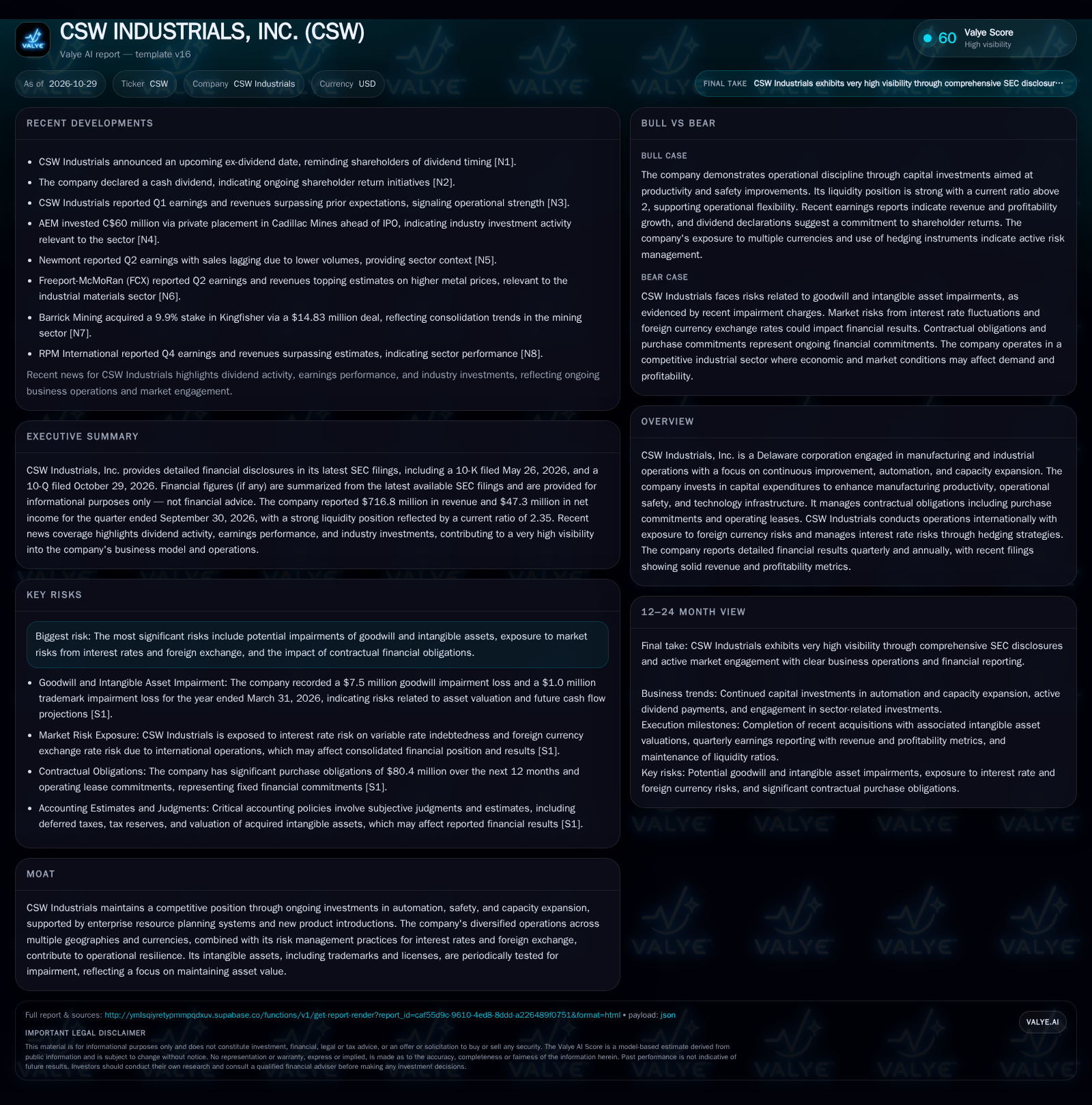
CSW Industrials reported $716.8 million in quarterly revenue and $47.3 million in net income as of September 30, 2026, supported by a current ratio of 2.35. The company’s acquisition of MARS Parts expands its HVAC/R repair and maintenance exposure, while recent goodwill and trademark impairments highlight valuation risks. Ongoing capital investment focuses on automation and productivity, but future value depends on successful integration, demand stability, and management of market risks such as interest rates and foreign exchange volatility. [S2] [N3]
CSW Industrials is demonstrating the classic industrial platform playbook: expanding its portfolio through targeted acquisitions, reinvesting in automation and capacity, and leveraging a mix of high-recognition brands to serve contractor and industrial markets. The cited source reports dividend-related activity; that disclosure alone does not establish dividend-policy continuity, management confidence, or a material constraint on capital flexibility. However, recent goodwill and trademark impairments, as well as exposure to macro risks, raise questions about the sustainability of its current profitability and the long-term value of acquired assets.
Recent Results, MARS Parts Acquisition, and Impairment Charges: What’s Most Material Now
CSW Industrials reported $716.8 million in revenue and $47.3 million in net income for the quarter ended September 30, 2026, with a current ratio of 2.35, reflecting operational liquidity. The company completed its acquisition of MARS Parts in late 2025, expanding its HVAC/R segment with a greater emphasis on repair and maintenance products—a move that could increase recurring revenue exposure. However, CSW also recorded a $7.5 million goodwill impairment and a $1.0 million trademark impairment for the fiscal year ended March 31, 2026, signaling challenges in asset valuation and integration. These developments collectively shape the near-term thesis: the company is growing and investing, but must demonstrate that new assets contribute durable value and that impairments are not a recurring feature of its acquisition strategy. [S1] [S2]
How the Portfolio Model and Capital Investments Drive Margin Potential
CSW Industrials’ business model is built on manufacturing and distributing a broad range of branded, value-added products for HVAC/R, building safety, and industrial markets. Revenue is a mix of direct sales and channel distribution, with a significant portion tied to recurring maintenance, repair, and overhaul (MRO) activity—especially post-MARS Parts acquisition. This orientation toward consumables and replacement parts could provide revenue stability and higher gross margins compared to capital equipment sales, given the critical, non-discretionary nature of many MRO purchases.
The company’s capital expenditures focus on automation, operational safety, and technology upgrades, which may reduce variable labor costs and improve throughput. If these investments yield higher productivity, CSW could realize operating leverage as incremental revenue flows through at higher margins. However, the business still faces fixed costs tied to manufacturing and distribution infrastructure, and the ability to flex costs in response to swings in demand will be tested in a cyclical downturn.
Integration of acquisitions like MARS Parts brings both opportunity and risk. Successful integration could create synergies in procurement, cross-selling, and distribution, but failure to realize these benefits—or to accurately value acquired intangible assets—could result in further impairment charges. The company’s ongoing contractual obligations ($80.4 million in purchase commitments over the next 12 months) and operating leases also lock in a portion of the cost base, limiting near-term flexibility. [S1] [S2]
Brand Breadth, Channel Access, and the Challenge of Industrial Substitution
CSW Industrials’ competitive stance rests on a portfolio of over 100 well-known brands, targeting niche markets where performance, reliability, and regulatory compliance are valued. This breadth provides some insulation from direct price competition, especially in specialized HVAC/R, building safety, and industrial consumables. However, the company operates in a highly fragmented sector with numerous regional and global players, and product differentiation can erode if competitors replicate features or undercut on price.
The recurring, maintenance-oriented nature of much of CSW’s product base may foster customer loyalty and switching costs, particularly for products that protect expensive or mission-critical assets. Still, channel partners and distributors could pressure margins if alternative suppliers emerge or if end customers consolidate purchasing power. The risk of technological substitution is relatively low for many consumables, but for certain engineered products, advances in materials or digital monitoring could shift value toward new entrants or OEMs.
The company’s international operations expose it to additional competitive dynamics, including foreign exchange volatility and local market preferences. Effective risk management and localization strategies will be key to maintaining share and profitability outside North America.
If Integration Delivers and MRO Demand Holds, Earnings Quality Could Outperform
The most favorable outcome for CSW Industrials is that the MARS Parts acquisition is fully integrated, with cross-selling and operational synergies realized across HVAC/R and adjacent segments. If automation and technology investments deliver meaningful productivity gains, and if MRO demand remains resilient even in a softer macro environment, the company could see above-trend margin expansion and free cash flow growth.
Confirmation of this scenario would require evidence of rising gross and operating margins, successful integration updates (e.g., cost savings, expanded distribution reach), and continued growth in recurring revenue categories. [S2] [N3]
Key falsifiers would include integration setbacks, cost overruns, or new impairments that suggest acquisition discipline is weakening, or that the company is overpaying for revenue growth rather than building a sustainable platform.
Sustained Growth with Episodic Risks: What a Normal Year Looks Like for CSW
The most plausible trajectory is that CSW Industrials continues to grow revenue through a blend of organic initiatives and targeted acquisitions, with capital investments incrementally improving productivity. Recurring revenue from MRO and consumables provides some revenue stability, but profitability is periodically dampened by integration costs and occasional asset impairments—a common feature for acquisitive industrial platforms.
Evidence supporting this view would include stable or modestly improving margins, continued investment in automation and product development, and impairment charges that remain infrequent and manageable relative to total assets. [S2] [N1] [N2]
Major deviations from this path would be signaled by a clustering of impairments, sustained margin erosion, or an inability to execute on integration and capital projects.
Asset Impairments and Financial Commitments Amplify Downside in a Demand Shock
If macroeconomic conditions deteriorate sharply—reducing industrial and construction activity—CSW Industrials could experience a drop in MRO and replacement demand, exposing the company’s fixed cost base and leveraging downside to earnings. In this context, integration of recent acquisitions could prove more difficult, with underperforming assets leading to additional goodwill or trademark impairments.
Significant purchase and lease commitments could limit the company’s ability to quickly cut costs, while exposure to adverse interest rate or foreign exchange movements could further pressure results. If recurring revenue proves less durable than anticipated—due to customer consolidation, substitution, or aggressive competitive pricing—CSW’s margins and cash flow could compress more than expected.
Confirmation of this scenario would include a string of impairment charges, negative free cash flow, deteriorating liquidity ratios, or a dividend cut. Conversely, resilience in revenue and asset values would help falsify the more bearish case. [S1] [S2]
Testing the Durability of CSW’s Acquisition Strategy and Recurring Revenue Thesis
Track the pace and cost structure of MARS Parts integration, including any updates on realized synergies or operational challenges.
Monitor the frequency, size, and rationale of future goodwill and intangible asset impairments relative to the pace of new acquisitions.
Gross and operating margin trends will signal whether capital investments in automation and technology are translating into productivity gains.
Assess the stability and growth of recurring revenue streams from MRO and consumables—if disclosed, segment-level revenue breakdowns would be instructive.
Monitor the impact of foreign exchange and interest rate volatility on reported results, as these external factors could amplify swings in profitability.
Any signs of distributor or customer consolidation, or shifts in channel power, would be important signals for future pricing and margin pressure.
Disclaimer: This is research-only, informational analysis and not investment advice. It may include AI-generated interpretation and general industry context. Always verify important details using primary sources.

Comments