
Viking Therapeutics: Advancing a High-Stakes Metabolic Pipeline Amid Legal and Development Crossroads
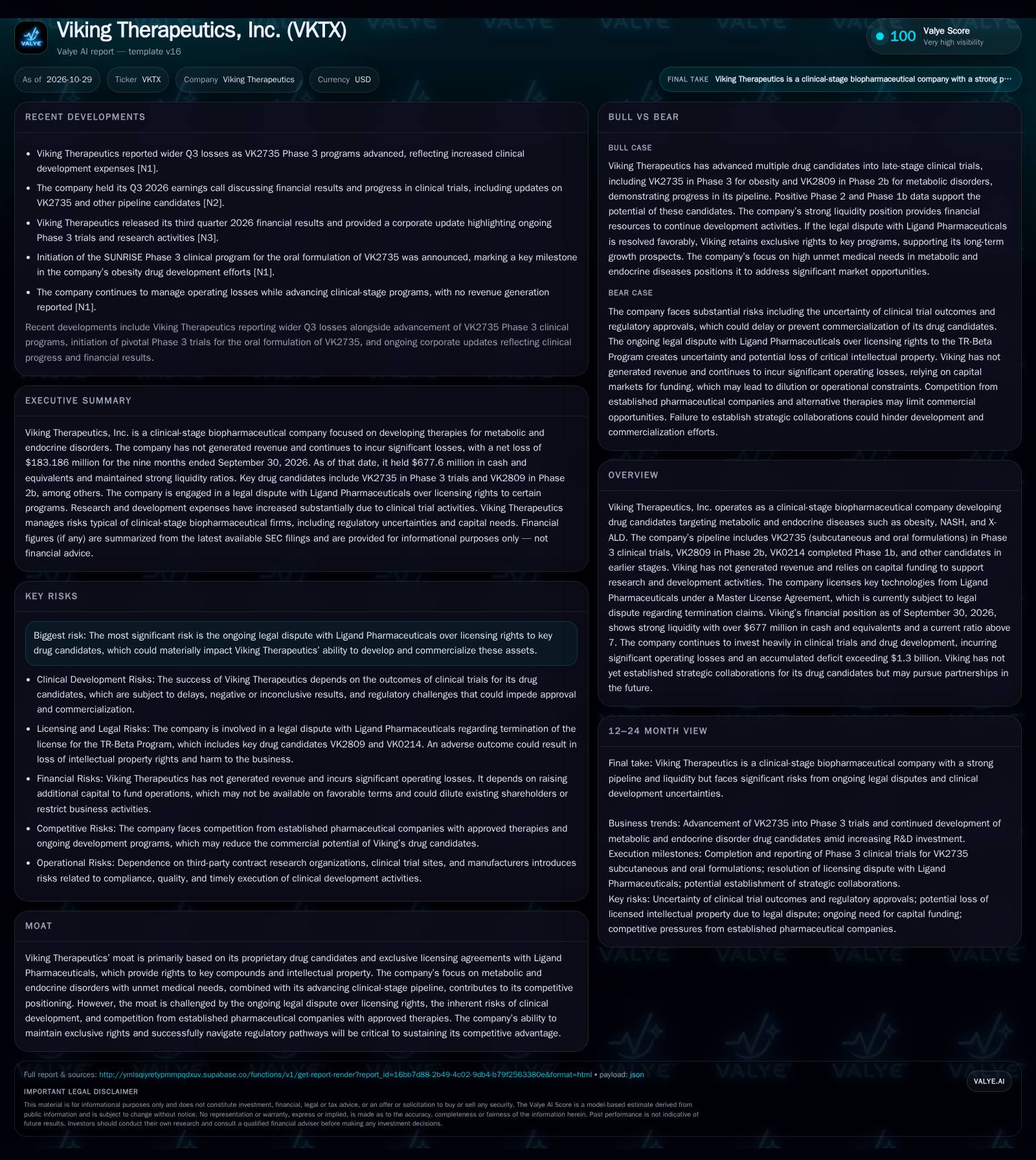
Viking Therapeutics has deepened its investment in late-stage metabolic drug development, notably launching a Phase 3 obesity trial, while its future pivots on both clinical outcomes and the resolution of a critical licensing dispute. The company’s substantial liquidity buys time, but commercial viability remains contingent on regulatory success, IP clarity, and the potential to secure strategic partnerships.
Viking Therapeutics is deploying significant resources into late-stage clinical development of obesity and metabolic drugs, highlighted by the SUNRISE Phase 3 trial for VK2735, but remains pre-revenue and faces a pivotal legal dispute over intellectual property rights. The absence of strategic partnerships and ongoing operating losses underscore the urgency for clinical and legal milestones to break decisively in Viking’s favor. [S2] [N1] [N2]
Viking Therapeutics is at a critical juncture, defined by escalating investment in its metabolic and endocrine drug pipeline and the simultaneous uncertainty of a major legal dispute over its foundational intellectual property. With no strategic partnerships in place and operating losses mounting, the outcome of both ongoing clinical trials and a contentious licensing battle with Ligand Pharmaceuticals will shape whether Viking can transition from a high-potential developer to a commercial-stage contender. [S2] [N1]
Clinical Progress and Legal Disputes Define the 2026 Landscape for Viking
Viking Therapeutics closed the third quarter of 2026 with a reported net loss of $183.2 million for the year to date, a figure reflecting aggressive investment in late-stage clinical development, especially as the VK2735 obesity program advanced into Phase 3. Research and development expenses surged to $344.96 million in 2025, up from $101.64 million the prior year, as the company prioritized both manufacturing and clinical trial execution. [S2] [N1]
The company reported cash and liquidity metrics for the period; these figures do not by themselves establish operating runway, investment capacity, financial flexibility, or financing capacity. [S2]
However, the legal dispute with Ligand Pharmaceuticals over the termination of the license for the TR-Beta Program—covering VK2809 and VK0214—poses an existential threat to Viking’s most advanced assets. The outcome of this litigation could determine whether Viking retains exclusive worldwide rights to its lead programs or faces the loss of critical intellectual property. [S2]
How Viking’s Clinical-Stage Economics Shape Its Funding and Commercialization Outlook
Viking’s current business model is typical of clinical-stage biopharmaceutical firms: the company is pre-revenue, reliant on external capital, and incurs substantial R&D costs as it advances drug candidates through the clinic. The spike in R&D expenses, now exceeding $340 million annually, reflects the cost structure of late-stage trials, which are capital-intensive and carry significant fixed costs in manufacturing, patient recruitment, and regulatory compliance. [S2]
With no products on the market, Viking’s only path to revenue is through eventual drug approvals or the formation of strategic collaborations. Pricing power, margin structure, and commercial scalability are therefore hypothetical and will depend on successful trial outcomes and subsequent market adoption. If approved, metabolic and obesity therapies often command premium pricing, but the company would also face high variable costs related to commercialization, sales infrastructure, and ongoing regulatory obligations.
Additional capital raises may be required if commercialization is delayed or if major programs are compromised by legal or regulatory setbacks, introducing potential dilution or restrictive financing terms. [S2]
Another critical economic consideration is the potential market access environment for Viking’s metabolic therapies. Payer reimbursement decisions will depend on demonstrated clinical benefit relative to existing treatments, cost-effectiveness, and long-term safety. If the company’s candidates can show superior outcomes or address unmet needs in patient subpopulations, pricing negotiations may be more favorable, supporting sustainable margins. However, intense competition and increasing scrutiny on drug pricing in obesity and metabolic diseases could constrain pricing power, requiring Viking to optimize its cost structure and commercial strategy to maintain profitability upon launch.
Can Proprietary Metabolic Assets and Licensing Rights Offset Big Pharma Competition?
Viking’s competitive posture is built around its proprietary metabolic drug candidates, with exclusive licensing rights from Ligand Pharmaceuticals forming the backbone of its pipeline. This exclusivity, if maintained, could provide a defensible position in the high-value markets of obesity and NASH, where unmet need remains significant.
However, the moat is narrow and vulnerable. Established pharmaceutical companies, including those with approved GLP-1 agonists and other metabolic therapies, possess greater resources, regulatory experience, and commercial reach. Viking’s lack of commercialization infrastructure and strategic partnerships further weakens its position relative to these incumbents.
Should the legal dispute with Ligand Pharmaceuticals end unfavorably, Viking could lose not only key intellectual property but also the ability to differentiate its lead assets from generic or competitive therapies. The absence of network effects or switching-cost advantages means Viking’s future differentiation will rest almost entirely on clinical efficacy, safety, and the ability to secure and defend exclusive rights.
What Would It Take for Viking to Become a Commercial-Stage Leader in Metabolic Disease?
A favorable scenario for Viking would see the company resolving its legal dispute with Ligand Pharmaceuticals in a way that preserves exclusive, unencumbered rights to VK2809, VK0214, and related assets. Successful completion of the SUNRISE Phase 3 trial (and other pivotal studies) would yield positive efficacy and safety data, enabling regulatory submissions and, ultimately, market approval.
High unmet need in obesity and NASH could translate into rapid physician and payer adoption, especially if the clinical profile is differentiated from existing therapies.
Confirmation of this scenario would come from: positive top-line Phase 3 data, resolution of the Ligand dispute with Viking retaining full rights, initiation of partnership negotiations or deals with major pharma, and regulatory acceptance of new drug applications.
The Most Plausible Path: Incremental Progress, Ongoing Legal Uncertainty, and the Need for Partnerships
The most likely outcome is that Viking advances its lead programs through late-stage trials while the legal dispute with Ligand remains unresolved or is partially settled. Clinical data may be mixed or subject to further regulatory requests, delaying approval timelines and increasing the burn rate.
In this scenario, Viking continues to operate as a development-stage company, using its liquidity to fund additional trials, but without generating revenue or securing major partnerships until legal clarity is achieved. Dilution risk rises as the company may need to access capital markets to extend its runway.
Evidence supporting this path would include ongoing litigation updates, extended trial timelines, absence of material partnership announcements, and continued reporting of net losses without revenue.
How Legal and Clinical Setbacks Could Undermine Viking’s Pipeline and Financial Stability
The principal downside risk is a negative resolution of the licensing dispute with Ligand Pharmaceuticals, resulting in Viking losing rights to VK2809, VK0214, or other key programs. This would force the company to curtail or halt development of its lead assets, sharply reducing its addressable market and future revenue potential.
Adverse clinical outcomes—such as failed Phase 3 trials, significant safety signals, or regulatory rejections—would further erode investor confidence and limit funding options. Without revenue, partnerships, or a salvageable pipeline, the company would be forced to seek strategic alternatives, restructure, or wind down operations.
Confirmation of this scenario would be indicated by public disclosure of adverse legal decisions, termination of clinical programs, sharp reductions in R&D spending, or emergency capital raises at dilutive terms.
Milestones That Will Determine Whether Viking Can Bridge to Commercialization
Resolution or further escalation of the Ligand Pharmaceuticals licensing dispute, including court rulings or settlement terms.
Top-line and 52-week data readouts from the SUNRISE Phase 3 trial for VK2735 and other pivotal studies.
Updates on any strategic collaborations, licensing deals, or co-development agreements with major pharmaceutical partners.
Changes in R&D and SG&A spending that may signal shifts in clinical priorities or responses to legal outcomes.
Cash burn rate and projected runway, especially if disclosed in management commentary or filings.
Regulatory interactions, such as acceptance of new drug applications or additional data requests from the FDA or EMA.
Patent status updates and any changes to the scope or exclusivity of Viking’s IP portfolio.
Disclaimer: This is research-only, informational analysis and not investment advice. It may include AI-generated interpretation and general industry context. Always verify important details using primary sources.

Comments