
Logitech’s Strategic Response to Peripheral Headwinds: AI, B2B, and Capital Allocation in Focus
Despite delivering solid profitability and maintaining reported liquidity position, Logitech faces heightened market scrutiny as industry dynamics shift. The company’s ability to leverage AI-driven innovation, expand B2B offerings, and execute disciplined capital returns will determine whether it can outpace sector headwinds and defend its leadership in computer peripherals.
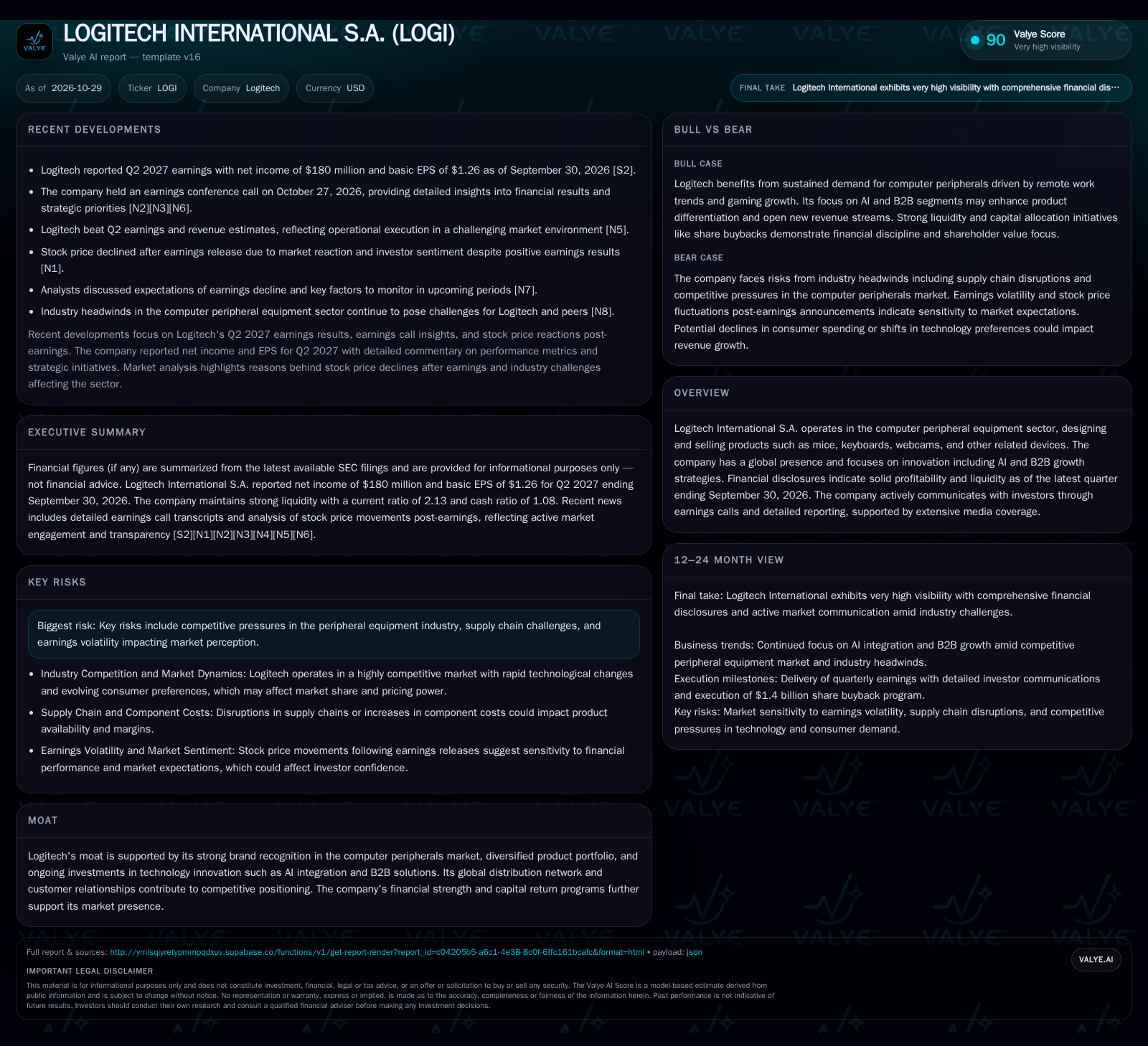
Logitech reported Q2 2027 net income of $180 million and basic EPS of $1.26, maintaining a current ratio of 2.13 and cash ratio of 1.08 as of September 30, 2026 [S2]. Despite beating earnings and revenue estimates, shares declined post-earnings amid investor concerns about future growth [N1] [N5]. The launch of a $1.4 billion share buyback underscores capital discipline, but analysts remain cautious about earnings trajectory in a competitive and evolving sector [N7]. Logitech’s pivot toward AI and B2B markets, alongside its strong financial base, will be tested by supply chain risks, consumer demand shifts, and rapid technological change.
Logitech International S.A. enters the final quarter of 2026 with a solid financial foundation—$180 million in quarterly net income and $1.51 billion in cash—yet faces a market increasingly focused on its ability to adapt. While the company’s core PC peripheral business remains profitable, the sector’s maturity, coupled with post-pandemic normalization and technological disruption, has heightened investor scrutiny. Logitech’s strategic direction now hinges on its push into AI-powered devices, B2B expansion, and disciplined capital allocation, all set against a backdrop of volatile stock performance and shifting industry headwinds. The next phase will test whether Logitech can convert its balance-sheet strength and product innovation into sustained market leadership.
Logitech’s Recent Performance and Market Reactions: What the Numbers Reveal
Logitech reported Q2 2027 net income of $180 million and basic earnings per share of $1.26, demonstrating continued profitability in its core operations [S2]. Cash and equivalents totaled $1.51 billion, with a current ratio of 2.13 and cash ratio of 1.08, signaling strong short-term financial health [S2]. Despite exceeding earnings and revenue estimates, the company’s stock price declined following the earnings release, suggesting that investors remain concerned about growth prospects and sector dynamics [N1] [N5]. Analysts have highlighted expectations of earnings declines and ongoing debates about the sustainability of Logitech’s performance in the face of industry headwinds [N7]. The $1.4 billion share buyback program further underscores management’s commitment to capital return.
Profit Engines, Margin Structure, and Capital Discipline in a Maturing Segment
Logitech’s primary revenue drivers are the design, manufacture, and sale of computer peripherals—mice, keyboards, webcams, and related accessories—where volume and mix shifts are tightly linked to end-market demand in PC, gaming, and enterprise sectors. Pricing power is limited in commoditized categories, though premium offerings and brand recognition can support higher margins in segments such as gaming and creator tools. Fixed costs are significant in R&D and marketing, while variable costs are dominated by manufacturing and logistics. This structure offers some operating leverage: incremental revenue growth should expand margins, but market contraction or heightened price competition can erode profitability.
Recent capital allocation, including the $1.4 billion buyback, suggests a belief in undervaluation or a lack of outsized organic reinvestment opportunities. The company reported cash and liquidity metrics for the period; these figures do not by themselves establish operating runway, investment capacity, financial flexibility, or financing capacity. However, as the hardware cycle matures and replacement demand normalizes, Logitech’s future economics may hinge on its ability to build software and services layers, deepen B2B relationships, and extract recurring revenue streams that offset hardware cyclicality.
Brand, Distribution, and Innovation: How Logitech Stacks Up Against Sector Forces
Logitech holds a strong position in the global peripherals market, with brand recognition, broad product coverage, and a reliable distribution network. These attributes help defend share against both incumbent electronics manufacturers and low-cost entrants, particularly in mature categories. However, the market is characterized by rapid product cycles, low switching costs for consumers, and persistent price-based competition.
The company’s recent focus on AI-enabled products and B2B expansion may provide a pathway to differentiation. In B2B, Logitech competes not only with traditional peripheral makers but also with integrated solutions providers targeting hybrid work and enterprise collaboration. The ability to embed AI features—such as smart video conferencing or productivity tools—could create moderate switching frictions for business customers and could support premium pricing if execution matches customer needs. Still, substitute risks remain high as cloud-based collaboration tools and alternative input devices evolve.
Unlocking New Growth: AI, B2B, and Shareholder Returns Drive Outperformance
If Logitech successfully leverages its financial strength to accelerate AI-driven product innovation and penetrates enterprise markets with differentiated B2B solutions, it could establish new revenue streams less exposed to consumer cyclicality. AI integration in peripherals—such as adaptive input devices, intelligent video conferencing, or workflow automation—could command higher margins and enable subscription or service-based models. Effective execution of the $1.4 billion buyback may further amplify per-share earnings growth and signal management confidence.
Evidence supporting this scenario would include sequential growth in B2B and software/service revenues, margin expansion in premium product lines, and customer wins or partnerships in enterprise verticals. Analyst upgrades and sustained outperformance versus peers in both top-line growth and profitability would further validate the thesis.
Sustaining Profitability Amid Sector Maturity and Selective Innovation
The most plausible path is that Logitech maintains core profitability in its traditional peripherals business, supported by disciplined cost management and occasional product refreshes. Growth rates are likely to moderate as the sector matures and post-pandemic demand normalizes. AI and B2B initiatives begin to contribute incrementally but do not yet transform the revenue mix. Capital returns—primarily through buybacks—provide some support to earnings per share, but stock valuation remains sensitive to quarterly performance and broader consumer electronics trends.
This scenario would be confirmed by stable or modestly declining revenue, consistent gross margins, and steady execution of capital allocation programs. Any significant deviation in consumer demand, supply chain stability, or execution on AI/B2B ambitions would serve as early warning signals of departure from the base case.
Margin Compression and Demand Shocks: Risks from Competition, Supply Chains, and Tech Shifts
Logitech’s exposure to industry headwinds could intensify if consumer demand for peripherals contracts more sharply, supply chain disruptions raise input costs, or aggressive competitors erode market share through price cuts or faster innovation. In this scenario, the company may face margin compression, inventory challenges, and downward earnings revisions, with capital returns unable to fully offset operational weakness.
Confirmation of the downside would come from sequential revenue declines, notable margin erosion, inventory write-downs, or missed earnings targets. Negative analyst revisions, lower guidance, or loss of key B2B contracts would further reinforce the risk case. Prolonged stock price underperformance relative to peers would also suggest eroding investor confidence in management’s ability to adapt.
Milestones and Metrics That Will Define Logitech’s Next Chapter
Quarterly revenue mix by product category and geography—especially shifts toward B2B and AI-enabled offerings, if disclosed.
Gross and operating margin trends as an indicator of pricing power and cost discipline in both core and emerging segments.
Progress on the $1.4 billion share buyback, including pace of repurchases and impact on share count and EPS.
Disclosure of new B2B contracts, partnerships, or customer wins, particularly in enterprise collaboration or hybrid work solutions.
Updates on AI integration in product roadmaps and the launch of peripherals or services with software-driven features.
Inventory levels and supply chain commentary—watch for signs of overstocking or component shortages.
Management guidance and analyst revisions following each earnings cycle, reflecting market expectations and confidence.
Disclaimer: This is research-only, informational analysis and not investment advice. It may include AI-generated interpretation and general industry context. Always verify important details using primary sources.

Comments